The ache never shows up while you are shooting. It shows up twenty minutes after you put the camera down, low at the back of the skull, and it is the most common reason anyone goes looking for a camera shoulder strap in the first place.
Before you buy one, though, there is something worth knowing, because it catches nearly everybody out. A neck strap and a shoulder strap are very often the same object. What changes is where you put it.
Neck, shoulder, crossbody: three names for one piece of webbing
Our own Amazon advertising report makes the point better than we could. In a single month the phrase "camera shoulder strap" put our listing in front of shoppers 2,334 times. "Camera strap neck" did it another 134 times, "camera strap crossbody" another 55. One strap, three search phrases, three different mental pictures of it.
Real slings are a separate mechanism, where the camera rides on a glider and slides up the webbing to your eye. Those behave differently enough that we gave them their own article. But most of what sells under the shoulder-strap heading is webbing with a pad on it, and you decide what kind of strap it is by how you wear it.
Which makes the real question a much cheaper one. Not which product, but which of three positions you should be in, and whether what you own is long enough to reach it.
Position one: around the neck
This is the default because it is what the box strap is cut for. Both hands free, camera at chest height, nothing to learn. For an hour in a garden it is completely fine.
It goes wrong in two separate ways at once, and only one of them is obvious.
The obvious one is the hanging weight. A Nikon D7500 is 1 pound 9.4 ounces with a battery and a card in it, and Nikon's own specifications are where that number comes from. Hang a mid-range zoom off the front and you are well past 2 pounds, all of it bearing down through a band an inch wide on the back of your neck.
The second one is posture, and it is the bigger problem. A camera at chest height is a camera you keep looking down at: checking the screen, thumbing through the last frame, changing a setting. Kenneth Hansraj's 2014 paper in Surgical Technology International put numbers on what that costs. Your head weighs 10 to 12 pounds sitting level. Tip it forward 15 degrees and the load through the cervical spine is around 27 pounds. At 30 degrees it is 40 pounds, at 45 it is 49, and at 60 degrees it reaches 60 pounds. Those figures are the head alone, with no camera involved at all.
So a neck strap asks the same part of you to carry the hanging weight and to hold the posture that multiplies your own head. That is why the ache is so specific and why it outlasts the shoot.
Position two: over one shoulder
Take the same strap off your neck and drop it onto one shoulder. Nothing has been bought and the load has moved off your cervical spine onto the trapezius, which is built for carrying things.
It is a real improvement and it is free. It also has one flaw, and you will find it within a hundred yards: a shoulder is a slope. Bend to tie a lace, turn sharply, reach up, and the strap walks off the edge. Most people solve that by walking with a hand resting on the strap, which quietly gives back the hands-free part they moved for.
Shoulder carry suits stop-start shooting, where the camera is coming up and going down and you are not covering distance between frames.
Position three: across the body

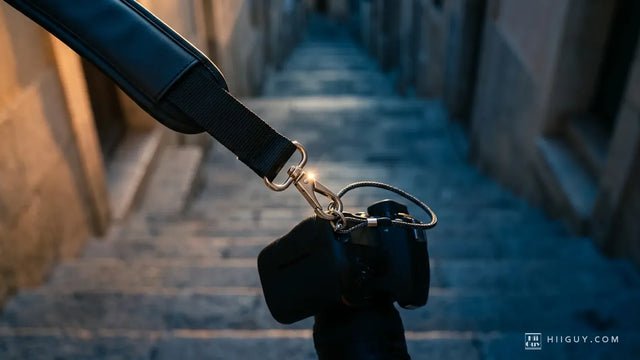
Same webbing again, longer, running from one shoulder down to the opposite hip. The photograph above is what it looks like with a long lens on the front, and the thing to notice is where the camera has gone: down to the hip, lens pointing at the floor, outside the swing of both arms.
Your torso is now holding the strap on, so the sliding problem disappears entirely. The weight is spread down the back rather than pressing on one point. And because the camera is at hip height instead of chest height, you stop looking down at it, which is the posture half of the problem solved as a side effect.
This is the position most photographers end up in after one long day with heavy glass. It is also the position that exposes whether your strap is long enough, which is the next part.
Why the pad does more than the material
Strap listings talk about leather and webbing and braided cord. Width is what you can actually feel.
The clearest evidence comes from load-carriage research rather than from photography. Golriz, Hebert, Foreman and Walker published a study in the journal Work in 2017 that put a 44-pound load on a manikin and compared four shoulder strap widths, from about 2 inches up to roughly 3 inches. Interface pressure at the shoulder fell significantly as the straps got wider, and the least pressure of all came from the widest straps with the load carried high.
Packs are not cameras, and 44 pounds is not 2. But the mechanism is the same one either way: the same force over a wider contact patch is less pressure anywhere in it. That is the whole argument for a padded shoulder strap, and it is why a narrow strap with a beautiful finish can still be the one that hurts. It is one of the four things worth checking on any strap before you buy it.
Do you need a camera shoulder strap, or just a longer one?
Work through it honestly:
- Neck aches, short sessions, light body. Move the strap to your shoulder. Buy nothing yet.
- The strap slides off every time you move. You want crossbody, not shoulder. Check whether yours will let you out to that length.
- It reaches, but the camera ends up under your armpit. The strap is at its limit and you have run out of adjustment. This is the one that actually needs a purchase.
- The pad is narrow or there is no pad. Width first, everything else after.
Only the third and fourth of those are product problems. The first two are free, and they are worth trying this afternoon before you spend anything.
Where ours sits in that
The HiiGuy strap was built for the third case, because that is the complaint we kept hearing: not that the strap was uncomfortable, but that it ran out before the camera reached the hip. It comes in two variations, and length is the only difference between them. The Regular adjusts up to 32 inches on the body and the XXL adjusts up to 44 inches, so a taller or broader photographer can still put the camera where they want it rather than where the webbing gives up.
Everything else is identical in both. Heavy-duty polyester webbing, a wide padded shoulder pad, a stainless steel quick release so the body comes off in one motion at a tripod, and a safety tether sitting behind that release. HiiGuy has been making it since 2016 and backs it for three full years. You can see both variations on Amazon, or read the full specification here first.
The five-second version
Your neck is the worst place on your body to hang a camera and the easiest place to stop hanging it. Shoulder is better and free. Across the body is better still and costs nothing either, as long as the strap is long enough to get there.
Try it on the way out today. Lift the strap off your neck, drop it over one shoulder, then let it out and run it to the opposite hip, and see which of the three your shoulders are still happy with at four in the afternoon. If none of them work because the camera keeps ending up in your ribs, the problem was never the position. It was the length. If you want the longer view on all of this, we laid out seven ways to carry a camera all day and what each one costs you.