You bought a strap, and somewhere in the bullet list it said safety tether. A thin cord came in the box, you could not see what it was for, and it went in the drawer with the spare lens caps.
Fair enough. A quick release safety tether looks like the least important part of a camera strap. It is short, it is thin, and on a normal day it does nothing whatsoever. It is also the only part of the system that exists for the day something else lets go, which is a decent argument for understanding it before you need it rather than after.
Your camera is hanging from a chain of four things
Clip the camera on and look at what is actually holding it up. Not the strap as a product. The individual parts, in order, from the glass upwards.
Link one: the lens and the body
The bayonet mount. Whatever is heaviest in your kit is usually hanging off this, and it is the link almost nobody thinks of as a link at all.
Link two: the body and the strap fixing
Either a screw into the threaded socket in the base, or the two metal eyelets on the top corners. One thread, or two small loops.
Link three: the fixing and the strap
The hook, clamp or clip. If your strap has a release, this is it, and it is the only link in the chain deliberately designed to come apart.
Link four: the webbing and the pad
The part you look at in the shop, and statistically the part least likely to be the problem. Webbing that carries a few pounds does not simply give up one Tuesday afternoon.
Every one of those four is a single point of failure. Break any one and the camera goes to the ground exactly as fast as if you had broken all four. That is the whole reason a tether exists: it is a second route for the load, so one failure becomes a fright rather than a repair bill.
Where a quick release safety tether helps, and the one place it cannot
Here is the part that is usually left out of the marketing, and it is the part actually worth knowing.
A tether clips to a camera eyelet at one end and to the strap at the other. That means it sits alongside links two and three. If the screw backs out of the tripod socket, the tether is still connected. If the release opens when you did not ask it to, same. Both of those are real, and both are covered.
It does nothing at all about link one.
Nikon's own online manual for the D3500 states how a lens comes off: press and hold the lens release button while turning the lens clockwise. Two actions, at once, in two different directions. That is deliberate, and it is why lenses do not casually fall off cameras.
Almost never is not never, though. On most bodies that release button sits on the front face, low down and right beside the mount, and when a camera hangs lens down at your hip that front face is what spends the afternoon pressed against a jacket, a hip belt or a car seat. The button alone does nothing. The button plus rotation does, and a camera swinging from a strap rotates a few degrees at a time for hours. If it ever happens to you, the tether will be dangling neatly from the eyelet, still attached to a body that is no longer attached to the lens.
So the tether is half of a system and the other half is free: give the lens a firm twist in the locking direction before you put the strap over your shoulder, and check it again if you have been leaning on the camera all day. Five seconds. No cord required.
The failures the tether is genuinely for
Two of them, and they are the boring kind that happen slowly.
The first is the screw. A base-plate strap hangs your camera from one fixing in one thread, and that fixing is under a small rotational nudge every single time the body swings. Nothing dramatic happens. It just gets a quarter turn looser every few weeks, quietly, in a place you never look, and there is no point at which it warns you.
The second is the connector. Anything built to open can open, which is not a criticism of quick releases so much as a description of them. A gate held shut by a spring is held shut by a spring, and springs live in pockets full of grit.
Our guide to what a quick release actually does on a camera strap goes through the mechanism itself in detail. The short version for this article: the release is the link you are choosing to make openable, so it is the link that most deserves a backup.
What five pounds does to one small fixing
Worth doing the sum once, because the number is bigger than the feeling in your hand.
Take an ordinary working pair. Canon's own specification page for the EOS 5D Mark IV gives the body, on its own, at 1 lb 12 oz. Canon's specification page for the EF 70-200mm f/2.8L IS III USM gives that lens at 3 lb 4 oz. Put them together and just over 5 lb is hanging off one screw or two eyelets, before a battery grip, a filter or a flash.
Then you walk. Every step briefly makes it heavier than that, and every step gives it another small shove in the direction the thread unwinds. It is not the weight that undoes a fixing. It is the weight arriving several thousand times a day.
What a tether actually is, physically
They are less impressive than you expect, and that is fine. One of the sling-strap brands sells a standalone tether and publishes its dimensions: about 7.25 inches of nylon webbing, roughly 0.4 in wide, with a small swivel carabiner. Its own page describes the job as an extra point of contact in the unlikely event of an accidental fall. What that page does not publish is any load rating.
That bothers people, and it should not. A tether is not carrying the camera. It carries it once, for a fraction of a second, over a few inches, and then you catch up with it. The shortness is the whole design. A generously long tether lets the camera pick up speed before it stops, and a 5 lb body arrested hard at the end of a cord is not obviously better off than one that hit grass.
Two things do matter. It has to attach somewhere independent of the fixing it is protecting, which means the eyelet if your strap screws into the base. And it has to be short enough that the camera cannot reach your knee.
How the HiiGuy strap handles it

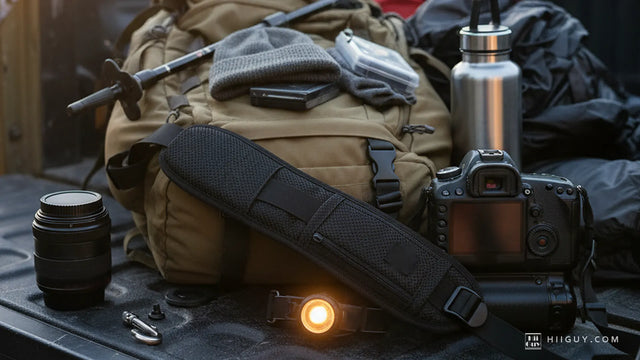
That is one of our own photographs, and it is the situation this article is about: a heavy body and a long lens, hanging from a single fixing, at hip height, all day. The HiiGuy strap ships with the safety tether in the box rather than as an upsell, and the tether goes on the standard camera eyelet, so it is holding a point the screw mount has nothing to do with. That separation is the only thing that makes a tether worth having.
The rest of the chain is built to match. Heavy-duty polyester webbing into a wide padded shoulder pad, a stainless steel quick release at the camera end and rustproof metal fittings, plus a second screw mount in the box so a second body is a clip rather than a rebuild. HiiGuy has been making these since 2016 and backs the HiiGuy strap for three full years.
It comes in two variations, and the only difference between them is how far they adjust. The Regular adjusts up to 32 inches on the body and the XXL adjusts up to 44 inches, which is what lets the camera sit at your hip rather than your ribs whatever your build.
The two-minute check, once a month
None of the above needs a workshop. Before a day out, in this order:
Twist the lens in the locking direction until it stops. Nip the base screw finger tight, or if you are on the eyelets, look at the split rings and throw away any that have opened into a spiral. Open and close the release a few times and listen for grit. Then pull hard against the tether alone and confirm it is holding a different point from the main fixing. A tether looped through the same ring as the release is decoration.
If you are buying rather than checking, our list of four things to check on any camera strap before you buy covers what to look for in a listing photograph, tether included.
So does your strap need one
If your strap attaches at the eyelets and has no release at all, honestly no. There is nothing in that chain designed to open, and a tether protects against a failure mode you do not have.
If your strap screws into the base of the camera, or has a quick release, or both, then yes, and not because the parts are bad. Because a single load path with a deliberately openable link in it is a single load path, and the fix costs a few inches of webbing and nothing at all in comfort. Put it on the eyelet, keep it short, and forget about it. That is the correct amount of attention to give a safety tether.