By four in the afternoon you stop noticing the light and start noticing your neck. That is the honest test of how you carry a camera, and almost nobody applies it in the shop, where the body feels weightless and you are holding it in two hands anyway.
There is no single right answer here. There are seven common ones, each of them genuinely better than the others for a particular kind of day. What follows is what each one actually does to your body over six hours, and who it suits.
Before the seven: the three questions that decide it
Every carry method is a trade between comfort, speed and security. You cannot have all three at once, so work out which one you are short of:
- How long is the camera on you? Twenty minutes and almost anything works. Six hours and the weight has to move off your neck.
- How heavy is the setup? A body with a small prime is a different problem from a body with a telephoto. The lens is usually the heavier half.
- How fast do you need it at your eye? A wedding is not a hike. If the shot is gone in two seconds, security matters less than reach.
Hold those three answers while you read the rest. They will pick for you.
1. Around the neck
The default, because it is what came in the box. The camera hangs at chest height, both hands free, and it is the fastest method to learn because there is nothing to learn.
It is also the one that hurts first. The entire weight bears down on the back of your neck through a band that is usually narrow, and the camera swings forward every time you bend. For a short shoot with a light body it is fine. For a day out it is the reason people go looking for something else.
Suits: short sessions, light kit, anyone who wants the camera dead center and does not intend to walk far.
2. Over one shoulder
Lift the same strap off your neck and drop it on one shoulder, and the load transfers to a much stronger part of you. It is a real improvement and it costs nothing.
The catch is that a shoulder is a slope. Lean forward, reach for something, turn quickly, and the strap slides off. Most people end up walking with one hand resting on the strap, which quietly cancels the hands-free benefit they moved for.
Suits: a moderate walk, a camera you are picking up and putting down, anyone who does not mind a hand on the strap now and then.
3. Across the body

Run the strap over one shoulder and down to the opposite hip, and the geometry changes completely. The strap can no longer slide off, because your torso is holding it. The camera sits low and behind your leading arm, out of the way of your hands. The weight is carried by your shoulder and spread across your back rather than pressing on one point.
This is the method most photographers land on once they have carried a heavy setup for a full day, and the photograph above is what it looks like with real glass on the front. Note where the camera is: at the hip, muzzle down, close enough to steady with one hand and low enough that it is not swinging into the ribs.
Two things make or break it. The first is the pad. A wide, padded shoulder pad turns a thin line of pressure into a broad one, and that difference is most of the comfort. The second is length, and it is the part people get wrong. Crossbody carry needs considerably more strap than neck carry, and if you are tall or broad, a strap that is already at its limit will ride the camera up under your armpit all day.
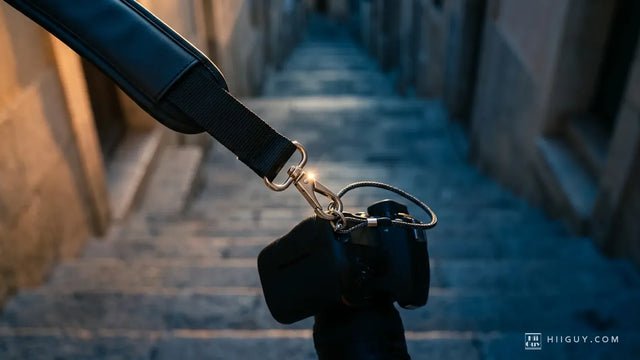
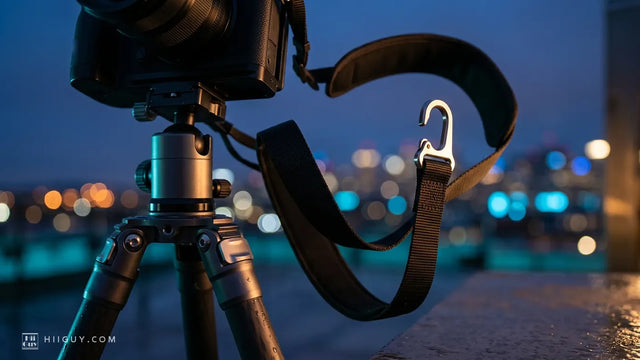
That is the problem the HiiGuy strap was built around. It comes in two variations, and length is the only difference between them: the Regular adjusts up to 32 inches on the body and the XXL up to 44 inches, so the camera can sit where you want it rather than where the strap runs out. It is heavy-duty polyester webbing with a wide padded shoulder pad, a stainless steel quick release so the body comes off in one movement at a tripod, and a safety tether behind the release. HiiGuy has been making it since 2016 and backs it for three full years. If you are on the taller or broader side, the longer version is worth reading about before you buy anything.
Suits: long days, heavy lenses, walking, travel, anyone whose neck has already told them the box strap is finished.
4. The sling, where the camera slides
A sling looks like crossbody carry and behaves differently. The camera is attached to a ring or a glider that runs along the strap, so the body rides at your hip and then slides up the webbing to your eye in one motion, without the strap moving on your shoulder at all.
It is the fastest of the seven by some margin, and if you shoot events that speed is the whole argument. The costs are real though: the camera usually mounts by the tripod socket, which means unscrewing it to use a tripod, and a body that slides is a body that swings when you bend over. Most slings add a lock or a bumper for exactly that reason.
Suits: events, weddings, press and sport, anywhere the difference between one second and three seconds decides whether you got it.
5. On the hip
Clip the camera to a belt or a plate at your waist and it stops being a hanging weight altogether. Your hips are the strongest place on your body to carry anything, which is why every serious rucksack puts its load there.
The trade is access and profile. The camera is below your hands rather than in front of them, so bringing it to your eye is a longer movement, and a body sticking off your waist catches on doorways, car seats and other people. It also does very little for you while you are sitting down.
Suits: hiking and long approaches, especially with a rucksack whose straps are already occupying both shoulders.
6. A dual harness, for two bodies
If you are working with two cameras, no single strap arrangement survives it. Two crossbody straps cross at your chest, grind against each other, and tangle at the worst possible moment.
A harness solves it structurally: the load sits on both shoulders and is tied across your back, so the two bodies hang at your hips and stay separated. A dual harness earns its keep the first time you shoot a full day with a wide lens on one body and a long lens on the other and never once have to change a lens.
It is overkill for one camera, and it looks it. That is a fair price for the only arrangement that makes two bodies comfortable.
Suits: weddings, events, anyone shooting two focal lengths who is tired of changing lenses in the field.
7. On the wrist
The smallest option and the most underrated. A wrist strap carries nothing. The camera is in your hand, which is where it already was. What it removes is the consequence of dropping it.
Used alone it is for short, deliberate shooting: street, a walk around a town, a compact body you are holding anyway. Used alongside a shoulder or crossbody strap it is a second line of defence, and it costs almost nothing in weight or bulk to have both.
Suits: compact and light setups, street photography, and as a backup on any camera you would be sick about dropping.
And the eighth: putting it away
Worth saying plainly, because the internet forgets it. If you are walking for forty minutes with nothing to photograph, the most comfortable carry is no carry. The camera goes in a bag and your shoulders get the walk off. A strap that comes off the body quickly is what makes that practical rather than a five-minute negotiation.
So which one
Take your three answers from the top and read down:
- Short shoot, light body. Neck or shoulder. Do not overthink it.
- Long day, heavy lens, lots of walking. Across the body, with a wide pad and enough length to sit where you want it.
- Speed above all. A sling.
- Hiking with a pack. Hip, and keep your shoulders for the rucksack.
- Two bodies. A harness. Nothing else works.
- Compact camera, or fear of dropping it. A wrist strap, on its own or as well.
Most photographers end up owning two of these and switching by the day, and that is the correct answer rather than a failure to decide. The one thing worth doing today is the cheapest: take the strap off your neck and put it across your body, and see what your shoulders say about it at four in the afternoon.