Straps are the piece of camera gear nobody researches. You save for a body, you agonise for weeks over one lens, and then you carry the whole lot on whatever nylon loop came free in the box.
That works until it does not. Then the neck starts complaining by lunchtime and you go looking, and the looking is where it falls apart. Search for a camera strap quick release and you get page after page of listings that are indistinguishable at thumbnail size: black webbing, a pad, a buckle, a four-and-a-half star average. Nothing in the photographs tells you which one is still going to be on your camera in three years.
Four things will. All four are findable on a listing page before you spend anything, and after ten years of making straps these are the four we get asked about most. Work through them in order.
Check 1: the length, and whether it is a maximum or a fixed size
This is the check that goes wrong most often, because the number on the listing is ambiguous and almost nobody says which kind of number it is.
A strap listed at 50 inches might mean total webbing length laid flat on a table, or it might mean how long the loop is once it is round you. Those are wildly different measurements. What you actually care about is neither: it is how far the camera hangs from the top of your shoulder when the strap is worn across the body. That is the number that decides whether the camera sits at your hip where your hand naturally falls, or up at your ribs where it bangs into you every time you walk.
Before you shop, measure yourself. Take a bag you already like wearing across the body, put it on, and run a tape from the top of your shoulder down the strap to where the bag sits. Write that number down. It is the only sizing information that matters and it takes thirty seconds to get.
Then check whether the listing is quoting you a range or a single size. A strap that adjusts gives you room to be wrong. A strap sold at one length is a bet that the maker guessed your build correctly, and the guess is usually made for someone around five foot nine. If you are taller or broader than that, you will find the adjustment is already at its limit on day one. We wrote about that at more length in why extra long camera straps matter for tall and big photographers, because it is the single most common complaint we hear.
Check 2: how wide the pad is, and how much weight it is spreading
Comfort is not really about padding thickness. It is about how much of your shoulder the load is pressed into. The same weight on a one inch strip of webbing and on a three inch pad are two completely different experiences, because the second one has three times the area to spread across.
So it helps to know what you are actually carrying. Using manufacturers' own published figures, a Nikon D850 comes to about 2 lb 3.5 oz with a battery and a memory card in it. Nikon lists the AF-S 70-200mm f/2.8E at 50.5 oz, which is another 3 lb 2.5 oz. Put them together and you are hanging roughly 5 lb 6 oz off one shoulder, all day, and every bump in your stride multiplies that for a fraction of a second.
Even at the light end it adds up faster than people expect. Nikon gives the D3500 body as 12.9 oz, and by the time there is a kit lens, a battery and a card on it you are past a pound. A pound on a thin nylon band for six hours is enough to leave a mark.
On the listing, look for three things. How wide is the padded section where it crosses your shoulder. Is the padding under the whole width of the webbing or just a token strip down the middle. And can the pad slide along the strap, so you can position it on the shoulder rather than having it sit wherever the stitching decided.
Check 3: what the quick release actually releases from
Two completely different mechanisms get sold under the same phrase, and if you buy the wrong one you have not bought what you thought.
Mid-strap versus camera-end
Some quick releases are a buckle partway down the webbing. Undo it and the strap splits in two, which is handy for getting the strap out from under a jacket but leaves both halves dangling from the camera. Others put the release at the camera end, so the body comes off the strap completely and the strap stays on you. If your reason for wanting a release is putting the camera on a tripod, only the second kind solves it.
The attachment point matters more than the buckle
There are only two places a strap can attach to a camera: the lugs on the top corners of the body, or the threaded socket on the bottom.
That socket is standardised. Nikon's D850 manual lists it as a quarter inch ISO 1222 tripod socket, and almost every camera you can buy uses the same thread. Which is exactly the problem: it is the same socket your tripod plate screws into. A strap that mounts there means you cannot leave an Arca-style plate on the camera, and every switch between handheld and tripod becomes a coin-and-a-screw job in the field. People search for "camera strap with screw" specifically looking for this design, and it genuinely suits some photographers, but go in knowing the trade.
Attaching at the lugs leaves the base of the camera clear. Check which one a listing is describing, because the photographs often do not make it obvious.
What the release is made of
Look for metal at the release itself. This is the single component carrying the entire weight of the camera through one small part, it gets operated hundreds of times a year, and it is the part that fails first on a cheap strap. Plastic clips get brittle. If the listing does not say what the mechanism is made of, assume the answer is plastic.
Check 4: whether there is a safety tether
Any quick release is, by definition, a thing designed to let go. It is meant to let go when you press it, but the whole point of a release is that opening is a normal state for it, not a failure.
A safety tether is a second line that stays attached to the camera whether or not the main release is open. If the release is knocked, or worn, or you catch it on a strap of a bag, the tether is what stops the camera reaching the floor. It costs the maker almost nothing and a lot of straps still do not include one.
Check whether a tether is included or sold separately, and check whether it attaches somewhere independent of the main mount. A tether that loops through the same single point as the release is decoration, not a backup.
What the four checks look like on one strap

We are not pretending to be neutral here, so read this as us showing our working rather than as the verdict. The HiiGuy strap answers the four in this order. On length it comes in two variations that differ in nothing but how far they adjust: the Regular adjusts up to 32 inches on the body and the XXL adjusts up to 44 inches, so a taller or broader photographer is not starting at the end of the range. On the pad, it is a wide padded shoulder pad on heavy-duty polyester webbing rather than padding stitched onto a thin band. The release is a stainless steel quick release at the camera end, so the body comes off and the strap stays on you. And there is a safety tether in the box rather than on a separate listing.
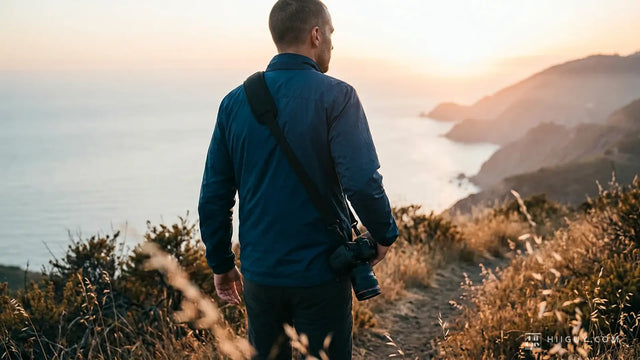
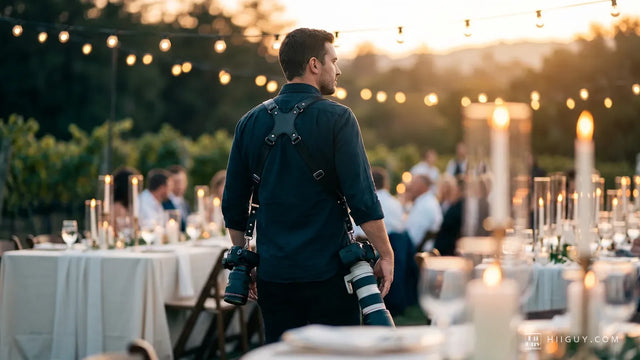
The photograph above is one of ours, shot on a real afternoon rather than in a studio, and it shows what the four checks add up to: the camera down at hand height, the pad flat on the shoulder, the weight of a long lens carried across the body instead of on the neck. HiiGuy has been making these since 2016 and backs them for three full years.
Two things not worth checking
The star average is close to useless on this category. Straps are bought by people who have never owned a good one, rated within a week of arrival, and the failures that matter show up in month eleven. Read the one and two star reviews for what broke and ignore the number.
"Universal fit" is also not information. Nearly every strap fits nearly every camera, because there are only the two attachment points described above. What varies is whether it fits you, which is check one.
The order to do this in
Length first, because a strap of the wrong length is unusable no matter how good the rest of it is. Then the pad, because that is what you will feel by hour four. Then the release and the tether together, because those two are really one question about whether the camera can come off quickly without coming off accidentally.
If you are still deciding how you want to carry the thing at all, rather than which strap to buy, start with the ways to carry a camera all day and come back to this list once you know whether you want it on your neck, across your body or in your hand. The four checks work the same either way.