Someone has a used body for sale, the price is good, and the listing says one number you do not really know how to read: 64,000 actuations. Is that a bargain or a warning?
The camera shutter count is the closest thing second-hand gear has to mileage, and like mileage it gets treated as a pass or fail mark when it is nothing of the sort. A tired body with 30,000 frames is a worse buy than a cared-for one with 120,000. Here is what the number is, what the manufacturers actually publish about it, and the three checks that tell you more than the count does.
What a camera shutter count actually measures
Every time the mechanical shutter opens and closes, a counter in the camera goes up by one. That is it. It is a count of full mechanical cycles, and on a DSLR the mirror slaps up and back on the same trigger, so in practice the number tracks the wear on two moving assemblies rather than one.
Nikon's own support article on the subject puts the speed in context first. The mechanical precision needed to reach shutter speeds up to 1/8000s is, in Nikon's words, awe inspiring. Then comes the line most used listings leave out: as with everything mechanical, it may need to be serviced or replaced someday.
May. Someday. Nikon is careful with both words, and the care is the point. A shutter is a wear part, like brake pads, and nobody, including the company that built it, will tell you the date. That framing is more useful than any threshold, because it turns the question from is this camera dead into how much life am I paying for.
Nikon publishes the numbers, and they are not one number
This is the part worth screenshotting before you go and look at a camera. Nikon's support article, last modified in September 2024, publishes a table of estimated cycles by model, and is clear that data is only available for the models it lists. Reading it in tiers:
The professional bodies, the D6, D5, D4S and D4, are tested to 400,000 cycles. The older single-digit bodies, the D3, D3S and D3X, to 300,000. The high-resolution and semi-pro tier, which covers the D850, D810, D810A, D800, D800E and the D500, is tested to 200,000. Then the enthusiast tier, and this is where most used listings sit: the Df, D780, D750, D700, D610, D600, D300, D300s, D7000, D7100, D7200 and D7500, all tested to 150,000. The entry-level and mid bodies, the D5600 down through the D5000 plus the D3200, D3100, D3000 and the D90, are given as over 100,000.
Nikon lists the Z bodies in the same table, which is handy for anyone weighing a used DSLR against a used mirrorless. The Z7II, Z7, Z6III, Z6II, Z6, Z5 and Zf are tested to 200,000 cycles, and the Z50, Z30 and Zfc to 100,000. Note what is not there: the newest bodies have no published figure yet, so an absence in that table is not a low number.
Two things jump out. First, the spread between tiers is four to one, so a count means nothing until you have matched it to the model. Second, an entry-level body rated at over 100,000 and a pro body rated at 400,000 are not the same product wearing different badges.
Canon does not publish a figure at all
I went looking for the equivalent table. Canon's own published specification pages for the EOS 5D Mark IV and for the EOS-1D X Mark III both list the shutter type and the speed range, and neither carries a durability figure of any kind. I read both pages to check.
The numbers you see quoted for Canon bodies, and you will see them quoted confidently, are not coming off Canon's spec sheet. Treat them accordingly.
Ricoh goes the other way and says it plainly. Its own English product page for the Pentax K-3 Mark III states that the shutter unit withstands a total of 300,000 shutter release actions at a speed of 12 images per second, and adds, to its credit, that this was measured under Ricoh in-house testing standards.
That footnote is the honest part, and every published figure deserves one. These are bench tests of a sample, run in a lab, at room temperature, without your beach sand in them.
Rated is not a deadline
The single most common mistake is reading 150,000 as an expiry date. Nikon does not describe it that way, and it explains exactly what the number is instead. The figures come from MTBF, mean time between failures, which Nikon describes as a statistical projection of an average expected lifespan. On that basis it gives an estimated average number of shutter releases that can be expected before probable shutter failure, and it says in the same breath that mean refers to a mathematical average and not an exact number, so the actual amount may be higher or lower.
Average, and probable. Which means plenty of bodies die well before the rating and plenty sail past it. Nikon's own announcement of the D800, dated 7 February 2012, described a new shutter unit that had passed testing for 200,000 cycles, and D800s are still working today at numbers that would have sounded alarming when that sentence was written.
Run the arithmetic from the other direction and the ratings look more generous than they sound. A D7200 rated at 150,000 cycles, in the hands of someone shooting a hundred frames most weekends, is about 5,000 frames a year. That is thirty years. The same camera in the hands of a wedding photographer doing 2,000 frames a Saturday reaches the same figure in under two years. The rating did not change. The user did.
There is one more number that makes the point. Nikon lists the D850 at 7 frames per second. Held down continuously, 200,000 cycles is under eight hours of shooting. The rating is not a big number, it is a big number relative to how most people actually shoot.
The count itself is softer than it looks
Here is the thing nobody selling a camera mentions, and it comes from Nikon rather than from me. There is no way to accurately tell the total number of times a camera's shutter has been released. Third-party software exists to read the count, and Nikon says plainly that this number is not always accurate, because the shutter release times may be reset by a firmware update.
Read that twice if you are about to hand over cash. The figure on a listing is a reading taken by software the manufacturer does not vouch for, from a counter the manufacturer says can be reset. It is evidence, not a certificate.
Which does not make the number useless. It makes it one input of three.
The three checks that beat the count
1. Count against age
Divide the actuations by the years since the model was current. A 2016 body with 40,000 frames has been used about five thousand times a year, which is a hobbyist who went out most months. The same body with 4,000 frames was in a cupboard, and a camera that sat in a cupboard for nine years has its own problems: seized aperture levers, perished light seals, a battery that will not hold overnight. Very low is not automatically good.
2. What the shutter sounds like
Fire twenty frames in single shot, slowly, and listen. You want the same sound twenty times. A change in pitch, a double click, a hesitation on the mirror return, any of those are worth more than the number on the screen. Then fire a burst and watch the frame rate hold.
3. Everything that is not the shutter
Check the corners of the frame at f/16 against a white wall for sensor dust. Look at the rubber on the thumb rest, which lifts before anything mechanical complains. Work every dial and button, twice. Open the card door and the battery door and look at the hinges. A body that has been carried hard shows it in plastic and rubber long before it shows it in the shutter, and those parts tell you how the previous owner treated the thing.
Carrying a body you did not pay full price for

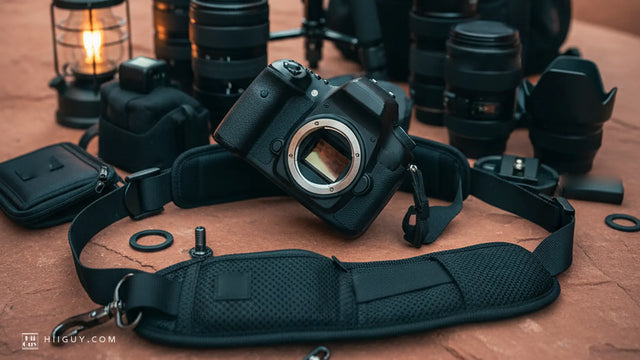
One practical note, because used bodies almost always arrive with the previous owner's strap still on them, and it is usually the thin printed one that came in the box a decade ago. That strap has taken the same years the camera has, and it is the cheapest part of the whole setup to replace.
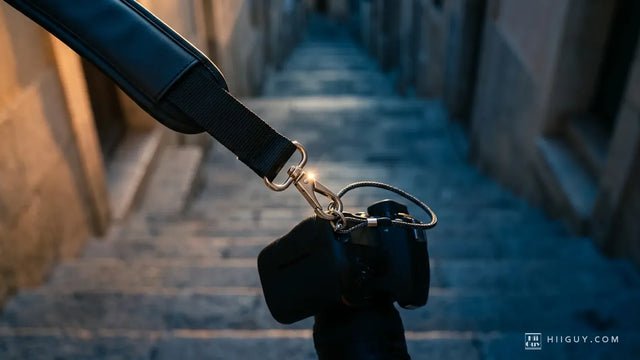
The HiiGuy strap uses heavy-duty polyester webbing into a wide padded shoulder pad, with a stainless steel quick release at the camera end and a safety tether on the standard eyelet. It comes in two variations that differ only in how far they adjust: the Regular adjusts up to 32 inches on the body and the XXL adjusts up to 44 inches. HiiGuy has been making these since 2016 and backs the HiiGuy strap for three full years, which is a reasonable thing to know when the camera it is carrying came with none. If you are about to inspect a second-hand body anyway, our list of four things to check on any camera strap before you buy takes about the same two minutes.
So how many clicks are too many
A working answer, stated as opinion rather than fact, because no manufacturer will give you one.
Under half the rated figure, the count should not be part of your decision at all. Pay attention to the rubber and the glass instead. Between half and the full rating, treat it as a discount you should be receiving, not a reason to walk: the camera is likely fine and you are buying fewer remaining years. Past the rating, it becomes a question of what a shutter replacement costs against what you are paying, and that is a real calculation rather than a superstition, because a shutter is a serviceable part.
And under all three of those, the same rule: the count is one number from a counter that can be reset, sitting next to a camera you can hold in your hands. Trust the hands. If you are new to the body you end up with, our walk through the mode dial, one row at a time is the fastest way to stop shooting it in Auto.