The colour is outside right now and it will be gone in about six weeks. Most people go out with the camera exactly as they left it in August, come home with a card full of flat orange mush, and quietly blame the weather.
The weather is usually not the problem. Four things change when the leaves turn, and none of them are difficult. These are the fall photography settings worth adjusting before you walk out of the door, and the one piece of glass that does more for autumn than any slider in an editing app.
First, throw out the sunny day rule
Almost every instinct you have about good light is wrong in October.
Nikon's own guide to shooting autumn foliage, written by the nature photographer Rod Planck, puts it bluntly: an overcast day is best, first because you can shoot all day long, and second because the light is soft and even. Bright midday sun on a wood does two unhelpful things at once. It blows the top leaves to white while the ground under the canopy goes black, and it bounces a hard sheen off every waxy leaf surface that drains the colour you came for.
So the grey day you were going to stay home on is the one to go out on. If it is sunny, work early and late, when the light comes in from the side rather than overhead, and use the middle of the day to scout.
The same guide makes a point that costs nothing: drive up. A lot of locations let you get above the colour, which turns a wall of trees into a landscape you can actually compose. Colour arrives at higher ground first and works its way down, so elevation buys you timing as well as a viewpoint.
Aperture: two numbers, and knowing which day you are having
Autumn splits neatly into two kinds of picture, and they want opposite settings.
The wide scene. A hillside, a road, a reflection in a pond. You want it sharp from the foreground grass to the far ridge, so shoot aperture priority somewhere around f/8 to f/11, which is where Nikon's guidance on aperture puts landscape work and also where most lenses are at their sharpest.
The single leaf. One branch, one mushroom, one sycamore key against the wood behind it. Now you want the opposite: a wide aperture near f/2.8 to blur the background and get rid of the distractions, which is exactly what Nikon recommends for close-up work in its own autumn notes. That article suggests the 105mm f/2.8 macro as the lens to take, and prefers shooting after rain or frost, when there is water sitting on everything.
There is a third setting worth remembering for one specific shot. If you are pointing into the sun through the branches and want that starburst effect on the light, Nikon gives f/16 or f/22 for best results. Stop down hard and the sun turns into a star instead of a blob.
Shutter speed: the leaves are moving even when you cannot see it
This is where the autumn pictures go soft, and it is almost always misdiagnosed as focus.
Leaves on a thin twig move in air you cannot feel on your face. At 1/60 in a wood, the trunks will be pin sharp and every leaf will be faintly smeared, which reads on screen as a lens problem. It is not. Zoom to 100% on the back of the camera, look at the edge of a leaf rather than the branch it is on, and raise the shutter speed until the edge stops crawling.
The easier answer is to stop deciding this by hand. Turn Auto ISO on and set a minimum shutter speed, and the camera will hold the speed you asked for and only lift the ISO when the light under the canopy makes it necessary. We wrote that setting up properly in Auto ISO, set properly, and autumn is the season it earns its keep, because you walk in and out of deep shade every thirty seconds.
Going the other way is a deliberate choice, not an accident. Nikon's autumn notes describe around one second for an intentional camera movement shot, dragging the camera vertically down a stand of trees, and one minute or longer with a five stop neutral density filter for water that turns to smoke. Both want the camera held still by something other than you.
ISO and the tripod, which are the same conversation
Under a canopy you are often two or three stops darker than the open field you just walked out of, and the camera will take those stops from the ISO if you let it.
Planck's tip list says he uses a tripod for everything, precisely so he controls the shutter speed and the ISO rather than accepting whatever the light dictates. That is the whole argument for carrying one in autumn: not stability for its own sake, but permission to keep the ISO low and the aperture where you chose.
On exposure itself, his advice is refreshingly unromantic. Use matrix metering whatever the sky is doing, then look at the histogram and dial in exposure compensation when the highlights are clipping. Bright yellow foliage against a grey sky is one of the classic cases where the meter gets it wrong, and a glance at the histogram catches it in the field rather than at home.
The polarizer, which is the actual answer
If you take one thing from this, take this one. A circular polarizer does more for autumn colour than any amount of editing afterwards, and not because it is a saturation booster.
Nikon's own explainer on polarizing filters describes what it does: it reduces, and sometimes removes, unwanted reflections, it often increases colour saturation, and it makes blue skies bluer with the clouds standing out. On a wet or waxy leaf, most of what you are calling dull colour is a sheet of white sky reflecting off the surface. Take the reflection away and the red underneath was there all along.
Here is the part that matters. A saturation slider cannot do this. It can only push the colours that reached the sensor, and the reflection reached the sensor too, so raising saturation makes the glare more colourful along with everything else. The filter removes the reflected light before it is ever recorded, which is not something you can undo later.
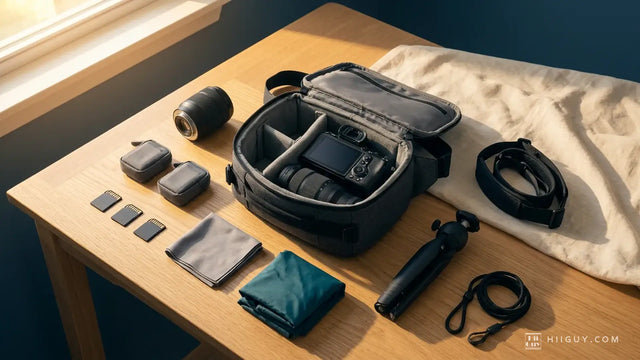
Two practical notes. It costs you 1.5 to 2 stops of light, which is another reason the tripod and the minimum shutter speed matter. And the effect depends on where you are pointing: Nikon's trick is to make a pistol shape with your hand, point the barrel at the brightest part of the sky, and your thumb shows the part of the sky the filter will affect most. Turn the ring while looking through the viewfinder and stop where it looks right, not at maximum. Wound all the way round it can leave a sky so dark it looks fake.
The fall photography settings, in five lines
Print this on the back of your hand if you like.
- Light: overcast all day, or sidelight early and late. Skip midday sun.
- Aperture: f/8 to f/11 for the scene, around f/2.8 for one leaf, f/16 to f/22 for a sunstar.
- Shutter: fast enough that leaf edges stop crawling at 100%, set through Auto ISO minimum shutter speed.
- ISO: as low as the tripod lets you keep it. Matrix meter, then check the histogram.
- Filter: circular polarizer, turned to taste, costing you up to 2 stops.
If you want the same treatment for the rest of the year, our camera settings by scenario chart covers the situations this one does not.
The setting that beats all of them

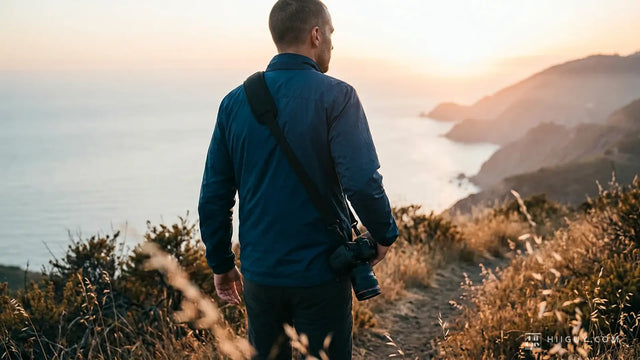
None of the above matters if the camera is zipped into a bag when you pass the good tree. Autumn light changes every ten minutes and the shot you want is nearly always the one you walk past on the way somewhere else.
That is the argument for carrying the camera on your body rather than packing it. The HiiGuy strap holds the body at your hip on heavy-duty polyester webbing with a wide padded shoulder pad, so a long lens is bearable for a whole afternoon, and the stainless steel quick release means the camera comes off in one movement when you set up the tripod for the long exposure on the stream. The Regular adjusts up to 32 inches on the body and the XXL adjusts up to 44 inches, which matters in autumn because you are wearing a coat.
Go this week rather than next. Colour peaks at different times in different places and it does not wait for your weekend.