The camera is new, the strap that came in the box is already threaded through the lugs, and nothing hurts yet. So the question is a fair one. Is a new DSLR camera strap a real upgrade, or is it just the first thing everybody tells you to buy after the camera?
Here is the honest version. For some owners the strap in the box is genuinely enough, and we will get to who they are, because nobody else will tell you that. For most people reading this, something specific has already gone wrong. It is almost always one of three things, and knowing which one you have is the difference between fixing the problem and buying a nicer version of it.
What the strap in the box is built to do
It is built to cost the camera maker close to nothing, survive a shipping box and hold a camera up. Judged on those three jobs it does fine. Judged on carrying, it was never really in the running.
Look at what the manufacturers publish about their own. Nikon's specification for the AN-DC29, the strap supplied with the Z30 and the Z50, lists it as nylon, 1.1 inches wide, length set by sliders, attached through the strap lugs, with no quick release of any kind. Canon's EW-400D, the one that ships in the Rebel boxes, is woven nylon an inch and a quarter across. Different logos, same object: a flat band, no padding, friction for an adjuster.
Nothing about that is a scandal. It is what free looks like, and for a camera that comes out twice a year it is the correct amount of strap. The trouble starts when the camera turns into something you carry for a whole day.
Symptom one: the back of your neck is keeping score
Weight is not really the problem. Pressure is, and the two are easy to confuse.
All of the load arrives at your body through the patch of contact the strap makes. On 1.1 inches of unpadded nylon that patch is narrow, stiff and sitting on the soft tissue either side of your spine. Now put a real kit on it. Nikon lists the D850 body at 32.3 ounces and the 70-200mm f/2.8E at 50.5 ounces, so a working pair weighs about 5 pounds 3 ounces, all of it landing on a band a bit wider than your thumb.
Compare that with the other end of the range. The Z30 body is published at 350 grams, about 12.3 ounces, and its 16-50mm kit zoom at 4.8 ounces. Together they are roughly 17 ounces, and a battery and card barely move it past a pound. That is the same strap under a third of the load, which is why two people can own the identical strap and only one of them has a complaint.
One number worth keeping in your head: the published write-ups that blame a bundled neck strap for a sore neck are usually describing a three-hour walk, not a long shoot. If a camera you would call light is bothering you after an afternoon, the strap is doing it, not the camera.
Symptom two: you keep ending up carrying it in your hand
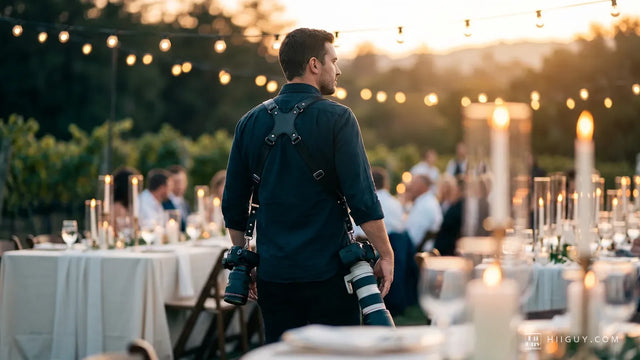
This one is easier to spot in other people than in yourself. Watch anyone with a camera on a neck strap for ten minutes and count how often they take hold of the body with their free hand.
Worn round the neck, the camera hangs on your sternum, which happens to be exactly where your arms swing, where you bend when you crouch and what hits the doorframe first. So you steady it with a hand, and then you keep the hand there, and the strap has quietly stopped doing its job. A camera you are holding is a camera you put down, and a camera you put down is the reason the photographs stop after lunch.
If that is your symptom, the fix is a position change rather than a comfort upgrade. We went through the options in the ways to carry a camera all day, including the two that need no new hardware at all.
Symptom three: it does not fit the person wearing it
The clearest version of this complaint we have found was written by a 6'5" photographer about the strap that came with his DSLR: it is "crap and way too short", and he wanted a longer one that still used the standard lug points on the body. That is the whole problem in two lines. The strap in the box is cut for an average build, and if you are taller or broader than average it rides high and parks the camera under your ribs instead of at your hip.
No amount of padding fixes a strap that is too short for your frame, which is the mistake people make when they shop by comfort. If this is you, length is the specification to shop on first. We built a strap length chart by height so you can get the number before you order rather than after.
When the answer is no, keep it
None of this is an argument that everyone needs to replace a working strap. Four cases where the answer is genuinely no:
- A light kit that comes out in short bursts. A small mirrorless body and a compact lens at around a pound, out of the bag for ten minutes at a time, is not a load any strap struggles with.
- The camera mostly lives on a tripod. If the body spends its day on a plate, the strap is a safety line between setups, and the one in the box is already that.
- You shoot with a wrist strap or hand strap. Different tool, different argument, and it is not solved by a better neck strap.
- Nothing hurts and nothing is in the way. The real test is not what the strap is made of. It is whether the camera is still out of the bag at hour four.
If you read those and none of them is you, the upgrade is not marketing. You have a specific symptom and there is a specific thing that fixes it.
What a new DSLR camera strap actually changes
Three things are worth checking on any replacement, in this order.
The contact patch. Width and padding are the only two variables that lower the pressure on your body, and neither one removes an ounce from the camera. A wide pad spreads the same weight across more of you so no single line of it takes everything.
Where it attaches. A lug-mounted strap uses the two eyelets on the shoulders of the body. A single-point strap uses the tripod socket underneath instead, which frees the lugs for a safety tether and changes how the camera hangs. We pulled the two apart in tripod socket or strap lugs, and the choice matters more than the brand on the webbing.
Whether you can adjust it standing up. A length you can only change by unthreading webbing is a length you set once and then live with through t-shirts and winter coats alike.

That is the shape of the alternative, photographed on our own kit rather than rendered. The HiiGuy strap is heavy-duty polyester webbing with a wide padded shoulder pad, and it mounts on the stainless steel quick release that threads into the tripod socket, with a safety tether running up to a lug as a second load path. The pad is where the weight lands and the quick release is how the body comes off for a tripod without the strap leaving your shoulder.
It comes in two variations and length is the only difference between them. The Regular adjusts up to 32 inches on the body and the XXL up to 44 inches, with the same webbing, pad, quick release and safety tether in both, so the decision is a measurement of you and not of your camera. HiiGuy has been making them in Los Angeles since 2016 and backs the HiiGuy strap for three full years. See it on Amazon.
Before you order anything
Spend two minutes with the camera in your hands first. Find both strap lugs and check nothing is already threaded awkwardly through them. Look at the tripod socket on the base and work out whether a plate is living there, because a single-point strap wants the same hole. Then put the heaviest lens you own on the front, because a strap decision made with a pancake lens fitted is a different decision from the one you need. If you want the full version, what to check on a camera strap before you buy runs through the rest.
The strap in the box is not a trick played on new owners. It is the cheapest thing that works, included so the camera is usable the moment you open it, and plenty of people never need more than that. The moment the camera becomes the thing you carry all day, it turns into the first part of the kit worth upgrading, and you will know exactly which of the three symptoms sent you looking.