Most lists of cheap camera accessories are padded with things nobody uses twice. Lens caps you already own, a cleaning cloth that comes free in the box, a tripod too flimsy to hold the camera it was sold for. The point of a price ceiling is to force a choice, not to fill a number, so everything below earned its slot by answering one question: does this change a photograph you would otherwise not have got?
Ten made it. Two things to say before the list. Prices on Amazon move daily and we do not control them, so treat the ceiling in the title as the shelf we shopped from, not a promise about what you will see today. And the number on the listing is the one that counts, always.
Some of the links below are affiliate links and we earn a small commission if you buy through them. It costs you nothing extra and it does not change what is on the list. The HiiGuy strap is our own product and is not an affiliate link.
1. A circular polarizer
This is first because it is the only filter that does something software cannot. A polarizer cuts light that has bounced off a non-metallic surface, which is reflection on water, glare on wet leaves, and the white sheen sitting on top of paint and glass. Take that away and the color underneath comes through. There is no slider in any editor that recovers detail the sensor never recorded.
The K&F Concept 58mm in the K series runs 18 multi-layer coatings on imported AGC glass, with the manufacturer quoting 0.2 percent reflectivity, and the frame is about a fifth of an inch thick so it does not cut into the corners of a wide lens. Buy it in the thread size of the lens you shoot most, which is printed on the inside of the lens cap next to a circle with a line through it.
Two warnings, because this filter gets misused more than any other. Rotate it and watch the effect come and go, because it does nothing at all at one angle and everything at another. And it is at its strongest roughly ninety degrees away from the sun, which is why skies go blotchy on an ultra-wide: different parts of the frame are at different angles. On a normal or short telephoto lens that problem disappears.
See the K&F Concept 58mm polarizer on Amazon
2. A set of step-up rings, so that one filter fits every lens
Nobody tells beginners this and it quietly saves a lot of money. A step-up ring is a metal collar with a small thread on one side and a bigger one on the other. Screw it onto a 52mm lens and the front of it is now 58mm, and your one good filter fits.
The Neewer eight-piece set covers 49 to 52, 52 to 55, 55 to 58, 58 to 62, 62 to 67, 67 to 72, 72 to 77 and 77 to 82, all anodized aluminum. Chain two together and you can bridge almost any gap in a normal kit. Buy your filter in the largest thread you are ever likely to own, step everything else up to meet it, and you never buy a second polarizer.
The one thing a step-up ring costs you is the lens hood, which no longer screws on over the bigger ring. On a polarizer that is a fair trade, because you are mostly shooting away from the sun anyway.
See the Neewer step-up ring set on Amazon
3. A proper air blower
Dust on the sensor shows up as soft grey dots in the same place in every frame, usually first noticed in a sky at a small aperture. You can clone them out one at a time forever, or you can blow them off in four seconds.
The thing that separates the Giottos AA1900 from the little bulb blowers bundled in cleaning kits is a one-way valve in the base. It draws its air in through the bottom, so it is not inhaling the dust it just blew off the sensor and firing it straight back. The nozzle also unscrews, which means the tool that cleans your camera can itself be cleaned.
Use it instead of canned air, not alongside it. Compressed air cans fire propellant as well as gas, they can throw liquid if tilted, and the pressure is high enough to drive grit into a shutter curtain rather than off it. A rubber bulb cannot do any of that.
See the Giottos Rocket Air Blaster on Amazon
4. A strap you can wear across your body

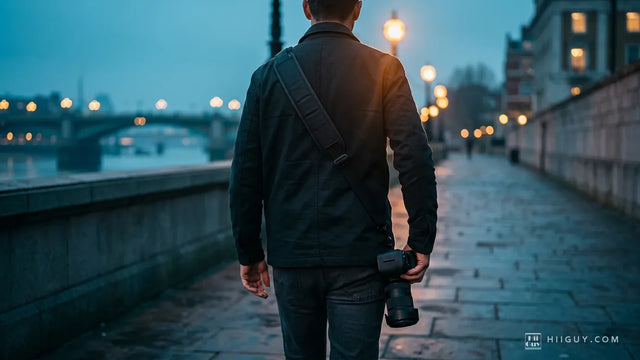
We make this one, so read it with that in mind. The argument for it does not depend on whose name is on it: the strap in your camera box goes round your neck, which hangs the entire weight of body and lens on the two tendons at the back of it, and it is cut as though every photographer has the same chest. By the third hour the camera is in your hand, and a camera in your hand is a camera that gets put down.
Worn across the body the load lands on one shoulder and your back, and the camera sits at your hip under your arm. The HiiGuy camera strap is heavy-duty polyester webbing running into a wide padded shoulder pad, with a stainless steel quick release at the camera end, rustproof metal fittings and a safety tether behind the release as a second route for the load. It comes in two variations and length is the only difference: the Regular adjusts up to 32 inches on the body and the XXL adjusts up to 44 inches. HiiGuy has been making it since 2016 and backs the HiiGuy strap for three full years.
If you are broad through the chest, if you shoot in a coat half the year, or if you want a long lens hanging clear of your leg, the XXL is the one. Our camera strap length chart works out the number properly if you would rather measure than guess, and you can see both variations on Amazon.
5. A LensPen
Air moves the loose dust. What is left on the front element after that is skin oil from a fingertip, and oil does not blow off.
The LensPen NLP-1 has a retractable natural-fiber brush at one end for the grit, and a carbon-impregnated tip just under half an inch across at the other for the smears. The tip is slightly concave to match the curve of the glass, so it meets the element across its whole face instead of on one edge. There is no fluid in it, which is the real advantage over a bottle and a cloth: nothing to spill into the barrel, nothing to leak in a bag, nothing to dry out between the two times a year you remember you own it.
Brush first, every time. Rubbing the carbon tip over sand is how you scratch a lens with the thing you bought to protect it.
See the LensPen NLP-1 on Amazon
6. A spare card that never leaves the bag
Not the card you shoot on. A second one, taped into a pocket of the bag, that you forget about until the day the first one fills up in the middle of something.
The SanDisk Extreme SDXC is rated at 180 MB/s read and 90 MB/s write. The read figure is the one printed large on the front and it is the one that matters least while you are shooting: it describes how fast files come off the card onto a computer. Write speed is what decides whether your camera stalls after eight frames of a burst, and whether 4K video records without the camera refusing outright. If you shoot any video at all, look for the V30 mark on the card rather than the headline megabytes, because that is the symbol that guarantees a sustained floor rather than a peak.
See the SanDisk Extreme SDXC on Amazon
7. Somewhere to put the cards
Loose cards live in jacket pockets, go through the wash, and get mixed up so you cannot tell the full one from the empty one. The fix costs very little and takes one evening to become a habit.
The JJC MC-SD12 holds twelve SD cards in a rubber-sealed polycarbonate shell, measures 5.63 by 3.23 by 1.1 inches and weighs about 4.7 ounces, so it drops into a jacket pocket. Adopt one rule with it and it earns its place: cards go back in label-up when they are empty and label-down when they are full. You will never again stand in a field trying to remember which is which.
See the JJC MC-SD12 card case on Amazon
8. A wired remote release
Pressing the shutter button is the single biggest source of blur in a tripod shot, and it is worst in exactly the situation you bought the tripod for, which is a long exposure after dark.
Canon's own RS-60E3 is a two foot cable ending in a 2.5mm sub-mini plug, with a two-stage button that focuses on a half press exactly like the camera's own. It locks down, which is the feature that actually matters: in bulb mode the shutter stays open as long as the button is held, and a lock means you are not standing there holding it for four minutes. Third-party cables using the same 2.5mm plug exist and work.
Check your body's port before you order, because the connector is not universal across makers or even across one maker's range. If yours does not have one, your camera's two-second self timer does most of the same job for free.
See the Canon RS-60E3 on Amazon
9. A rain cover, two to a pack
Light rain is when the interesting pictures happen and when almost everybody goes home. A clear plastic sleeve with a drawstring is not elegant and it is not a weather-sealed body, but it means you stay out.
The Altura two-pack takes lenses up to 18 inches long, which covers a telephoto with the hood on, and the sleeves are see-through so you can still read the rear screen and the top plate through the plastic. Each weighs almost nothing and folds flat enough to live permanently in a bag pocket.
Buy the two-pack rather than one. These are a consumable: they tear on a tripod clamp eventually, and the second one being already in the bag is the entire point.
See the Altura rain cover two-pack on Amazon
10. A hot shoe bubble level
Last, and the smallest thing here. A three-axis acrylic level slides into the hot shoe and shows you pitch, roll and yaw at a glance.
Plenty of cameras have an electronic horizon built in, and if yours does, use that instead and skip this. The reason a physical one still has a job is that it works with the camera switched off and the screen dark, which is when you are setting up a tripod at dusk, and it works through a viewfinder where the electronic display is not visible. The SENHAI pack comes with two, which is right, because the first one falls out of a bag within a year.
Straightening a horizon afterward is possible and it always costs you the edges of the frame. Getting it right in the hot shoe costs nothing.
See the SENHAI hot shoe level two-pack on Amazon
Three cheap camera accessories we left off on purpose
The multi-filter bundle. Sold next to every beginner camera, usually a UV, a fluorescent and a warming filter with a pouch. Two of the three are effects you can apply afterward for free, and all three mean more air-to-glass surfaces for flare to bounce around in. If you want one filter, make it the polarizer at the top of this list.
The spare battery from a brand you have never heard of. A cheap battery is the one component here that sits inside the camera, and the failure mode is not that it holds less charge, it is that it swells and jams in the compartment. Spend more here or stay with the maker's own.
The tripod that costs less than the rain covers. There is a floor below which a tripod is worse than no tripod, because it holds the camera almost still, which is the one thing that produces a blurred frame you thought was sharp. Save up.
If you buy one thing
The polarizer, if you photograph anything outdoors. It is the only item on this page that changes what the sensor records rather than how comfortably you carry it or how clean you keep it.
If you mostly photograph indoors, buy the blower instead and put the money toward a lens. We wrote the longer argument for that in our piece on the photography essentials a beginner actually needs, and the short version is that glass outlasts every accessory on this list.