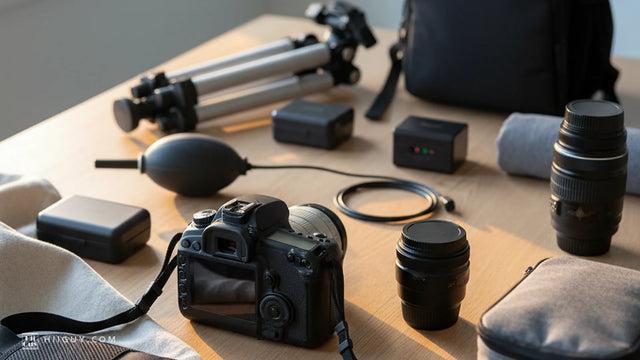
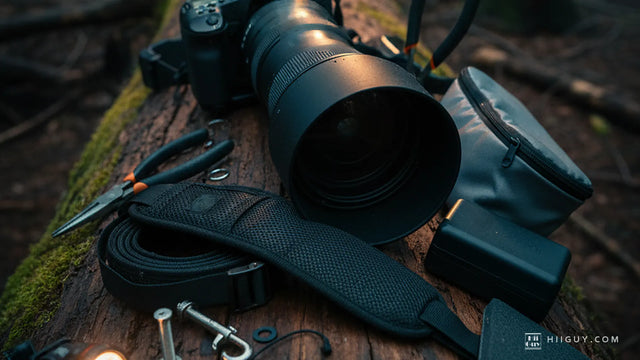
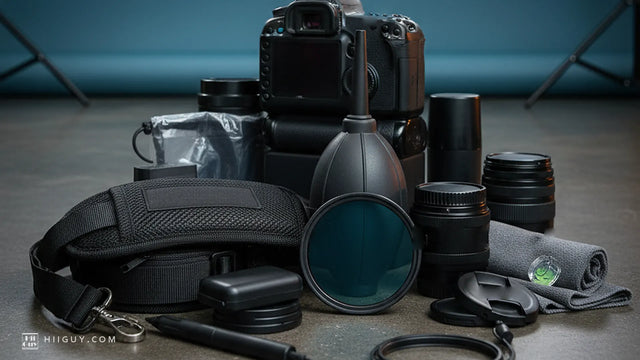
You know the sound. A dull knock as you turn through a doorway, and the camera you were carrying has just met the frame. Then it is the back of a chair in a cafe, then a rock on the way down off a ridge, then the corner of your own kitchen counter. Most people decide a camera sling strap just does this, and that carrying a camera means accepting a few scuffs on the lens barrel.
It is not how slings work. It is how a weight hanging on a cord works, and the cord is the part you can change. Swing comes from two things, the length you are hanging the camera at and where on the body the camera is anchored, and both of them are adjustable in about ninety seconds.

Why a camera sling strap swings, and what is actually pushing it
A weight on a flexible cord has one speed it wants to swing at, and that speed depends almost entirely on how far below the pivot it hangs. Not on how heavy it is. The pendulum formula from school physics gives the full back-and-forth time, and for a camera it works out like this:
- hanging about 10 inches below the pivot: roughly 1.0 seconds per swing
- 14 inches: about 1.2 seconds
- 20 inches: about 1.4 seconds
- 26 inches: about 1.6 seconds
- 30 inches: about 1.75 seconds
Treat those as a range rather than a measurement. A camera on a strap is not a tidy weight on a string. The pivot sits somewhere between your shoulder and the last place the webbing touches your back, the body is a rigid lump rather than a point, and your clothing is adding friction the formula knows nothing about. The shape of the thing is still right: hang it lower, it swings slower.
Now the other half. Published walking-cadence research puts a comfortable adult walking pace at around 115 steps a minute, with most ordinary walking landing somewhere between 100 and 130. At 115 steps a minute you take a step every 0.52 seconds, which means a full left-and-right cycle of your gait comes round every 1.04 seconds.
Put the two numbers beside each other. A camera hanging ten to fourteen inches below the pivot swings at 1.0 to 1.2 seconds. Your stride cycles at 0.9 to 1.2 seconds. Those are the same number.
That is not a coincidence you can ignore. When you push a swing at the exact rate it already wants to move, every push adds to the last one. Your hip is doing precisely that, every single step, to a camera hanging in that range. The camera is not swinging despite your walk. It is swinging because of it, and it will keep gaining amplitude until something stops it, which is usually the door frame.
The worst length is the one the strap in the box gives you
Here is the unlucky part. Take the strap that shipped with your camera, let it out as far as it goes, and sling it over one shoulder. The camera lands high on your ribs, somewhere around ten to fifteen inches below the shoulder. That is the resonant zone, dead center.
The factory strap was designed to go round your neck, where it is short enough that the camera sits against your chest and your body damps it. Worn diagonally, which is how most people actually want to carry, it parks the camera in the one place where your own walking pumps it hardest. Everybody who has ever said "slings swing more than neck straps" was comparing a correctly used neck strap against a badly set up sling.
There are two ways out of the resonant zone and they both work.
Go longer, past where your stride can feed it
Let the camera down to 24 inches or more below the shoulder and the swing period stretches to 1.6 seconds and up. Your stride is no longer in time with it. Each step now arrives at a random point in the swing, and the pushes cancel instead of accumulating. Better still, at that length the camera is sitting at your hip rather than your waist, which puts it directly under your hanging arm. Your forearm rests on the lens barrel without you thinking about it, and a hand on the lens kills a swing instantly.
This is the setting almost nobody tries, because the stock strap cannot reach it. Most straps that came with a camera top out around 50 inches of total webbing, which is simply not enough to put the body at your hip on an adult torso. Working out how much you need is a measuring job rather than a guessing one, and we put the numbers into a camera strap length chart by height and carry position.
Go shorter, and let your chest do the damping
The other direction works too, and it is the right answer in a crowded market or on a packed train. Pull the camera up until the body is pressed against your sternum. It cannot swing because it is in contact with you, and anything that short has no room for an arc anyway. You give up fast access to the camera, which is why this is a situation setting rather than a day setting.
What you must not do is split the difference. Mid-chest is the resonant zone. It is the most tempting place to leave the strap because it feels like the camera is somewhere sensible, and it is the one length that guarantees the knocking.
Change where it is anchored, not only how long it is
Length decides how fast the camera swings. The anchor decides how much of the camera is sticking out into the world while it does.
Attached to the two lugs on the top corners of the body, a camera hangs upright, lens pointing straight out from your hip. That lens is now a four or five inch spike aimed at whatever you walk past. Canon's published specification for the EF 75-300mm f/4-5.6 III puts it at 4.8 inches long and 16.9 ounces, and on a Canon EOS Rebel T7, which Canon's own specification chart lists at 16.75 ounces with battery and card, you are swinging about two and a tenth pounds of camera with a five inch nose on it.
Mount instead from the tripod socket underneath and the whole thing rotates. The camera hangs lens-down, the barrel lies flat along the outside of your thigh, and the widest part of your kit is now parallel to your leg instead of pointing across the corridor. The photograph at the top of this article is exactly that setup, and you can see how little of the camera is actually projecting.
Lens-down also lowers the center of mass relative to the attachment point, which makes the whole assembly less inclined to twist on its own axis as you move. If you have never compared the two mounting points, we went through what each one is built to withstand in our piece on the tripod socket versus the strap lugs.
Four fixes you can make before you leave the house
None of these cost anything and you can do all four in the time it takes to find your keys.
Lengthen until your hand falls on the lens. Stand up, let your arm hang, and adjust until the lens barrel is where your palm naturally lands. That is the right length for walking, and it is usually a lot longer than people expect. You now have a damper attached to your own shoulder.
Push the camera behind your hip bone. Rotate the strap a few inches so the camera rides just behind the point of your hip rather than in front of it. Behind the hip, your leg swings away from the camera on each stride instead of into it, and the doorway clears your front profile before the camera reaches it.
Shorten the free end. On most adjustable straps there is a tail of loose webbing flapping past the buckle. It catches on bag straps and jacket zips, and every catch is a jolt that starts a swing. Fold it and hold it down with a hair elastic.
Change your hand habit, not your grip. You do not need to hold the camera. Rest two fingers on top of the lens as you walk and the arc dies instantly, because you have added damping to a system that had almost none. It becomes automatic within a day.
If what is bothering you is the strap rolling over on your shoulder rather than the camera swinging at your hip, that is a different fault with a different fix, and we covered it separately in why a sling strap rotates and how to stop it.
What we built into the HiiGuy strap
We have been making this strap since 2016, and length is the thing we get asked about more than everything else combined. The HiiGuy camera strap comes in two variations and length is the only difference between them: the Regular adjusts up to 32 inches on the body and the XXL adjusts up to 44 inches. Everything else in the box is identical.
That range matters for exactly the reason this article is about. A strap that stops at 50 inches of webbing cannot put a camera at an adult's hip, which means it cannot get you out of the resonant zone in the long direction, which leaves the short direction as your only option. The XXL exists so that going longer is a setting rather than a wish, and it is the one to take if you are broad through the chest, if you shoot in a coat for half the year, or if you want a long lens hanging clear of your leg rather than jammed against it.
The camera end is a stainless steel quick release, which is what lets you switch between the lugs and the tripod socket without rethreading anything, and there is a safety tether sitting behind the release as a second route for the load. The shoulder end is heavy-duty polyester webbing into a wide padded shoulder pad, with rustproof metal fittings. HiiGuy backs it for three full years.
You can read the full specification on the product page, or see both variations on Amazon.
The short version
A camera hanging ten to fifteen inches below your shoulder swings at almost exactly the rate you walk, so your own stride drives it like a child on a swing. Get out of that window in either direction. Long, so the camera reaches your hip and your forearm covers it. Or short, so it is pinned against your chest. Then mount from the tripod socket so the lens hangs down your thigh instead of out into the doorway.
Do those two things and the knocking stops. Not reduces. Stops.