Somebody told you never to hang a camera from the tripod socket. Probably in a forum thread, probably with real conviction, and now the sling strap sitting in your basket feels like a mistake you are about to pay for.
It is worth unpicking properly, because a camera strap bottom mount is how nearly every sling and crossbody strap works, and that warning gets repeated far more often than it gets explained. There are two places a strap can attach to a camera. Each carries the weight along a different path, each one costs you something you might want, and only one of them has a decade of argument attached to it.
The two attachment points, and what each was built to do
Turn the camera over and look at both before deciding anything. They are not the same kind of fixing at all.
The strap lugs
Two small metal loops on the top corners of the body, one on each side. Nikon's own parts diagrams call them eyelets for the camera strap, which tells you exactly what they are for: a strap, and nothing else. Every camera that ships with a neck strap in the box uses these.
They carry the load at two points instead of one, up high, and the camera ends up hanging flat against your chest with the lens pointing at the floor in front of you.
The tripod socket
One threaded hole in the base plate. It is not a camera-maker's invention but an international standard: ISO 1222 governs tripod connections and specifies a 1/4-20 UNC thread for consumer cameras, with a wider 3/8-16 on heavier professional bodies and long lenses. That is why a tripod head from one brand fits a body from another.
Screw something into it and the camera hangs from a single point at its base, which flips it lens-down at your hip. That orientation is the entire reason sling straps exist.
What the evidence for a camera strap bottom mount failing actually amounts to
This is the part that deserves a straight answer, so here it is: much less than the warning implies.
Hunt for accounts of a socket tearing out of a camera and what you mostly find are tripod accidents. A leg gets kicked, a head is over-tightened, the whole rig goes over sideways and takes the base plate with it. Those are real, and they are also a completely different load. A tripod falling applies a violent sideways lever to the socket. A strap applies a few pounds straight down, which is the direction the thread is strongest in.
The construction is better than people assume, too. On cheaper bodies the socket is a metal insert set into a base that is otherwise plastic, and that sounds alarming until you remember what the insert is rated to hold: a camera plus a long lens, cantilevered out on a tripod head, all day.
Nobody publishes a load rating for either fixing, so anyone claiming a hard number about one is guessing. What can be said honestly is that the failure people warn about is not the failure that shows up in practice.
The failure that does happen, and it is not the one you were warned about
Screws back out. That is the whole problem with a camera strap bottom mount, and it has nothing to do with strength.
One screw in one thread is free to rotate, and a camera on a strap rotates constantly. Not dramatically. A few degrees each time you walk, turn, sit down or lift the body to your eye, thousands of times a day, and roughly half of those nudges are in the loosening direction. Nothing breaks. The fitting simply becomes finger-loose over a few weeks in a place you never think to look.
The strap makers know this, which is the tell. BlackRapid's FastenR FR-5, the screw fitting their sling straps hang from, is stainless steel with a rubber washer included, and the company's own description of the washer is that it prevents over-tightening. Rubber under the head also means friction against the base of the camera, which is what stops a fitting unwinding. The washer is not packaging. It is the fix.
Lugs have a smaller version of the same problem. The split ring between the eyelet and the strap is a keyring, and keyrings open into a spiral if you catch them on something often enough. The difference is that you can see a ring going wrong from across the room, and you cannot see a screw doing it at all.
If you have ever wondered why a sling keeps turning the wrong way on your shoulder, that is a separate mechanism, and we have gone through why a sling strap rotates and what stops it in its own article.
What each mount costs you
Strength is not the deciding factor. What each one blocks usually is.
The socket costs you the tripod
You have one threaded hole and two things that want it. Screw in a strap fitting and the tripod plate has nowhere to go, so a tripod day means unscrewing the strap in a car park with cold hands.
There are ways round it. Arca-Swiss plates exist with a second 1/4-20 tapped into them for exactly this, and some clamps carry a threaded socket on the side, so the strap hangs off the plate rather than the camera. If you shoot on a tripod most days and want a sling as well, buy that plate first and the strap second. Doing it the other way round is how people end up with a drawer of adapters.
The lugs cost you the lens-down hang
A strap on the lugs holds the camera flat and face-forward across your chest. It bounces there when you walk, the lens hoods up into your sternum, and the controls sit where your forearm rests. For a small prime that is fine and arguably nicer. Put a long telephoto on it and the whole assembly wants to swing outward, because you are holding a heavy horizontal object by its top edge.
The socket answer is better here and it is basic physics rather than marketing. Lens-down means the weight hangs in a line under the fixing, the barrel tucks along your leg, and nothing levers against your ribs.
How the HiiGuy strap handles both at once

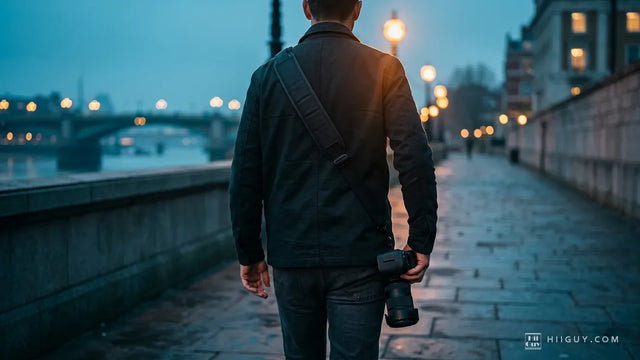
That is one of our own photographs, shot on a working day rather than in a studio, and it shows the part of this argument that matters: where the metal actually meets the camera.
The HiiGuy strap uses a 1/4-20 screw mount into the tripod socket, so you get the lens-down carry, and it ships with a safety tether that clips to a camera eyelet. Those are two different points on two different faces of the body, which is the only arrangement where a backup is genuinely a backup. A tether looped onto the same fitting it is meant to protect is decoration, and we went through the reasoning in full in our piece on what a safety tether is actually for.
The rest is unglamorous and deliberate: heavy-duty polyester webbing into a wide padded shoulder pad, a stainless steel quick release at the camera end, rustproof metal fittings, and a spare screw mount in the box so a second body is a clip rather than a rebuild. HiiGuy has been making these since 2016 and backs the HiiGuy strap for three full years.
It comes in two variations and the only thing separating them is how far they adjust. The Regular adjusts up to 32 inches on the body, the XXL up to 44 inches, which is what decides whether the camera lands at your hip or up under your ribs.
So which should you actually use
Answer three questions and it settles itself.
Do you shoot with anything longer than a kit zoom? Socket. The lens-down hang stops a heavy barrel levering off your chest, and that is worth more over eight hours than any argument about thread strength.
Are you on a tripod most days? Lugs, unless you are willing to buy a plate with a second threaded hole. Unscrewing a strap fitting every time you set up gets old faster than you expect.
Is the camera small and light, with a pancake or a 35mm on the front? Lugs are completely fine and you can stop reading here. There is nothing in that load path designed to come apart.
The one combination to avoid is a screw mount with no tether and no washer on a body carrying long glass. Not because it will fail today. Because there is no second route for the load, and the single fitting holding it up is the one fitting you cannot inspect without taking the camera off.
The thirty-second check
Whichever you use, do this before a day out and never think about it again.
On a screw mount: nip it finger tight, then confirm there is something soft under the head. Bare metal on a metal base plate has almost no friction and will walk loose. If your fitting came without a washer, that is worth solving before the next trip.
On lugs: look at both split rings and throw away any that have started to open into a spiral. They cost pennies and they are the only part of that system that fails quietly.
Either way, hang the camera off the strap at waist height and give it a firm downward tug before it goes over your shoulder. Two seconds, and it is the only test that checks the whole chain at once.