The awkward part is that your DSLR still works. Nothing has broken. The pictures are fine. But every video you watch is shot on a mirrorless body, the shop window has stopped displaying anything with a mirror in it, and somewhere in a drawer there are four or five EF lenses that cost more than the camera did.
So the question people actually ask is not "dslr vs mirrorless". It is narrower and more anxious than that: if I move, what happens to the glass I already own?
That question has a published answer, and it is worth reading before the opinion pieces.
Your EF lenses mount. Canon says so in its own manual
Canon's instruction manual for the EOS R6 Mark II opens the lens section with a sentence that settles most of the argument: all EF and EF-S lenses can be used by attaching an optional Mount Adapter EF-EOS R, and the camera cannot be used with EF-M lenses. That second half matters as much as the first. EF-M was the mount on the small EOS M bodies, and it is not part of this path.
Autofocus comes with them. The same manual's setup step tells you to put the lens's focus mode switch to AF, and says plainly that on MF autofocus will not operate — which is only worth writing down if AF is otherwise expected to work through the adapter. It does.
There is one real cost, and it lands on the cheap kit zoom rather than on the expensive glass. Canon states that with EF-S lenses an approximately 1.6x crop factor is applied to the center of the regular image area. Put the EF-S 18-55 that came with your Rebel on a full-frame R body and the camera crops to the middle of the sensor. Your EF lenses — the 50mm, the 24-105, the white telephoto — use the whole thing.
The adapter table is worth two minutes before you buy a body
Canon publishes a compatibility table for its mount adapters, current as of September 2026, listing four of them: the plain Mount Adapter EF-EOS R, the Control Ring version, and two Drop-In Filter versions. Two entries in it are the kind of thing you find out after paying.
On the EOS R100, Canon footnotes that the control ring of the Control Ring Mount Adapter EF-EOS R has no effect — and that footnote appears against no other camera in the table. On that one body, the feature the dearer adapter is named after does nothing, and the plain adapter does the same job. Separately, the EOS M50 Mark II is marked as incompatible with all four adapters, which is the EF-M sentence above arriving from the other direction.
What you lose on day one: battery
This is the honest bad news, and it is larger than most comparisons admit.
Canon rates the EOS Rebel T8i, using CIPA's testing standards with a fully charged LP-E17, at approximately 1,240 shots through the viewfinder at 73°F, falling to about 1,120 at 32°F. The EOS R6 Mark II, on a fully charged LP-E6NH at the same 73°F, is rated at approximately 450 shots through its electronic viewfinder in power saving mode, and 320 in the smooth setting.
Roughly a third of the frames, then, for the same day out. An optical viewfinder is a piece of glass with no running cost; an electronic one is a small screen that has to be lit from the moment you switch on. There is no clever way around that, only spare batteries.
But hold the conclusion, because the comparison flips the instant you stop using the viewfinder. Canon rates that same Rebel at approximately 360 shots in Live View at 73°F. The R6 Mark II on its rear screen is rated at approximately 760. If you are the sort of photographer who composes on the back of the camera — and a great many people who bought a DSLR in the last decade never really stopped — the mirrorless body is not the shorter-lived camera. It is twice the camera.
One caveat said out loud: those are two different batteries in two different cameras, and Canon's figures are measured per body rather than per cell. They are still the numbers you will actually live with, because you buy the camera, not the battery.
What you gain: autofocus that does not depend on which lens you bought
The spec-sheet version of this is 45 AF points against 1,053 zones, and that framing is almost useless. The real difference is hidden one page deeper in the DSLR manual.
Canon's manual for the T8i warns that although the camera has 45 AF points, lenses are sorted into eight groups, A to H, which vary in how many of those points are available. Groups A through D get all 45. Groups E and F get 35. Group G gets 27, and loses Large Zone AF entirely. Group H autofocuses only with the center point. Your lens decides how much of your autofocus system you are allowed to use.
There is a harder limit underneath it. Canon states that if a lens's maximum aperture is slower than f/8, autofocus is not possible during viewfinder shooting at all. That is the sentence that ends the conversation for anyone stacking a teleconverter onto an already slow telephoto.
Against that, Canon describes the R6 Mark II's Dual Pixel CMOS AF as offering a maximum of 1,053 zones in a 39 by 27 grid, covering approximately 100% of the frame horizontally and 100% vertically. Not a cluster near the middle with a lens-dependent subset switched on — the whole rectangle.
For somebody with a bag of EF glass, this is the argument that actually carries weight, and it carries it in an unexpected direction: the older and slower your lenses are, the more a mirrorless body changes what they can do. If you are still working out what your current camera is doing when it hunts, we took the settings apart in focus modes and focus areas, which are two different things that get confused constantly.
The "mirrorless is smaller" claim does not survive the spec sheet
Canon gives the Rebel T8i as approximately 18.17 oz including battery and card, and 16.61 oz body only. The R6 Mark II is approximately 23.63 oz with battery and card, and 20.74 oz body only. The mirrorless camera is the heavier one, by about five and a half ounces, before you have attached anything.
Then you attach something. The adapter is a rigid spacer that sits between the body and every EF lens you own, so the combination is longer than the DSLR version of itself, not shorter.
That comparison is not like for like and should not pretend to be: a crop-sensor DSLR against a full-frame mirrorless is a sensor-size difference as much as a mirror difference. But it is the swap people actually make, and "mirrorless is lighter" is not a reason to make it. The viewfinders are a fair fight on paper and a rout in practice — the Rebel's pentamirror shows approximately 95% of the frame at approximately 0.82x, the R6 Mark II's OLED panel shows approximately 100% at approximately 0.76x with around 3,690,000 dots, and only one of them can show you the exposure before you take it.
Where mirrorless simply wins, with no argument
Shutter and burst are not close.
The T8i tops out at approximately 7.0 frames per second through the viewfinder and 7.5 in Live View, with a shutter range of 1/4000 to 30 seconds. The R6 Mark II is rated at a maximum of approximately 12 frames per second on the mechanical shutter and 40 on the electronic one, with 1/8000 to 30 seconds mechanically and 1/16000 available electronically.
Forty frames a second and a sixteen-thousandth of a second are not refinements of the DSLR numbers. They are things a camera with a mirror in it cannot do, because something physical has to move out of the way first.
A word about our own bias here
HiiGuy sells camera straps, and our catalogue, our photographs and our customers are all DSLR-heavy. Rather than pretend otherwise, here is the actual number from our own Amazon advertising report for August 2026: of 620 unique search terms customers typed, 23 contained the word "DSLR" and drew 340 impressions between them. Two contained "mirrorless", and drew eight.
That is a gap of better than forty to one, and it is not evidence that nobody owns a mirrorless camera. It is evidence that "DSLR" is still the word ordinary people reach for when they mean "the big serious camera", whichever kind they are holding. We read it as language data, not market share, and we would rather show you the number than make a claim out of it.
The practical consequence for us is smaller than it sounds. Both kinds of camera have the same 1/4-20 socket in the base and the same lugs on the top corners, so a strap does not care which side of this argument you land on. The one thing worth checking is weight: a long lens on a body is a long lens on a body.

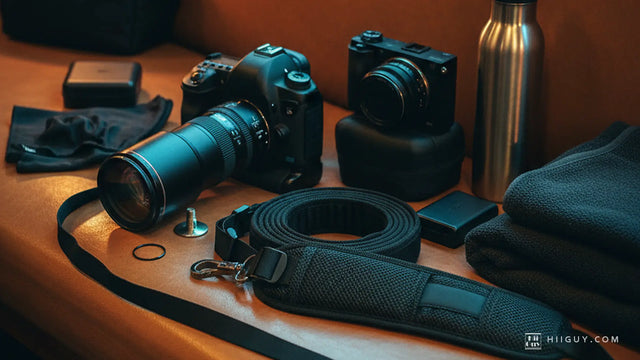
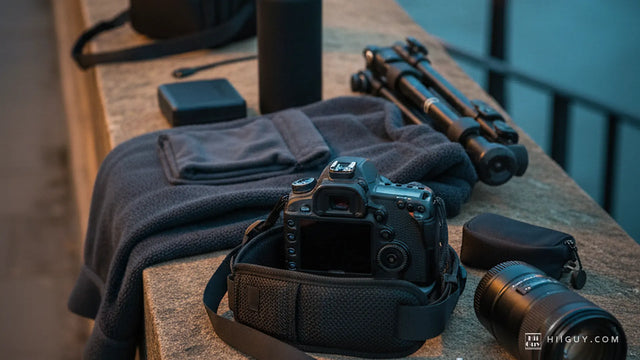
That photograph is from our own shoot and it is a DSLR, eye at the optical finder, exactly the setup this article is about. The HiiGuy strap on his shoulder is heavy-duty polyester webbing running into a wide padded shoulder pad, with a stainless steel quick release at the camera end and rustproof metal fittings, plus a safety tether that clips to a camera eyelet as a second attachment. It comes in two variations that differ only in how far they adjust: the Regular adjusts up to 32 inches on the body, the XXL up to 44 inches. HiiGuy has made camera straps since 2016, out of Los Angeles, and backs this one for three full years.
If what you are really trying to work out is whether a given strap will fit the body you are about to buy, we went through the Canon range body by body in will a camera strap fit your Canon, which covers the R6 Mark II and the Rebels in the same piece.
So: switch, or not
Keep the DSLR if you shoot through the viewfinder, in daylight, with lenses faster than f/8, and you value a thousand-shot day. None of those things get better by spending money. And if the itch is really for a better camera rather than a different mount, a second-hand body in the same family scratches it without buying an adapter and a set of replacement lenses — we wrote the nine things to check before buying a used DSLR for exactly that errand.
Switch if your subjects move and your autofocus is losing them, if you shoot a lot of video, if you compose on the rear screen anyway, or if your lens sits in one of those lower AF groups and you have been quietly putting up with 27 points. Those are the cases where the adapter pays for itself the first weekend.
Do neither yet if the honest answer is that you are bored. A new mount will not fix that, and it costs the price of several lenses to find out.
One last practical note for anyone who is keeping the DSLR for another year or two. Check the shutter count before you commit to it, because that is the component with a finite life and the only one you cannot inspect by looking — how many clicks are too many goes through the numbers. And if you do switch, sell the EF-S lenses rather than adapting them. They are the only part of the bag that genuinely gets worse on the other side.