Two hours into a day out, the back of your neck starts to complain. Not sharply. It is more that you notice the camera is there, and then you keep noticing it, and by the afternoon you are carrying it in your hand because that hurts less. Almost everyone blames the camera. It is usually the Canon Rebel strap that came in the box.
The T7 is not a heavy camera. The published specifications put the body at 16.8 ounces with a battery and a card in it, and the EF-S 18-55mm IS II kit lens adds another 7.1 ounces. That is a shade under a pound and a half for the whole thing. A pound and a half should not be able to ruin an afternoon, and the reason it does has almost nothing to do with the number.
What Canon actually puts in the box
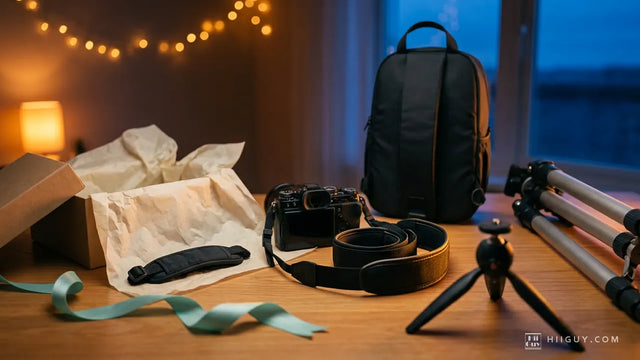
The strap packed with the Rebel T7 is Canon's EW-400D neck strap. Retail listings for it put the webbing at an inch and a quarter wide. It is woven nylon with the camera's name embroidered along it, a plastic buckle at each end, and no padding anywhere along its length.
Canon's own instructions for fitting it are worth reading once, because they explain the strap better than any review does. You pass the end up through the strap mount eyelet from the bottom, fold it over and back through the strap keeper, then run it through the inside of the buckle, pull the slack out, and check the webbing is not twisted before you do the other side. That is the entire mechanism. There is no hardware in it beyond friction.
Which is fine, and it is why the strap costs Canon so little to include. It is also why three specific things go wrong with it.
Why the Canon Rebel strap in the box starts to hurt
An inch and a quarter, with nothing behind it
All of the camera's weight arrives at your body through the contact patch the strap makes, and on a bare inch and a quarter of nylon that patch is narrow and hard. Put the double-zoom kit's EF 75-300mm III on the front, which Canon lists at 16.9 ounces, and you are at roughly two pounds one ounce hanging off that band. The weight has not changed much. Where it lands has.
A neck strap lands it on the two tendons either side of the spine at the base of your neck, which is some of the least forgiving tissue you own. It is not a load problem. It is a pressure problem, and width and padding are the only two things that solve it.
The buckle is a knot, not an adjuster
Because the length is set by threading webbing through a friction buckle, changing it means undoing the thread and redoing it. Nobody does this in a car park. So the strap gets set once, on day one, usually by whoever unboxed the camera, and then it stays at that length forever regardless of whether you are in a t-shirt or a winter coat.
That matters more than it sounds. A strap set for a t-shirt rides high over a jacket and the camera ends up under your ribs. A strap you cannot adjust quickly is a strap you carry badly.
It hangs the camera exactly where your hands are
Worn around the neck, the T7 sits on your sternum. That is directly in the path of your arms when you walk, the thing you lean into when you crouch, and the first object to hit a doorframe. Most people solve this by holding the camera, which puts the strap's one job back in your hand and is the real reason the photographs dry up after lunch.
What changes with width, padding and a crossbody position
Three things, in order of how much they help.
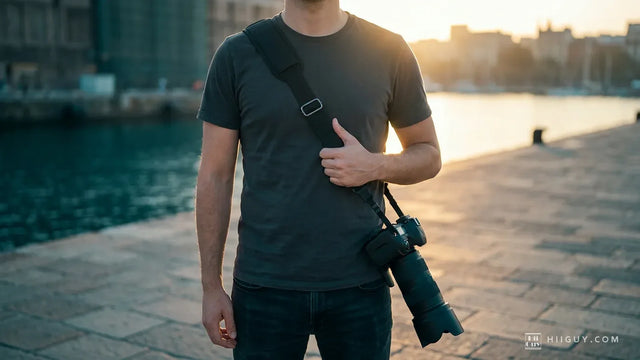
Position first. Moving the strap off your neck and across your body shifts the load to the top of one shoulder and the opposite side of your back, both of which are built to carry things. The camera then hangs at your hip rather than on your chest, out of the way of your elbows, and it stops being something you have to work around.
Then padding. A padded shoulder pad does not reduce the weight by an ounce. It spreads the same weight over a wider, softer area so no single line of it is doing all the work. This is the difference you feel at hour four rather than hour one.
Then length, and only if you need it. A crossbody strap has to be long enough to actually go across you. If you are tall or broad, the standard length of most straps puts the camera up under your ribs instead of at your hip, and no amount of padding fixes a strap that is too short for your frame. We put together a length chart by height for exactly this question.
Worth saying plainly: none of this makes a long lens weightless, and a crossbody strap does not stop the camera swinging if you let it hang loose while you scramble. It moves the load somewhere that can take it. That is the whole claim.
Carrying a Rebel T7 all day

That is what the geometry looks like from behind. The pad is on one shoulder, the webbing crosses the back, and the body hangs at the opposite hip where the swinging arm is not. It is a bigger camera and a much longer lens than a T7 with its kit zoom, which is the point of showing it.
The HiiGuy strap is heavy-duty polyester webbing with a wide padded shoulder pad and a stainless steel quick release that screws into the tripod socket on the base of the camera, with a safety tether running to the standard eyelet as a second path for the load. The quick release is what lets you drop the body onto a tripod without taking the strap off your shoulder. The box also includes a second screw mount, so a friend's body or a second camera takes the same strap.
There are two variations and length is the only difference between them. The Regular adjusts up to 32 inches on the body, the XXL up to 44 inches. Same webbing, same pad, same quick release, same safety tether in both, so the choice is a measurement of you rather than of your camera. HiiGuy has been making these in Los Angeles since 2016 and backs the HiiGuy strap for three full years. See it on Amazon.
Three things to check on the camera first
Before you buy any replacement, spend a minute with the T7 in your hands.
- Both eyelets. The T7 has a strap mount eyelet on each shoulder of the body. Any two-point neck strap uses both. A single-point crossbody strap uses the tripod socket instead and leaves them free, which is where a safety tether goes.
- The tripod socket. It is the standard quarter-inch thread in the base plate. If you already use an Arca plate there, work out which one is living on the camera before you order anything, because both want the same hole.
- What is on the front. A strap decision made with the 18-55mm on is a different decision from one made with the 75-300mm on, and most T7 owners bought the kit with both.
If you are working through the rest of the camera at the same time, we itemised the accessories that actually earn their place on a Rebel T7, including the two popular ones we would skip.
The strap in the box is not a defect. It is the cheapest item Canon could include that still technically works, and for a camera that lives in a cupboard between holidays it is genuinely enough. The moment the T7 becomes the camera you take out for a whole day, it is the first thing in the box worth replacing.