The camera is almost never what ruins a shooting day. Ask anyone who has come home with half the frames they expected and the story is the same shape every time: a battery that quit at the wrong hour, a card that filled up during the only ten minutes that mattered, a smear on the front element nobody noticed until the files were open. The essential camera accessories that decide how a day goes are boring, and nobody photographs them for a gear list.
So this is not a gear list. It is the six things that actually fail, in roughly the order we see them fail, and the cheap fix for each one.
Some of the product links below are affiliate links. HiiGuy may earn a small commission if you buy through them, at no extra cost to you. The HiiGuy strap is our own product and is not an affiliate link.
Failure one: the battery, and it is usually the cold
Published battery ratings are worth reading because they tell you how little they mean. Nikon's own page for the D3500 gives approximately 1,550 shots per charge, measured to the CIPA standard. Nikon's figure for the D7500, a newer and more capable body, is 950. Both are optical viewfinder DSLRs tested the same way, and one lasts nearly 40 percent longer than the other. Nothing on the outside of either camera suggests that.
Then the weather gets involved. Sony's own support note on battery temperature puts the recommended operating range at 32 to 104 degrees Fahrenheit and says plainly that battery performance temporarily declines in cold, reducing how long the pack can be used. Temporarily is the useful word: the capacity comes back when the battery warms up, which is why the single best cold-weather habit costs nothing. Keep the spare in an inside pocket against your body and fit it to the camera just before you shoot, which is exactly what that support note recommends.
The other number nobody checks is the charge time. Nikon's manual for the MH-24 charger puts a flat EN-EL14a at about one hour and fifty minutes at room temperature. That is the real argument for a second battery rather than an early night: there is no version of the day where you top up in fifteen minutes.
The fix is a spare, and a spare that matches your mount. Rebel owners need the LP-E10, and Canon's own LP-E10 is the one we would buy rather than a third-party cell, because a pack that reports its charge level honestly is worth more on a long day than two that do not. Charge both the night before. A spare at 40 percent is a slower version of the same problem.
Failure two: the card is full, or the card is simply gone
Card capacity is easy to underestimate because the file size moves with the scene. Nikon publishes a memory card capacity table for its 24 megapixel DX bodies, and for 14-bit raw it lists about 24.7 megabytes per file, which works out at roughly 743 frames on a 32 gigabyte card. That sounds like plenty right up to the first burst of a kid on a bike, and it halves the moment you shoot raw plus JPEG.
The speed rating is the part that is genuinely misread. A V30 card guarantees 30 megabytes per second of sustained writing, and that is a floor rather than a ceiling. The V scale runs V6, V10, V30, V60 and V90, and the number is always the minimum continuous write speed, not the headline figure on the front of the packet. For stills on a DSLR, V30 is not the bottleneck. For 4K video it is roughly the entry ticket. We took the rest of the markings apart in what the numbers on a memory card actually mean.
Two cheap habits fix most card days. Carry two smaller cards instead of one large one, because a single card holding everything is a single point of failure, and a SanDisk Extreme SDXC is a sensible second. Then give them somewhere to live. A loose card in a pocket is a card in a washing machine eventually, and a JJC MC-SD12 card case solves it for about the weight of a pack of gum. Turn the full ones face down in the case so you never guess which is which.
Failure three: a smear you cannot see until you are home
Front element grease is the quietest failure of the lot. A fingerprint or a bit of sea spray on the glass does not look like anything through the viewfinder. It shows up later as a soft, milky haze across every backlit frame, and no amount of editing puts the contrast back.
Nothing about the fix is clever. A LensPen NLP-1 lives in a pocket and handles the kind of smear a shirt tail makes worse, because a shirt tail is the grit from your last three days being dragged across coated glass. Check the front element every time you change position into the light. Shoot one frame of something bright and flat, a wall or the sky, and look at it at full size once. Thirty seconds, and it is the difference between finding out now and finding out at the desk.
Failure four: dust, and the can of air that makes it worse
Sensor dust announces itself as the same dark speck in the same spot across a whole afternoon, and it gets worse the more you stop down. If you have ever cloned out the same mark on 200 frames, that was dust, and it arrived during a lens change in wind.
The important thing here is what not to do, and the manufacturers are unambiguous about it. Canon's manual says never to use pressurised air or gas to clean the sensor, because the pressure can damage it and sprayed gas can freeze on the surface and scratch it. Canon's recommendation is a plain blower with no brush on it, since a brush can scratch the sensor too. RED goes further in its own maintenance documentation and excludes compressed-air damage from warranty cover entirely. A can of air is the one tool in this article that can turn a cleaning job into a repair.
So the fix is a bulb, and the Giottos Rocket Air Blaster is the one that sits in most working bags. Hold the camera face down with the mirror locked up so gravity is helping rather than fighting you, blow, and stop. If two rounds of that does not shift it, it is stuck, and stuck dust is a wet clean rather than a harder blow.
Failure five: twenty minutes of rain
Most of the cameras this article is about are not weather sealed, and the owners find that out in a shower rather than in a specification. You do not need a storm. Twenty minutes of light rain on an unsealed body is enough to put water into a hot shoe or a card door, and the symptom is usually a camera that behaves strangely for a day and then recovers, which teaches exactly the wrong lesson.
A folded rain cover weighs nothing and takes up the space of a sandwich, and the Altura rain cover two-pack is the version we point people at because having two means one lives in the bag permanently and never gets borrowed out of it. Put it on before the rain starts, not after. Shooting in weather on purpose is a different job with its own kit, and we went through that in accessories for shooting outdoors all day.
Failure six: the thing actually holding the camera
This is the failure nobody files under gear, because when it goes it does not feel like equipment failing. It feels like the day winding down.

Two things go wrong. The first is sudden and rare: the hardware lets go, usually at a split ring that was opening up for weeks before anyone looked at it. The second is slow and common: the strap is uncomfortable enough that the camera ends up in your hand, then in the bag, and the frames stop. That second one costs far more photographs than the first, and it never gets written up as a failure.
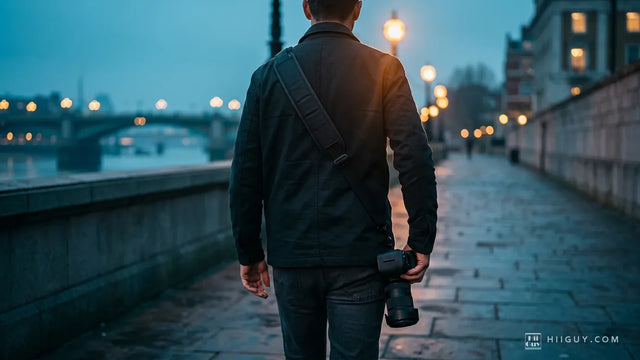
The HiiGuy strap is our answer to both. It is heavy-duty polyester webbing with a wide padded shoulder pad for the comfort half, and a stainless steel quick release into the tripod socket with a safety tether running up to a strap lug for the load-path half, so there are two things holding the camera rather than one. It comes in two variations and length is the only difference between them, the Regular adjusting up to 32 inches on the body and the XXL up to 44 inches. HiiGuy has been making them in Los Angeles since 2016 and backs the HiiGuy strap for three full years. See it on Amazon. Whatever you carry on, the two-minute version of the check is in the strap check before you walk out, and it is worth doing tonight rather than in a car park.
The essential camera accessories nobody photographs
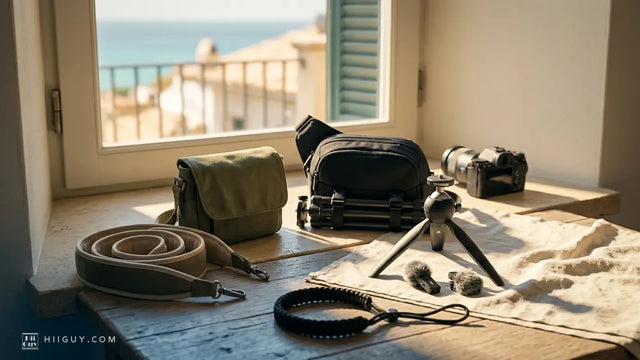
Packed the night before, the whole list fits in a jacket pocket and weighs less than a spare lens.
- A charged spare battery, in an inside pocket in winter, not in the bag.
- A second card, smaller rather than larger, and a case to keep both in.
- A lens pen or cloth, and one bright test frame checked at full size when the light changes.
- A blower, and absolutely not a can of air anywhere near the sensor.
- A folded rain cover that lives in the bag and never leaves it.
- A strap you will still be wearing at hour six, with its hardware looked at before you go.
None of it is interesting and all of it is the difference between the frames you came home with and the frames you meant to take. The camera was fine. It usually is.