Buying a gift for someone who photographs on the move is a narrow problem. They already own the camera. They already own a bag, probably two. And the one thing they cannot accept is another object to carry, because everything they own has to survive a security queue, an overhead bin and a day of walking.
So the test for gifts for travel photographers is simple and it is not about features. Does this thing earn the space it takes up? Six things below pass that test. Every one of them is small, every one of them solves a problem that only shows up away from home, and none of them requires you to know which brand of camera they shoot.
A note on how heavy "light" really is. Canon's own published specifications put the EOS R6 Mark II at 23.6 oz with a card and a battery, and the RF 24-105mm f/4L at another 24.7 oz. That is just over 3 lb before the bag, the spare battery or the water bottle. Every ounce after that is a decision.
Some of the links below go to Amazon, where HiiGuy earns a small commission as an Amazon Associate. It costs you nothing, and it did not decide what went on this list.
1. A strap long enough to wear across the body

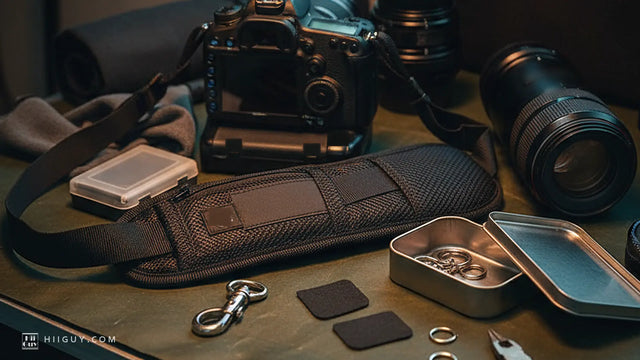
Travel is the situation where a short strap stops being an annoyance and becomes a real problem, because the camera has to share a torso with a bag, a jacket and a passport pouch. The HiiGuy camera strap comes in two variations that differ only in length: the Regular adjusts up to 32 in on the body and the XXL up to 44 in, which is the one to pick for a taller or broader build, or for anyone who wants the camera down at the hip and out of the way of a backpack strap. It is heavy-duty polyester webbing with a wide padded shoulder pad and a stainless steel quick release, so the camera comes off in one movement when it goes on a tripod or into a bag. HiiGuy has made these since 2016 and backs them for three full years.
2. A small canvas bag for the day, not the trip

The bag they packed for the flight is not the bag they want on a Tuesday in a strange city. This compact canvas sling bag is the second one, the small one they take out with a body and one lens while the big bag stays in the room. Canvas with faux leather trim, a flap that opens one-handed and a grab handle on top for lifting it out of a locker. It also has the underrated advantage of not looking like a camera bag, which matters more in a crowded market than any amount of padding.
3. A bag that carries the tripod for them

Carrying a tripod in one hand ruins a walk. This lightweight bag with a tripod holder straps the folded legs under the base so both hands stay free, which is the difference between taking the tripod out for the day and leaving it at the hotel. The shell is water-resistant nylon and polyester, and it wears on one shoulder so it swings round to the front without coming off. If your photographer keeps saying they should have brought the tripod, this is the gift that answers it.
4. A tripod that fits in the bag they already packed

Full-size tripods lose the argument with a carry-on. Delta's published carry-on limit is 45 linear inches, no single side over 22 by 14 by 9 in, handles and wheels included, and a travel tripod eats that allowance fast. This 21.6 inch mini tripod goes in the bag instead: metal legs with rubber feet, a metal ball head, and a phone clamp for the half of travel footage that gets shot on a phone anyway. Stand it on a wall, a café table or a car roof and every night shot on the trip becomes available.
5. A wireless mic, if they film any of the trip

Travel video fails on sound long before it fails on pictures. Wind on a headland, traffic in a street, a restaurant at full volume: the microphone built into a camera or a phone is pointing at the person holding it and picks up all of it. A pair of clip-on wireless lavalier microphones weighs almost nothing, clips to a collar and fixes the problem at the source. The furry windshields in the box are the part people forget, and they are what make a windy clifftop usable.
6. A wrist strap for the days they want both hands

There are days on a trip when a body strap is the wrong tool: climbing something, moving through a packed market, or shooting from a boat where anything hanging loose is a liability. A braided wrist strap keeps the camera locked to the shooting hand and takes up roughly no room in a bag when it is not in use. It is also the cheapest insurance on this list against the single worst thing that happens to a camera on holiday, which is dropping it.
If you are only buying one of them
Buy the strap. It is the only item here they use for every minute of every day of the trip, it is the one almost nobody replaces on their own, and the version that shipped free in the camera box is genuinely the weak link. A camera that rides comfortably at the hip gets carried. A camera that digs into a neck gets left in the room, which is the real reason people come home with fewer photographs than they meant to take.
If you want the next size up in usefulness, the tripod that goes in the bag is the answer, because it unlocks a whole category of photograph rather than improving one they already take.
What not to buy a travelling photographer
Skip anything that has to match their exact camera model, which rules out batteries, lens caps, filters and screen protectors unless you have seen the serial number. Skip a full-size tripod, because a carry-on is a fixed volume and Southwest's roomier 24 by 16 by 10 in limit is still not room for one. And skip a big new camera bag, because the bag is a personal decision they have already made three times.
The pattern behind all six picks is the same: they replace something the photographer is already carrying, or they weigh almost nothing. For the longer version of that argument, see what actually goes in a travel camera bag, and if the problem is comfort rather than kit, the ways to carry a camera all day covers the carrying side properly.