There is a particular ache that shows up around three in the afternoon. It sits on one side of the neck, right where the shoulder begins, and it gets a little worse every time you raise the camera. Most people blame the camera, or the lens, or their posture. It is usually none of those.
The camera strap is too short. Not broken, not cheap, not badly made. Short. The strap that came in the box was cut to suit one build of person, and there is a decent chance you are not that person. It is the one piece of gear almost nobody chooses, and it is the only piece touching you for every minute of the shoot.
Why the strap in the box is the wrong length for most people
A bundled strap has an impossible job. It has to ship with every copy of the camera, fit a huge range of bodies, and cost the manufacturer almost nothing. So it lands in the middle: a loop sized for an average frame, worn the way the diagram in the manual shows it, which is around the neck.
Around the neck is where the trouble starts, because the neck is the worst place on the body to hang weight. Consider an ordinary modern kit. Canon's published specifications give the EOS R6 Mark II as 23.6 oz with a card and a battery in it. Put Canon's RF 24-105mm f/4L on the front, another 24.7 oz on the same spec sheet, and you are carrying a bit over 3 lb. That is not heavy in your hands. Hung from a narrow band across the top of the trapezius for six hours, it is a completely different number.
Spread that same 3 lb diagonally across your back and it stops being an event. Nothing about the weight changed. The path it travels changed, and the path is a function of length.
How to tell your camera strap is too short
You do not need to measure anything. Four signs, and if two of them are true, your camera strap is too short for the way you actually shoot.
The camera sits high on your chest
Stand up straight and let your arms hang. If the camera is parked somewhere around your sternum rather than near your hip, the strap is short. A camera at chest height gets in the way of everything: your arms, your bag, the person you are talking to, and the ground every time you crouch.
You cannot wear it across the body
Try running the strap over one shoulder and down to the opposite hip. If it pulls tight, rides up your neck, or simply will not go, that is the answer. Crossbody carry is not a style choice. It is the one position where the load sits on a broad diagonal instead of on two small patches either side of your spine.
You take the camera off by lifting it over your head
Watch yourself do it. If getting the camera off means ducking out of the loop like a jumper, the strap only just fits. It also means you will not take it off, because taking it off is a nuisance, which is how people end up wearing a camera through lunch.
The pad ends up on your neck
Padding does nothing where there is no pressure. If the padded section keeps sliding up onto your neck rather than sitting on the flat of the shoulder, the strap is too short to hold the pad in the right place. People buy a thicker pad to fix this. The pad was never the problem.
What "adjustable" is actually telling you
Every strap on the market says adjustable. The word on its own means nothing. What matters is what it adjusts up to, and almost nobody prints that number where you can find it before you buy.
This is where we came in, and it is the entire reason the HiiGuy strap exists in the shape it does. It comes in two variations that differ in one respect only. The Regular adjusts up to 32 in on the body. The XXL adjusts up to 44 in, which is the one to take if you are tall, broad, wearing a winter coat, or you simply want the camera down at your hip and out of the way. Everything else is identical between them: the same heavy-duty polyester webbing, the same wide padded shoulder pad, the same stainless steel quick release, the same safety tether.

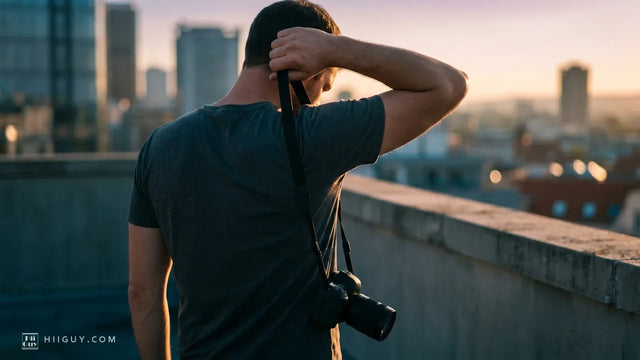
That photograph is one of ours, shot on an ordinary afternoon with our own gear. Look at where the camera is. It is at the hip, held steady with one hand, with the weight of a long telephoto running up a diagonal to the opposite shoulder instead of straight down onto a neck. That is what the extra length buys, and it is not a subtle difference by the end of a day. HiiGuy has been making these since 2016 and backs them for three full years.
Almost nobody searches for this, which is why it keeps happening
Here is the part that surprised us, from our own advertising data rather than anyone's opinion. Across a month of Amazon search term reporting covering 620 real phrases people typed, the two generic terms "camera strap" and "camera straps for photographers" produced 16,980 impressions between them. Every phrase to do with size or length put together, 17 different terms, produced 159.
People are not searching for a longer strap. They are searching for a strap, discovering halfway through the afternoon that something is wrong, and never quite naming it. A sore neck does not announce itself as a length problem. It announces itself as "cameras are heavy" or "I am getting old", and the strap gets a pass because it came with the camera and therefore must be the right one.
If you are tall or broad, this is worth reading next: we went into the sizing side of it in why extra long camera straps matter, including how to work out which of the two variations you want before you order.
What to do this afternoon, even if you buy nothing
You can improve a short strap without replacing it. Let it out to its full length first, because a surprising number of people have never touched the adjusters since the day they unboxed it. Then move the pad so it sits on the flat of your shoulder rather than climbing your neck.
Try wearing it over one shoulder instead of around your neck, even if the camera ends up higher than you would like. One shoulder beats two sides of the neck every time. And stop looping a long strap twice to shorten it, which puts a hard fold of webbing exactly where the pad is supposed to be.
None of that is a fix. It is a way to get through today. The fix is a strap long enough to go where you want it, which is why the length is the first thing to check and the last thing most people think about. If you carry more than one body, or you are weighing up a sling against a plain strap, we compared the options in the ways to carry a camera all day.
The short version
The mistake is not buying a bad strap. It is keeping the one that arrived, wearing it the way the manual drew it, and treating the ache as the cost of doing photography. Take the camera off your neck and put it on a diagonal. If your strap will not let you, that is the whole diagnosis, and you can see the HiiGuy camera strap and its two variations for what a strap that will looks like.