Almost every strap on the market has the words quick release somewhere in the listing, and hardly any of them say what the part actually does. You get a photograph of a black clip, a line about convenience, and no way to tell whether it changes anything about your day.
It does, but only in three specific moments. A camera strap quick release is not a comfort feature and it is not a safety feature. It is a way of separating two things that are normally bolted together: the camera, and whatever is carrying it. Once you look at it that way the rest of the mechanism stops being mysterious, and you can tell in about fifteen seconds whether a given strap solves your problem.
The four parts, in the order they sit
Strip the marketing off and every camera-end release is the same four things.
1. The mount, which stays on the camera
There are only two places on a camera body that anything can attach to: the two lugs at the top corners, or the threaded socket on the base. The socket has been standardised for decades. Nikon's own specification page for the Z8 lists its tripod socket as 1/4 in. (ISO 1222), and you will find close to that same line on nearly any body you pick up, Canon, Sony or Fujifilm.
That sounds like a boring detail. It is the most consequential fact in this whole article, because it is one thread, and only one thing can be screwed into it at a time.
2. The connector, which stays on the strap
This is the metal or plastic end of the webbing: a hook, a clamp, a cinch, whatever the maker chose. It never leaves the strap. If you have ever unclipped a camera and then wondered where the other half went, you were using a badly designed one, because the two halves should always be in obvious places.
3. The release itself
The action, and the only part you will ever think about. A good one works with one hand, in gloves, without looking down, and it does not require you to support the full weight of the body while you fiddle with it. A gate you have to hold open with a thumb while lifting a heavy camera with the same hand is a design that was never tested outdoors in November.
4. The tether
A second line that stays connected whether or not the main release is open. Anything built to let go can let go at the wrong time, so the tether is what turns a mechanical failure into an inconvenience rather than a repair bill. Not every strap includes one, and it is worth knowing before you order rather than after.
One warning on vocabulary. The same phrase gets used for a buckle halfway down the webbing, which splits the strap in two and leaves both ends hanging off the camera. That is a different part doing a different job. Our guide to what to check on any camera strap before you buy covers how to tell the two apart from a listing photograph. Everything below is about the kind that releases at the camera.
Moment one: the camera goes on a tripod
This is the one that sends people looking for a camera strap quick release in the first place, and it comes straight back to that single 1/4 in. socket.
If your strap mounts to the base of the camera, it is in the same hole your tripod plate wants. You cannot leave an Arca-style plate on the body and also have the strap attached. So every switch from handheld to tripod becomes a coin, a screw and a small metal part you are trying not to drop in wet leaves, usually at the exact moment the light is doing something.
A release at the camera end changes the shape of that. The mount stays screwed in, the body comes off the strap, and the strap stays on your shoulder instead of dangling into the frame or getting trodden on. If your mount and your tripod plate are the same part, better still, nothing comes off at all.
The version of this that catches people out is the strap that has no release. You put the camera on the tripod and now there is a loop of webbing hanging off it, swinging in the wind, doing an excellent job of vibrating a two-second exposure.
Moment two: the camera goes in the bag
A strap is a genuine nuisance to pack. Coil it and it takes up more room than it should, leave it attached and it snags on every zip. Most people end up carrying the camera with the strap wound around their hand, which defeats the point of owning one.
With a camera-end release the body goes into the bag clean and the strap either stays on your shoulder or goes flat down the side of the bag. On a travel day, where the camera moves between a bag, a seat pocket and your body ten times, that is minutes rather than seconds saved, and it is a lot less wear on the strap.
Moment three: changing how you carry it
This one is not obvious until you have two bodies or two ways of shooting on the same day.
If the mount is a separate small part, you can put one on each camera. Then one strap serves both, and the swap is a squeeze and a clip rather than unthreading webbing through a lug with your teeth. The same logic applies to switching between a strap and a wrist strap, or handing the camera to someone else without also handing over the thing round your neck. We went through the two-body version of this problem in how to carry two cameras without wrecking your shoulders.
What the release is really holding
Worth doing the arithmetic once, because the numbers are bigger than they feel in the hand.
Nikon lists the Z8 at 32.1 oz. Its announcement for the NIKKOR Z 70-200mm f/2.8 VR S II gives that lens at 998 g, which is 35.2 oz, and that is the light second-generation version, about 26% lighter than the lens it replaced. Put the two together and roughly 4 lb 3 oz is hanging from one clip, before a battery, a card or a filter. Then you walk, and every step briefly makes it heavier.
That is why the material of the release matters more than the look of it, and why a tether is not paranoia. Four pounds of metal and glass does not bounce.
The thirty-second check nobody does
If your strap screws into the base of the camera, that screw is under a small rotational load every time the body swings. It can work loose over months, and it does it quietly.
Once a month, before you go out: nip the screw finger tight, open and close the release a few times listening for grit or slack, and pull hard against the tether to confirm it is attached to something independent of the main mount. A tether that loops through the same point as the release is decoration. The whole check takes less time than charging a battery.
How the HiiGuy strap handles it

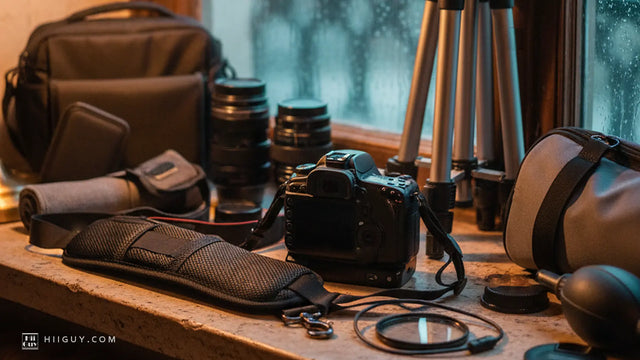
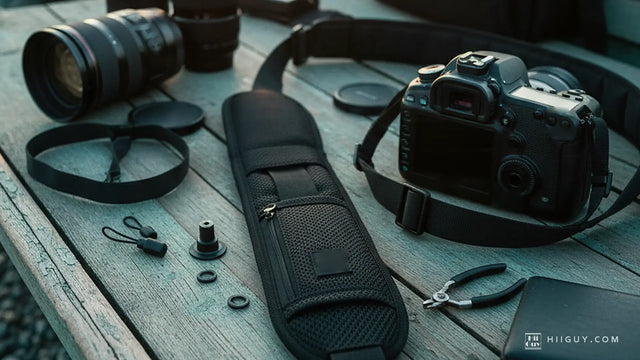
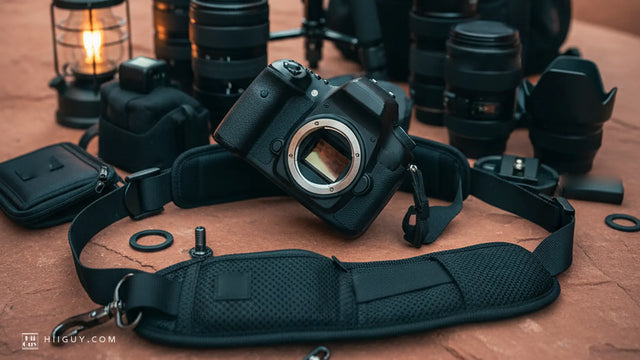
That photograph is one of ours, and the hook you can see hanging below the body is the whole mechanism. The HiiGuy strap puts a stainless steel quick release at the camera end, so the body separates and the strap stays on your shoulder. It screws into the tripod socket, the safety tether goes on the standard eyelet so it is holding a different point from the release, and there are two screw mounts in the box rather than one, which is the second-body trick from moment three. Heavy-duty polyester webbing carries the load into a wide padded shoulder pad, with rustproof metal fittings at the ends.
It comes in two variations that differ in nothing except how far they adjust. The Regular adjusts up to 32 inches on the body and the XXL adjusts up to 44 inches, so the camera can sit at hip height whatever your build. HiiGuy has been making these since 2016 and backs the HiiGuy strap for three full years.
So do you need one
If you shoot handheld, never use a tripod and keep the camera out all day, honestly no. The release earns nothing and is one more part to maintain.
If you use a tripod even occasionally, travel with the camera, or shoot with two bodies, it stops being a feature and starts being the thing that removes a small annoyance from your day fifteen times. That is the honest test, and it has nothing to do with how the clip looks in a thumbnail.