The Rebel T7 is a very honest camera. Canon's published specifications give it a 24.1 megapixel APS-C sensor, a DIGIC 4+ processor, nine autofocus points with one cross-type point in the middle, 3 frames a second, and a native ISO range of 100 to 6400. It shoots 1080p at 30 frames a second, the screen is a fixed 3.0-inch panel with 920,000 dots and no touch, and the whole thing weighs about 16.8 ounces with a battery and a card in it.
None of that is a complaint. It is a list of exactly where the camera stops, which is the only sensible way to choose Canon EOS Rebel T7 accessories. Every pick below is here because it answers a specific line in that spec sheet, and there are two popular ones at the bottom that we would tell you not to bother with.
Some of the links below are affiliate links, which means we earn a small commission if you buy through them. It costs you nothing and it does not change what we recommend. The HiiGuy strap is our own product, not an affiliate link.
1. A 50mm f/1.8, because the kit lens runs out of light first
The camera tops out at ISO 6400 in its normal range, expandable to 12800 if you go looking for it in the menu. The kit lens is an EF-S 18-55mm f/3.5-5.6 IS II, and at the long end that f/5.6 is what puts you at the ceiling in a restaurant, a gym or a church hall.
The fix is not a better body. It is a lens that lets in about two and a half stops more light than the kit zoom does at 55mm. Canon's EF 50mm f/1.8 STM, out since 2015, weighs 5.6 ounces, focuses down to 1.15 feet, and has a rounded seven-blade aperture, which is what makes the out-of-focus background look smooth instead of hexagonal. On the T7's APS-C sensor the 1.6x crop makes it behave like an 80mm lens, which is a portrait length rather than a walk-around one. That is worth knowing before you buy it expecting a general-purpose lens.
See the EF 50mm f/1.8 STM on Amazon
2. A second LP-E10 battery
The T7 takes the LP-E10, an 860 mAh pack, and Canon rates it at roughly 600 shots through the viewfinder with no flash, or about 500 with flash half the time. That is a genuinely good number for a day of stills.
It is a bad number the moment you shoot video or spend the afternoon in live view, because the rear screen is the thing that drains it. And the T7 charges its battery out of the camera in a separate charger, so there is no plugging it into a power bank at lunch to claw back an hour. A spare in the bag is the whole answer, and it is the cheapest insurance on this list.
See the Canon LP-E10 on Amazon
3. One good UHS-I card, not three cheap ones
Buy a single reliable SD card and put your whole trip on it rather than rotating four no-name cards you do not trust. A SanDisk Extreme 128GB SDXC card is rated to 180 MB/s read and 90 MB/s write, which is far more than this camera will ever ask of it, and that headroom is the point: the card is never the thing that slows you down or drops a file.
Worth saying plainly, because it saves money: the T7 shoots at 3 frames a second and its buffer runs to about 150 JPEGs or 11 RAW frames. Any modern UHS-I card clears that easily. You are not buying speed here, you are buying a card that comes back from a holiday with everything still on it.
See the SanDisk Extreme SDXC on Amazon
4. A strap you will actually leave on it

The strap in the T7 box is a neck strap with the camera's own name printed on it, and it is about the length of a neck strap from 1995. Put the 50mm on the front and it is fine. Put a telephoto on it, or carry it for six hours, and the weight sits on the two tendons at the back of your neck, which is why so many people end up holding the camera in their hand instead and taking fewer pictures.
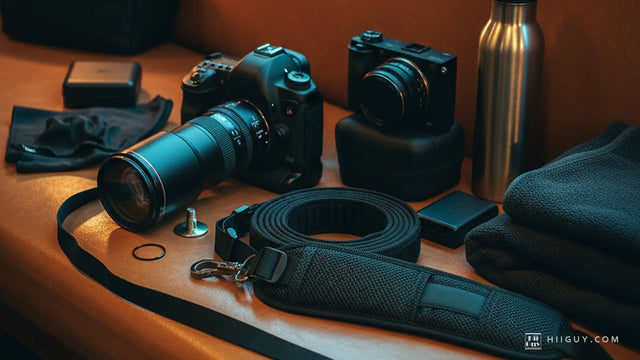
The HiiGuy strap is long enough to wear across the body, which moves the load onto your shoulder and your back. It uses a stainless steel quick release at the camera end, a screw mount into the tripod socket, and a safety tether as a second route for the load. Heavy-duty polyester webbing, a wide padded shoulder pad, rustproof metal fittings. HiiGuy has been making these in Los Angeles since 2016 and backs the HiiGuy strap for three full years.
There are two variations, and the only difference is how far each one adjusts: the Regular adjusts up to 32 inches on the body, the XXL up to 44 inches. If you are tall or broad, that is the one that decides whether the camera lands at your hip or up under your ribs. If you want to work out which way you carry best before spending anything, we laid out seven ways to carry a camera all day.
5. A wired remote switch
The T7's shutter runs from 1/4000 of a second to 30 seconds, plus bulb. Everything past about a second is where the remote earns its place, because pressing the shutter button by hand puts a shake into the frame at exactly the moment you were trying to avoid one.
Canon's RS-60E3 is the remote switch this body takes. It is a wire with a button, it needs no battery and no pairing, and it half-presses to focus like the shutter button does. There is no intervalometer built into the T7 and no touchscreen to drive one, so for long exposures and bulb work this is the simple route rather than the clever one.
See the Canon RS-60E3 on Amazon
6. A tripod tall enough that you use it
Follow the remote with something to put the camera on. The mistake almost everyone makes on their first tripod is buying a short one, discovering it only reaches chest height, and leaving it in a cupboard. A tripod you have to stoop over is a tripod you stop carrying.
The VICTIV aluminum tripod reaches 74 inches, which is head height for most people, and it comes with its own carry bag and a phone holder. Aluminum rather than carbon fibre means it is heavier to carry and cheaper to replace, which is the right trade at this end of the market. The T7's base has the standard 1/4-20 socket, so any tripod plate on the market fits it.
See the VICTIV 74-inch tripod on Amazon
7. A 58mm circular polarizer
The last one is the only filter worth owning early, and it is the only accessory here that does something you cannot do afterwards in software.
A circular polarizer cuts reflected glare. Water goes from a white sheet to something you can see into, wet leaves stop shining, paint and car windows lose their hotspots, and a blue sky deepens on the axis away from the sun. The kit 18-55mm IS II takes 58mm filters, so that is the size to buy, and the front element of that lens rotates as it focuses, which means you set the polarizer after you have focused rather than before.
It costs you light, usually between one and two stops, so it belongs on the camera outdoors and comes off indoors.
See the K&F Concept 58mm polarizer on Amazon
Two things not to buy for a Rebel T7
Both of these get recommended constantly in accessory lists, and neither one works on this body.
A UHS-II memory card. The faster pins on a UHS-II card have nothing to talk to here, and the camera's 3 frames a second and 11-frame RAW buffer were never going to stress a UHS-I card anyway. The card will work, at UHS-I speed, and you will have paid for the difference.
An external microphone. This is the one that catches people out, because every video accessory bundle includes a shotgun mic. The Rebel T7 has no 3.5mm microphone input. A mic on the hot shoe has nowhere to plug in. If you want better sound out of this camera, record separately on a phone or a recorder and line the audio up afterwards, or accept the built-in mic for what it is.
If you are only buying one
Buy the 50mm. Nothing else on this list changes what the photographs look like, and the gap between f/5.6 and f/1.8 is the difference between the T7 feeling like a camera that struggles indoors and one that does not.
Buy the strap second, because it is the accessory that decides whether the camera comes with you at all, and a camera in a drawer takes no pictures regardless of what is on the front of it. If you bought your T7 used, it is also worth knowing how many shutter actuations are too many on a used DSLR before you spend anything else on it.
The battery and the card are the boring pair you should own before a trip rather than after one. The remote, the tripod and the polarizer are for when you know which kind of photography you actually keep coming back to, and there is no rush to find that out.