Here is what usually happens. The camera arrives, you shoot about two hundred frames in the first week, and then you go looking for what else you need. An hour later you have a cart with fourteen things in it, four of which will never come out of their packaging, and you still have not bought the one item that would have changed your photographs.
So this is a DSLR starter kit written as a list with an order to it. Not forty accessories. Nine, bought in sequence, each one justified by what it actually does. If you stop after three you will still have a working kit, which is rather the point.
Some of the links here are affiliate links, which means a commission comes back to us if you buy through one. The order of this list was set before any of that and is not for sale. Our own strap is linked directly to our listing, not through an affiliate tag.

First, what the box already gave you
Before buying anything, know what you have. A new DSLR normally ships with the body, one zoom lens in the 18-55mm range, a battery, a charger, a body cap, and a thin neck strap with the brand printed down it. Occasionally a very short USB cable.
That is a complete working camera. The kit zoom in particular gets more abuse than it deserves. It is sharp enough at the middle apertures, it covers the range most people shoot, and the reason to replace it is not quality, it is that it cannot open wide enough to blur a background or to work indoors without a flash. Keep it. You will go back to it more than you expect.
What the box does not give you is any redundancy, any comfortable way to carry the thing, and any way to clean it.
The DSLR starter kit, in the order to buy it
1. Two memory cards, not one
Buy two cards before you buy anything else, and buy them smaller rather than one big one. The reason is not storage, it is that a card is the only part of this kit that can lose work that already exists. Everything else that fails costs you the shots you have not taken yet. A card that fails costs you the ones you already took.
Two cards also means you stop deleting in the field, which is where most genuinely good frames get killed. The SanDisk Extreme SDXC is the sensible default. SanDisk's published rating is 180 MB/s read and 90 MB/s write, and it carries the V30 mark, which is the one that actually matters because it describes sustained writing rather than a burst. Video needs sustained writing. So does a long burst of stills.
2. Somewhere for the cards to live
This sounds like a joke purchase until the first time you are kneeling in gravel patting your pockets. A JJC MC-SD12 card case holds twelve SD cards in a rubber-sealed polycarbonate shell, measures about 5.63 by 3.23 by 1.1 in, and weighs 4.7 oz. Put the empty cards face up and the shot ones face down and you never have to remember anything again.
3. A strap you will actually leave on
The strap in the box is the first thing most people replace, and it is third on this list only because the cards come first. A camera you are not comfortable carrying is a camera that stays at home, and no lens fixes that.
Two things make the difference. Width, because pressure is force spread over area and a narrow band concentrates the whole weight into a line across your neck. And length, because a strap long enough to wear across the body puts the camera at your hip instead of swinging off your throat.
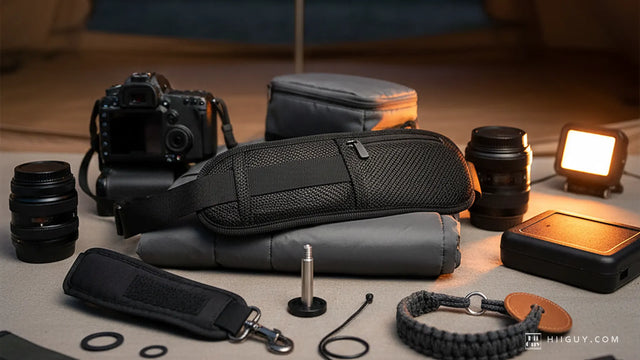
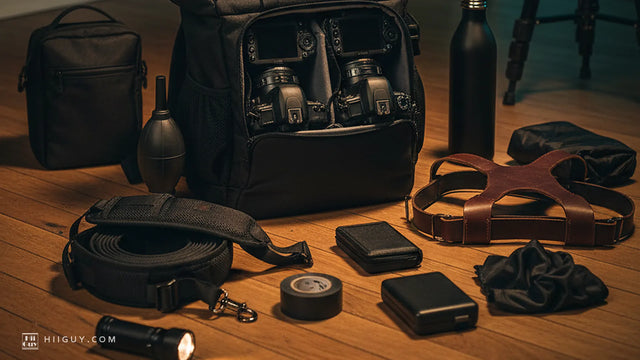
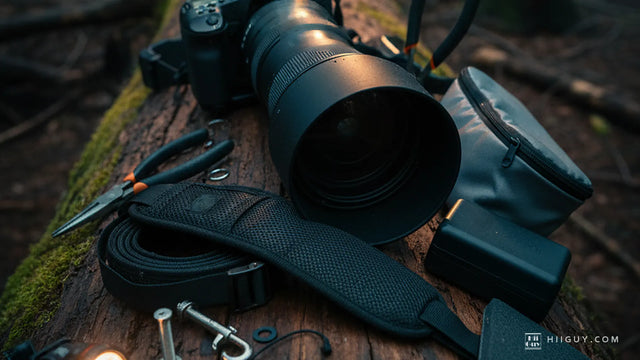
The HiiGuy strap is heavy-duty polyester webbing with a wide padded shoulder pad, a stainless steel quick-release hook and rustproof metal fittings, and it mounts with a 1/4-20 screw into the tripod socket on the base of the body. It ships with a safety tether that clips to a camera eyelet. It comes in two variations and length is the only difference between them: the Regular adjusts up to 32 in on the body, the XXL up to 44 in. HiiGuy has been making these since 2016 and backs the HiiGuy strap for three full years. The product page lists what is in the box.
The photograph above is one of ours, taken on an ordinary afternoon rather than in a studio. Notice how far down the body sits. That is the hip carry, and it is the whole argument for a long strap in one image.
4. One fast prime lens
This is the purchase that changes your photographs rather than your convenience, and if you only ever buy one thing on this list, buy this one.
A 50mm f/1.8 does two things the kit zoom physically cannot. It opens about two and a half stops wider, which is the difference between a usable indoor frame and a blurred one. And at that aperture the background goes soft, which is most of what people mean when they say a photo looks professional.
Canon's own published data for the EF 50mm f/1.8 STM gives it as 5.6 oz (160 g), with six elements in five groups, a 49mm filter thread, seven circular aperture blades and a closest focusing distance of 1.15 ft (0.35 m). Those seven rounded blades are why out-of-focus highlights come out round rather than heptagonal. Nikon shooters want the AF-S NIKKOR 50mm f/1.8G, which Nikon publishes at 6.6 oz with the same seven-blade diaphragm.
On a crop-sensor DSLR a 50mm frames tighter than it does on film, closer to a short portrait lens than a standard one. That is not a problem, it just means stepping back a little indoors.
5. A spare battery
Find your battery's designation before you shop, because the number on the cell is the only thing that matters and it is printed right on it. Canon's entry bodies use the LP-E10 or the LP-E17 depending on generation. Nikon's use the EN-EL14a or the EN-EL15c.
Worth knowing: the shot count on the box is a CIPA figure, and CIPA measures a DSLR through the optical viewfinder with the rear screen off. Shoot the way most people actually shoot, chimping every frame and using live view, and you will see a fraction of that number. The published figure is not a lie, it is just measuring a discipline you do not have yet.
6. A blower, and nothing else for cleaning
Most beginner cleaning kits are a bottle of fluid, a cloth and a brush, and the brush is how dust gets dragged across a front element. Start with air. The Giottos Rocket Air Blaster in the large size is 7.5 in long, 2.4 in across, silicone rubber, with a one-way intake valve in the base so it refills through the bottom instead of sucking the dust it just blew off back in through the nozzle. The nozzle comes off for cleaning.
Ninety per cent of what lands on a lens is loose dust, and loose dust should be blown off, never wiped. Save wiping for fingerprints, and only then.
7. A cable release
Cheap, small, and it solves a problem people usually try to solve by buying a heavier tripod. Pressing the shutter button shakes the camera. At anything slower than about a thirtieth of a second, that shake is visible.
Canon's RS-60E3 has a 2 ft cable, a 2.5 mm sub-mini plug and a two-stage button that locks down, so it half-presses to focus exactly like the shutter button and holds open for long exposures. Check which socket your body has before buying, because the plug type varies by model even within one brand.
8. A bag that holds the kit you now own
Buy the bag after the gear, never before. You cannot size a bag for a kit you have not finished assembling, and almost everyone buys one too big and then carries the extra space around.
For a body, two lenses and the small items above, a compact backpack is enough. Ours is a lightweight camera backpack with a water-resistant nylon and polyester shell and an external tripod holder, around nine litres, which is the size that still goes under an aeroplane seat.
9. A tripod, when you are ready for it
Last, deliberately. A tripod is the accessory most often bought first and used least, because it only earns its place once you are shooting something specific: long exposures, low light, landscapes at the ends of the day.
When you get there, the number to check is the load rating against the weight of your heaviest combination, not the height. Our 74 in aluminium tripod is rated to 9.5 lb and comes with a carry bag and a phone holder, which covers any DSLR with a normal zoom on it with plenty of margin.
What to leave out of a DSLR starter kit
The list is as useful for what is not on it.
- A UV filter for protection. It is an extra air-to-glass surface in front of a lens you paid for sharpness. Use the hood, which protects against impact better anyway and costs nothing if it came in the box.
- A big bundled accessory kit. The ones with a bag, a tripod, filters and a flash in one box are built to a price, and the price is spread across nine items. Three of them will be fine and six will be landfill.
- A second zoom that overlaps the first. If you already have 18-55mm, a 24-70mm equivalent buys you almost nothing. Go wider, go longer, or go faster.
- A flash, for now. Not because flash is bad, but because a flash used badly is worse than no flash, and the f/1.8 lens solves the same low-light problem with no learning curve.
The kit, itemised
Nine lines, in order:
- Two memory cards
- A card case
- A strap that fits you
- A 50mm f/1.8
- A spare battery, by designation
- An air blower
- A cable release
- A bag sized to the finished kit
- A tripod, once you need one
If you are still choosing the body itself, or buying it second hand, it is worth knowing what a shutter count actually tells you before you hand over any money. And if you want the shorter version of this list aimed at the very first week, we wrote that up separately as the photography essentials for beginners.
The honest summary is that a DSLR starter kit is three purchases and six conveniences. Cards, a strap, a fast prime. Everything after that makes the hobby smoother, but those three are the ones that change what comes out of the camera.