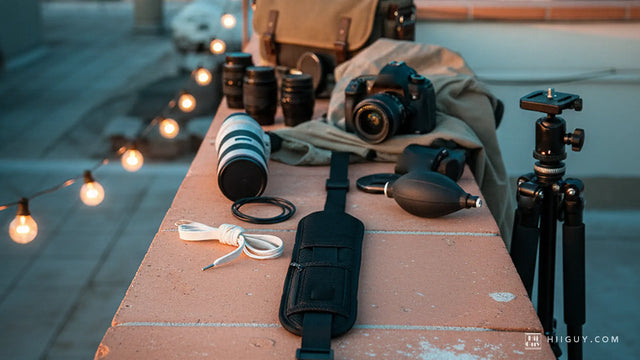
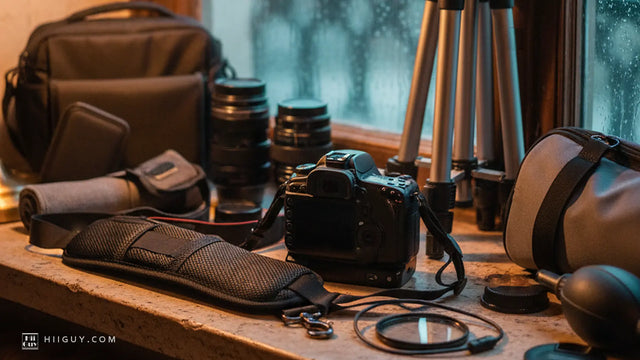
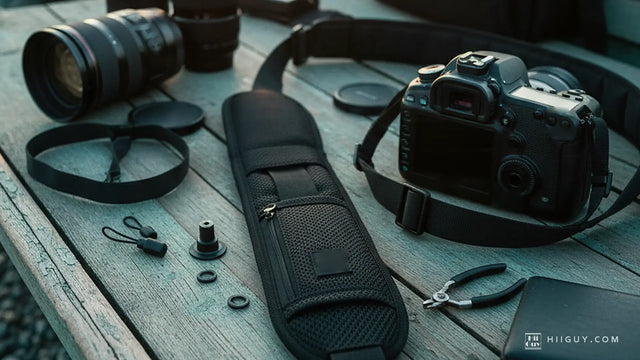
You notice it about forty minutes in. The body was fine. The lens was fine. Bolted together and hanging off the thin band that came in the box, the pair of them have turned into a dull ache that starts at your collarbone and spreads sideways, and you have started hooking a thumb under the webbing every few steps to take the weight off for a second.
A heavy duty camera strap is not just a thicker version of the kit one. The problem it solves is a different problem. Once the lens outweighs the body, the camera stops being the thing you are carrying and becomes the small end of a see-saw, and that changes three things at once: where the strap should attach, how long it should hang, and how wide it has to be where it crosses you.

Run the numbers before you blame the strap
Most people carrying a long lens have never actually weighed the rig, and the ratio is the part that surprises them. Here is what the manufacturers publish.
- Nikon's own online manual gives the D7500 as 1 lb 9.4 oz (approximately 720 g) with battery and memory card.
- Nikon publishes the AF-S NIKKOR 200-500mm f/5.6E ED VR at 81.2 oz, or 2,300 g, and 10.5 in long.
- Sigma publishes the 150-600mm F5-6.3 DG OS HSM Contemporary at 68.1 oz (1,930 g).
- Tamron's published specification for the SP 150-600mm F/5-6.3 Di VC USD G2 in Canon fit is 70.9 oz (2,010 g), and that figure already includes the detachable tripod mount.
Put the Nikon body and the Nikon 200-500 together and you are hanging 106.6 oz, a shade over 6 lb 10 oz, off one shoulder. The useful number is not the total though. It is the ratio. The lens weighs 3.2 times what the body weighs. Everything that feels wrong about carrying that rig comes out of that one number.
Why the kit mounting points stop working
A camera body and a lens are joined by one thing, the bayonet mount, and it is a few square inches of metal with a locking pin. That mount was designed to hold a lens in place while you shoot. It was not designed as a structural hanger.
So think about what happens depending on where the webbing is clipped.
Hang it from the body and the lens dangles off the mount
Attach at the strap lugs or at the body's tripod socket, and the body is the thing the strap is holding. The lens, all 5 lb of it, is then hanging off the bayonet, swinging on it every time you duck under a branch. It will almost certainly survive. It is still the wrong way round, because you have made the lightest, most precisely machined joint in the whole rig into the one carrying the most weight.
Hang it from the lens and the body becomes luggage
Attach at the lens collar instead and the load path gets short and sensible. The strap holds the lens near its own balance point, the lens holds itself, and the body hangs off the back of it where it weighs almost nothing by comparison. Nothing is cantilevered off the mount.
This is not a theory somebody invented on a forum. It is why the collar is in the box in the first place. Sigma's published description of the TS-71 socket that ships with the 150-600 Contemporary says in as many words that it is detachable, allowing the lens to be carried by itself. Tamron ships a detachable tripod mount with the 150-600 G2 and counts its weight in the headline figure. The lens makers already decided which end of this rig should take the load.
Where a heavy duty camera strap should actually attach
There is a happy accident in all of this, which is that the threads are the same everywhere. Nikon lists the D7500's tripod socket as 1/4 in., ISO 1222 (0.635 cm). That is the same thread on the bottom of nearly every camera made in the last sixty years, and it is the same thread you will find in the foot of a lens collar. A strap that screws into a tripod socket does not care which socket it is.
So the rule is short:
- Lens lighter than the body. Lugs or the body socket, whichever you prefer. Either is fine.
- Lens roughly the same as the body. Body socket. The rig balances lens-down and sits flat against you.
- Lens heavier than the body, and especially much heavier. The collar foot, every time.
If the whole socket-versus-lugs argument is new to you, we went through it properly in tripod socket or strap lugs, including what the evidence for socket failure really amounts to.
The one thing to check on the foot
Lens feet vary. Some have a single 1/4-20 socket, some have 1/4-20 and 3/8-16, some have an Arca dovetail with the threads sunk into it. Turn the lens over and look before you buy anything, because a foot with a clear, unobstructed 1/4-20 hole takes a screw-mount strap straight away, and one with the threads buried under a dovetail may want a plate in between.
Width is not a luxury once the rig is this heavy
Pressure is force divided by area, and that is the whole of it. The pounds do not change when you swap straps. What changes is how many square inches of you they are spread across. Take the same six and a half pounds off a narrow band and put it on a pad three times as wide, and the pressure at any one point on your shoulder falls to roughly a third. Nothing clever is happening. You just stopped concentrating the load into a line.
Length matters for a reason people get backwards. A longer strap does not make the rig lighter, it moves it. Worn short, a long lens rides across your chest and knocks into you when you walk. Worn long enough to sit at your hip, lens pointing down, it tucks behind your arm and stays there. That is the carry you want with heavy glass, and it is also the carry that needs the most webbing, which is where a lot of people run out of adjustment.
How the HiiGuy strap handles a long lens
The HiiGuy strap is heavy-duty polyester webbing with a wide padded shoulder pad, a stainless steel quick-release hook and rustproof metal fittings, and it mounts with a 1/4-20 screw into a tripod socket. Because the thread is the standard one, that screw goes into a lens collar foot exactly as happily as it goes into the base of a body, which is the whole point of this article. It also ships with a safety tether that clips to a camera eyelet, so the rig has a second path to you if you ever manage to unscrew the mount without noticing.
It comes in two variations, and length is the only difference between them. The Regular adjusts up to 32 in on the body and the XXL adjusts up to 44 in. For a hip carry with a long lens, start at the longer end of whichever you have, because the extra inches are what let the lens hang behind your arm instead of across your front. There is a length chart if you want to work it out against your own frame rather than guess, and the product page lists what is in the box. HiiGuy has been making these since 2016 and backs the HiiGuy strap for three full years.
The photograph above is one of our own, shot on a working day rather than in a studio. Look at where the hand is. She is not supporting the camera, she is just lifting the webbing off her shoulder for a moment, and that small unconscious gesture is the thing a wide pad is supposed to make unnecessary.
Three habits that save your shoulder more than any strap
Gear only gets you part of the way. These cost nothing.
- Swap shoulders on purpose. Not when it starts to hurt, before. Every time you stop to shoot is a free opportunity to put it back on the other side.
- Carry the lens hood reversed on the walk in. Four inches less overhang is four inches less pendulum, and the hood is doing nothing while the camera is at your hip anyway.
- Take it off when you stop. Standing still with 6 lb hanging on one trapezius for twenty minutes while you wait for a bird is worse for you than the walk was. Put it on the bag.
The short version
Weigh the lens. If it is heavier than the body, move the strap to the collar foot and stop asking the bayonet mount to be a hook. Get the webbing wide enough that the load spreads instead of digging, and long enough that the lens hangs at your hip rather than across your ribs. Then swap shoulders before you need to.
None of that is expensive and none of it is complicated. It is just three decisions that most people never make on purpose, and they are the difference between a long lens you take with you and a long lens that stays in the cupboard.