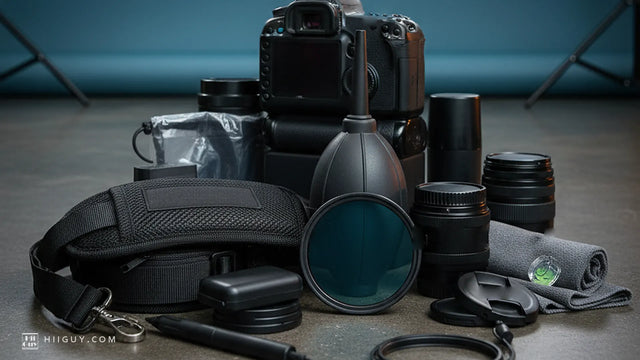
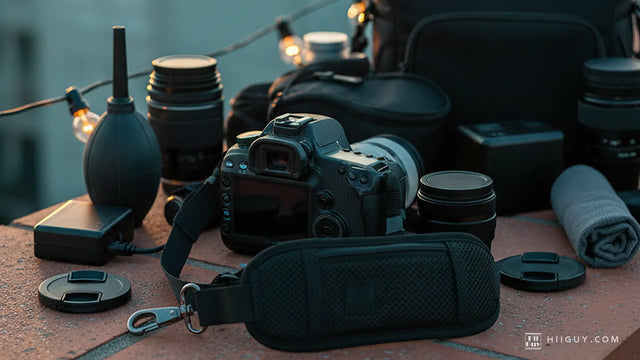
Most Nikon D850 accessories lists are the same list with a different camera name at the top. Spare battery, cleaning kit, bag, SD card, done. That list is written from habit, not from the camera, and on this body habit gets two of the four wrong.
So here is a different approach. Every item below is justified by a figure Nikon publishes for this specific camera, in its own reference manual for the D850, and if a popular accessory cannot be justified that way it is either further down with the reason or not here at all.
Some links below go to Amazon and we earn a commission if you buy through them. The HiiGuy strap is our own product. Nothing was paid to appear on this list.
First, the thing almost every list gets wrong: this camera takes two different cards
The D850 has two slots and they are not the same shape. Nikon's specification sheet lists the media as XQD and SD, including SDHC and SDXC cards compliant with UHS-II. One of each. If you own one SD card and a drawer full of spares, half this camera is empty.
What you do with the second slot is a real decision, and Nikon spells out the options: either card can be the primary or the backup, or the two can split the job with raw files going to one and JPEGs to the other, and images can be copied across afterwards. For a wedding or anything else that happens once, backup is the only sane setting, and it is the whole reason a second slot is worth paying for.
Size and speed follow from the file sizes, which Nikon also publishes. A large 14-bit lossless compressed NEF off this sensor is about 51.6 MB. On the 64 GB card Nikon used for its own capacity table you get 589 of them, and the buffer runs to 51 frames before the camera starts waiting on the card. Drop to 12-bit lossless and the same card holds 763 frames with a 170-frame buffer. Those are the numbers to budget against, not a guess at how many pictures a day feels like.
Nikon's guidance on speed is specific too, and it is framed around video: XQD cards with a write speed of 45 MB/s or better are recommended for movie recording, and on the SD side it asks for UHS Speed Class 3 or better. Below that, recording can simply stop mid-take.
See the Nikon 64GB XQD card on Amazon
See the Lexar 2000x UHS-II SDXC card on Amazon
If the symbols printed on the front of a card mean nothing to you, we decoded them in what the numbers on memory cards actually mean.
1. A card reader that accepts both formats
This is the accessory nobody warns you about and everyone ends up buying twice. Two card formats in the camera means two card formats on your desk, and most readers handle one of them. You either keep two readers in the bag or you buy one with both slots in it and stop thinking about it.
It is worth getting a reader rather than cabling the camera to the computer. The D850's USB port is a Micro-B connector, which is a small, old, easily wiggled fitting to hang a shoot off, and the camera is burning battery the whole time it transfers.
See a 2-in-1 XQD and SD card reader on Amazon
2. A battery grip, but only if you actually need the ninth frame
The D850 is usually described as a 9 frames per second camera. It is not, on its own. Nikon's own table is unambiguous: on the camera's internal battery, continuous high tops out at 7 frames a second. Nine is available only with an EN-EL18c battery sitting in the MB-D18 battery pack, and that combination also needs the BL-5 battery-chamber cover and an MH-26a charger, neither of which comes in the box with anything.
So the grip is not a comfort purchase on this body, it is a performance part, and two extra frames a second is either worth that stack of parts to you or it is not. If you shoot portraits in vertical orientation the second argument is the controls: Nikon puts a shutter release, an Fn button, an AF-ON button, a multi selector and both command dials on the pack, so a tall frame stops being an awkward wrist.
Nikon's own MB-D18 is not easy to find new any more. The third-party pack below describes itself as an MB-D18 equivalent and quotes the same two speeds, 7 frames a second on AA or EN-EL15 cells and 9 with an EN-EL18 and the BL-5 cover, which is at least the right pair of numbers.
See a D850 vertical battery grip on Amazon
3. A circular polarizer, and never a linear one
This is the only accessory in the manual that comes with a prohibition. Nikon states plainly that the D850 cannot be used with linear polarizing filters and that you should use a C-PL or C-PLII circular polarizer instead. Nikon does not explain why and the manual does not need to. A linear polarizer looks identical to a circular one on a shelf, it was perfectly normal on film bodies, and it turns up constantly in secondhand filter bundles. Read the ring for the letters C-PL before anything goes on the front of this camera.
Two more notes from the same page, both useful and neither widely repeated. Nikon recommends Neutral Color filters for protecting the lens rather than a generic UV filter, and it recommends not using a filter at all when the subject is framed against a bright light or a bright source is inside the frame, because that is when ghosting appears. And with any filter that has an exposure factor above 1x, which includes every polarizer and every ND, Nikon recommends center-weighted metering.
Match the thread size to the lens you own, not to the camera. The filter below is 77mm, which covers a lot of the standard Nikon full-frame glass, but check the number printed on your lens cap first.
See a 77mm circular polarizer on Amazon
4. Something to fire the shutter that is not your finger
The D850 goes to 30 seconds on the dial and then offers bulb and time on top of that, which is a camera built for long exposures. What it does not have is a way to start one without touching it.
The port for that is the ten-pin remote terminal on the front of the body, and Nikon names the two cords that fit it: the MC-30A, a plain trigger release on a cord Nikon lists at 2 feet 8 inches, and the MC-36A, the multi-function version of the same thing. There is also a wireless route, the WR-R10 receiver on the ten-pin terminal through a WR-A10 adapter with a WR-T10 in your hand, which doubles as the controller for radio flash. For most people a cord is the honest answer, because it has no pairing and no firmware.
See the Nikon MC-30A remote release on Amazon
5. A strap that suits 2 pounds 3.5 ounces
Nikon's figure for this body is 2 pounds 3.5 ounces with a battery and an XQD card in it, and 2 pounds 0.3 ounces for the bare body. That is before a lens. It is also why the very first step in the D850 manual, ahead of the battery and ahead of the card, is attaching the strap securely to the camera eyelets. Nikon considers it step one and then puts a thin nylon ribbon in the box.
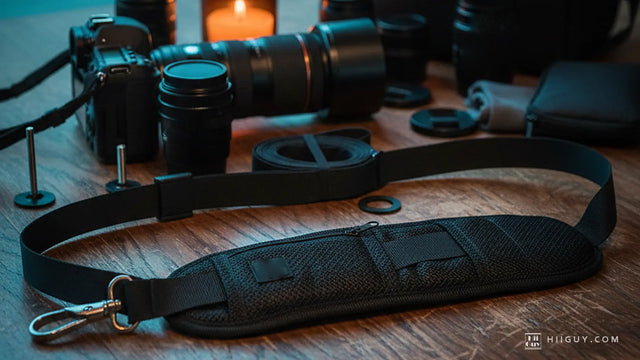
The HiiGuy strap goes on differently. It hangs off the tripod socket, which Nikon lists as a 1/4 inch thread to ISO 1222, on a screw mount with a stainless steel quick release above it. That puts the camera nose-down beside your leg rather than flat against your sternum, and lets you lift it to your eye without unclipping anything. The safety tether then goes to one of those eyelets, so a single screw is not the only thing between a heavy body and the ground. A wide padded shoulder pad spreads the weight, which matters more than usual when a long lens is on the front, and the webbing is heavy-duty polyester. HiiGuy backs the strap with a 3 year warranty.

It is made in two variations that are identical apart from how far each adjusts: the Regular up to 32 inches on the body, the XXL up to 44 inches. Put a grip under a D850 and a long lens in front of it and the rig hangs lower and further from your body than a size chart implies, so if you are between the two, the longer one is the safer call. Details are on the HiiGuy camera strap page, and if you are putting serious glass on this body we wrote separately about carrying a heavy telephoto lens.
The spare battery everyone puts first, and why it is last here
Nikon rates one EN-EL15a at approximately 1,840 shots to the CIPA standard in single-frame release, and approximately 4,030 shots in continuous release by its own test. That is a full wedding on one cell, and it is why the spare battery that heads every other D850 accessories list is not the first thing this camera needs. Buy one eventually. Buy the second card first.
Nikon also publishes what eats that figure, which is more useful than the figure itself: using the monitor, holding the shutter button halfway, repeated autofocus, shooting NEF or TIFF rather than JPEG, slow shutter speeds, leaving Wi-Fi and Bluetooth on, and running VR on the lens. If your battery life looks nothing like 1,840 frames, the cause is on that list rather than in the battery.
The Nikon D850 accessories that are deliberately not here
No sensor cleaning kit. The camera has an image sensor cleaning function built in and Nikon's own dust remedy is reference data captured in software, so the swabs and pens are a decision to make later and carefully, not a day-one purchase.
No bag, because a bag is a function of what else you carry and no spec sheet can choose it. No tripod here either, though the socket is a standard 1/4 inch and the shutter range above is the argument for one.
Three real Nikon accessories that did not make the five but are worth knowing exist: the EP-5B power connector with an EH-5c adapter, if the camera lives in a studio and you would rather run it from the wall; the WT-7 wireless transmitter, for shooting tethered to a computer over a network; and the DK-19 rubber eyecup, which is a small thing that makes the viewfinder noticeably easier to live with. None of those is a first purchase, and none of them is on this list because somebody paid for it to be.
If you want to get more out of the body itself before spending anything, start with the D850 settings guide instead.