The lens that is on your camera is a solved problem. The lens that is not on your camera is the one that ruins the day. It starts in your left hand, moves to a jacket pocket where it bangs against your hip, then gets zipped into a bag you have to take off your back every time you want it, which means after an hour you stop changing lenses at all. That is what a photographer lens holder is actually for, and it is why the search is more common than the gear press suggests.
Some links below go to Amazon, where HiiGuy earns a small commission if you buy through them. It costs you nothing, and nothing is here because of it.
Five ways to carry one spare lens, in the order we would try them. They are judged on hour three rather than on the feature list, because every one of them works fine for the first twenty minutes.
First, the honest limit nobody puts on the box
One spare lens on your body is comfortable. Two is manageable. Three is a bag, and you should stop pretending otherwise.
This matters because most of the kit below scales on paper and not in practice. A belt will take six pouches. Load six pouches and it drags your waistband down, swings when you crouch, and catches on every door handle. We have shot with this gear since 2016 and the number we keep coming back to is two: the one on the camera, and one more within reach. Past that, the honest answer is a backpack and a plan, which we laid out in what is actually in a working photographer's bag.
So: pick the lightest option that holds one lens well, not the system that holds four badly.
The coat pocket, and exactly when it stops being fine
It is free and it is faster than anything you can buy, so it deserves a fair hearing rather than a sneer.
A small prime, a pancake, a 50mm, lives in a jacket pocket perfectly well. The pocket is already there, it is at hand height, and nothing swings. For a short walk with a nifty fifty in reserve, this is the correct answer and buying anything else is spending money to feel organised.
It stops being fine at three points. When the lens is heavy enough to pull the coat sideways. When the rear element is bare and your pocket contains keys. And when it rains, because a coat pocket is not a dry place and a rear element is an expensive thing to fog. If any of those three apply, move on to the pouch.
A padded pouch, the one most people should buy
A single padded cylinder with a belt loop is the unglamorous answer, and for one spare lens it is usually the right one. It costs little, it weighs almost nothing empty, and it threads onto the belt you are already wearing.

Two things decide whether a pouch is good. The first is how it attaches: a belt loop that has to be threaded through your waistband before you put the belt on is a pouch you will leave at home, so look for a loop that opens, or a clip. The second is fit. A pouch a size too big lets the lens rattle and tip, which is worse than no pouch, because you stop trusting it and start holding it anyway.
Measure the lens with the hood reversed on it, which is how it will actually travel, and buy for that. This JJC pouch set comes in a range of diameters with a shoulder strap in the box, which covers the awkward case where the pouch is too big to hang off a belt comfortably. If you would rather sort it in one purchase, the Amazon Basics set of four soft lens cases gives you a range of sizes to find the right one and keeps the rest for storage.
A modular photography belt, if you are working rather than walking
A proper photo belt moves the load off your shoulders and onto your hips, where your legs carry it. At a wedding or an event, where you are on your feet for eight hours and both hands need to stay free, this is a genuine upgrade rather than a gadget.
The appeal is that nothing has to come off. There is no bag to swing round, no zip to open with one hand while the other holds a camera. Everything hangs at waist height in a known place. The Lowepro ProTactic Utility Belt III is the obvious modular version, with a sliding attachment system that takes lens cases along its length.
Two warnings, both earned. A belt system only makes sense if you already own, or will buy, the pouches that attach to it, and those are rarely included. And a loaded belt is miserable on a hike. The weight sits exactly where a backpack's hip belt wants to be, and the two fight each other. For a day out on foot, this is the wrong tool.
A lens holder that clips to your strap, and the objection it earns
This is the category people mean when they type "photographer lens holder" into a search box. A small double-sided mount that hangs off your strap or belt, with a lens bayoneted onto each end, so swapping is a twist and a twist rather than a zip and a rummage.
It is genuinely the fastest way to change a lens. You put the lens coming off the camera straight onto the free side, take the one you want off the other, and you have never opened anything. For event and wildlife work where the moment is gone in four seconds, that is the entire argument.
Now the objection, which owners raise themselves and it is fair: the lens hangs by its own bayonet mount, the same mount designed to hold it onto a camera body, and it swings. The lens mount is a load-bearing part, so this is not absurd, but it is also not what most people fear. Retail listings for the Lens Flipper quote a published capacity of 200 pounds, and the mount it copies is the same one that holds a 70-200mm onto a camera all day. The real risk is not the mount shearing. It is a lens that was not twisted fully home, and the fix is a habit: feel the click, then tug it once.
One more caveat worth saying out loud. These are mount-specific. A Canon EF version does not take an RF lens, so check which mount you are buying before you order.
A small sling, for the people who hate things on their belt
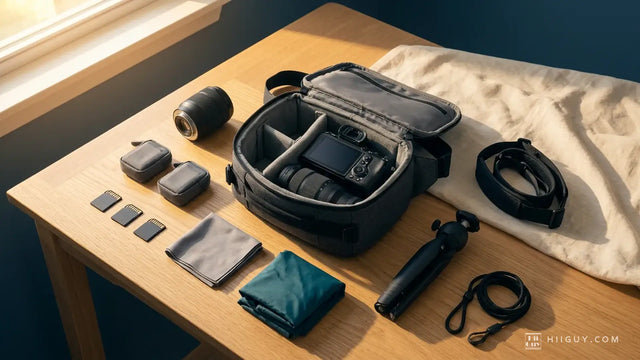
If a belt rig sounds like cosplay and a pouch on your waistband annoys you, a small sling bag is the compromise. It rides on your back, swings round to your front in one motion, and holds a spare lens with room for a battery and a card.

That inset is the whole pitch: the bag comes round to the front and opens flat, so the lens swap happens at chest height instead of on the ground. A sling sized for one camera and two lenses is about the largest you want for this job. Bigger ones stop swinging round cleanly and become a backpack you wear wrong.
The honest downside is that it is still a bag with a zip, so it is slower than a holder and slower than a pouch. What you get back is that your waist stays clear and nothing is dangling.
What the second lens does to the first one

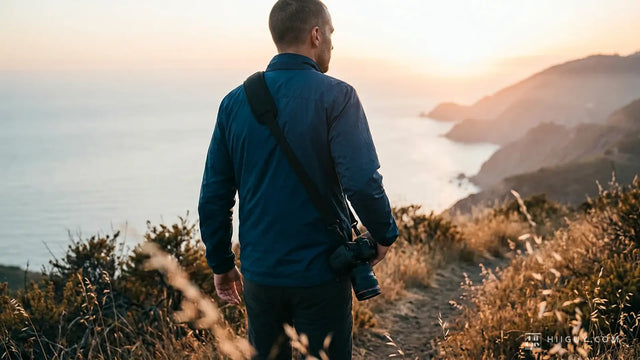
Something that gets missed in all of this: the moment you add a second lens to your body, the strap carrying the first one matters more. You now have weight on a shoulder and weight at your waist, and if the camera is hanging off a thin band across the back of your neck, that is the thing that gives out first, not the pouch.
The HiiGuy strap is heavy-duty polyester webbing with a wide padded shoulder pad and a stainless steel quick release, with a safety tether as a second path for the load. Worn across the body it puts the camera at the opposite hip, which also keeps it clear of a pouch or holder riding on the same side. There are two variations and length is the only difference: the Regular adjusts up to 32 inches on the body, the XXL up to 44 inches. See it on Amazon. If the lens that stays on the camera is the heavy one, carrying a heavy telephoto covers that half of the problem.
So which one
One small prime in reserve and a jacket on: the pocket, and spend nothing. One normal lens and a day out walking: a padded pouch on your belt, and this is most people. Fast swaps where seconds decide the shot: a clip-on holder, with the habit of tugging the lens after you seat it. Eight hours on your feet at an event: a belt, if you will also buy the pouches. Anything you would rather not wear on your waist: a small sling.
And if you find yourself reaching for the third pouch, that is the bag talking. Listen to it.