The D850 is the camera Nikon built when it stopped compromising. Forty-five point seven megapixels with no low-pass filter, 153 autofocus points, two card slots and a sealed body rated for 1,840 frames on a charge. It is still, years later, the most capable DSLR anyone made.
It is also the heaviest camera we cover at 1,005 g, and that is the honest trade. Everything below is specific to this body.
What it is good at
45.7 megapixels, and no low-pass filter. The most detailed sensor Nikon put in a DSLR. It rewards good glass and punishes a soft lens just as clearly.
Two card slots. XQD and SD together. Every frame written twice, which is the difference between a professional tool and an enthusiast one.
1,840 shots on a charge. Nearly double what most full-frame bodies manage. One battery genuinely covers a wedding.
Best settings, by situation
These are starting points calibrated to this camera's actual range. Adjust for your lens, your light and how fast your subject is moving.
Landscape and detail work
Mode A · f/8–f/11 · ISO 64 · live view focus · 2-second timer
ISO 64 is the D850's base, not 100, and it is the cleanest this sensor ever gets. On a tripod there is no reason to be anywhere else. Focus in live view on the touchscreen rather than through the finder: at 45.7 megapixels, a focus error you would never see on a 24-megapixel body is obvious at 100 per cent.
Portraits
Mode A · f/1.8–2.8 · ISO 64–400 · AF-S, single point on the near eye
With 99 cross-type points there is a usable point almost anywhere in the frame, so you can place focus rather than focus-and-recompose. That matters more here than on most bodies, because at this resolution recomposing at f/1.8 moves the plane of focus enough to see.
Wildlife and sport
Mode S · 1/1000 s or faster · Auto ISO, cap 6400 · AF-C · CH burst
Seven frames a second is not the fastest here, but 45.7 megapixels means you can crop hard and still print. Treat the resolution as reach. Write speed matters: the XQD slot clears the buffer noticeably faster than the SD one, so put your primary card in XQD.
Low light and events
Mode A · widest aperture · Auto ISO, cap 12,800 · highlight-weighted metering
Native ISO tops out at 25,600, and the expanded settings above that are best left alone on a sensor this dense. Both slots recording the same frames is the reason this body ends up at weddings.
Three things to know before you buy
All three are verified, and each one matters to a different photographer.
It weighs 1,005 g
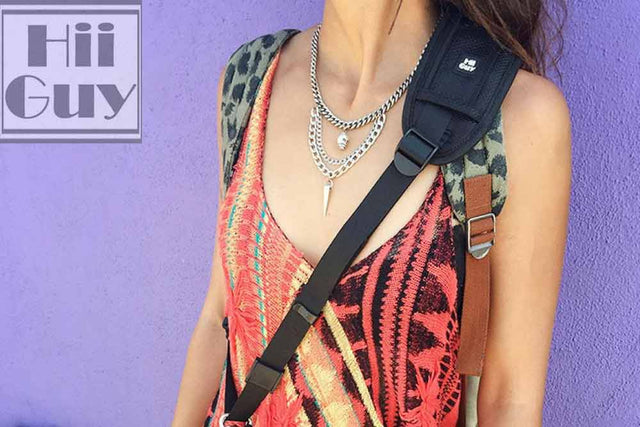
With battery and card, before any lens. Add a fast zoom and you are past two kilos on one shoulder. This is the body where a padded strap stops being optional.
No in-body stabilisation
Stabilisation lives in the lens on this system, so an unstabilised prime gives you none of it.
XQD cards cost more
One of the two slots takes XQD, which is faster than SD and noticeably more expensive per gigabyte.
Who it is for
- Landscape and studio work
- Wedding and event professionals
- Wildlife and sport
- Commercial and studio
- Not for carrying a camera casually all day, video-led creators.
Carrying it all day
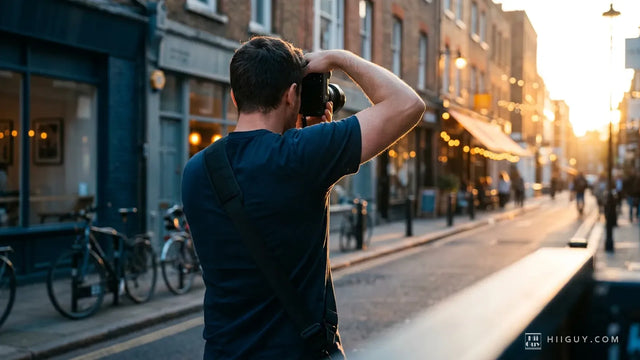
At 1005 g before a lens, this is one of the heaviest bodies in current use. Add a fast zoom and you are past two kilos hanging off one shoulder for as long as you are out.

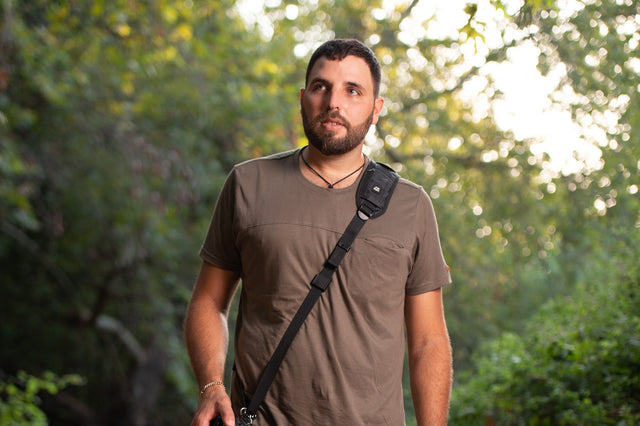
A cushioned shoulder pad spreads that load instead of concentrating it on one point, which is the difference between a camera you carry and one your back remembers the next morning.
Our strap comes in two lengths, 32" and 44". Same strap, same quick-release clips, same safety tether in both — the XXL is simply longer, for photographers who are tall or broad and find every standard strap rides too high. It is a measurement of you, not of your camera. See it on Amazon, backed by a 3-year HiiGuy warranty.
Nikon D850 — key specifications
| Sensor | 45.7 MP Full frame |
| Lens mount | Nikon F |
| Native ISO | 100 - 25,600 |
| Burst | 7 fps |
| Autofocus | 153 points |
| Video | 4K UHD 30p |
| Card slots | 2 |
| Battery | 1,840 shots (CIPA) |
| Weight | 1005 g with battery and card |
| Dimensions | 146 x 124 x 78.5 mm |
| Weather sealing | Yes |
| Announced | 2017 |
Specifications verified against the published data on 7 September 2026.
The full comparison table, an honest read on who this body suits and who should look elsewhere, and the manufacturer's own video are all on the Nikon D850 page.
If you are also considering
Almost nobody is choosing between this camera and nothing. These are the bodies it actually gets compared against.
- Nikon D780 — the same sensor size for less money, and twelve frames a second
- Canon EOS 5D Mark IV — the Canon working professionals chose instead
- Nikon D7500 — if 1,005 g turns out to be more than you want to carry
Every camera we cover is in the camera guides, and the specifications above can be checked against the independent database at DPReview.
Where to buy it
We do not sell cameras. If this is the right body for how you shoot, check the current price on Amazon. Prices move often enough that publishing one here would only ever be wrong.
As an Amazon Associate, HiiGuy earns from qualifying purchases. The camera link above is an affiliate link; the HiiGuy strap is our own product.