Ask what is in a photographer's bag and you usually get a list of lovely objects. Ask someone who gets paid to be somewhere, and you get a shorter list with stranger things on it, because the bag is not a collection. It is a set of answers to the question "what do I do when this fails".
That is the whole difference between a bag packed for a trip and a bag packed for a job. On a trip, a dead battery costs you an afternoon. On a job, it costs you the thing you were hired for, and there is no coming back next Tuesday to shoot the ceremony again.
This article contains affiliate links to products sold by other brands on Amazon. If you buy through them, HiiGuy may earn a small commission at no extra cost to you.
Everything in a photographer's bag answers one question
Pick up each item and ask what happens if it breaks, and whether you could keep working.
A spare lens cap fails that test, which is why it never makes a working kit. A second memory card passes it instantly. The gear that survives the question is rarely the gear that photographs well on a desk, and that is the honest reason these lists look so different from the ones on social media.
Work through the bag in that order and the packing more or less does itself.
Two bodies, or one body and a written plan
A second body is the single most expensive line in this article and the one professionals argue about least. It is not there to give you a second focal length. It is there so that a camera failing at 2pm is an inconvenience rather than a refund.
If a second body is not realistic yet, the substitute is not nothing, it is a plan you have written down: who you can borrow from locally, what you would shoot the rest of the day on, and what you would tell the client. Say it out loud before the day, not during it.
Where two bodies change the bag most is in how you carry them. Hanging both from separate straps means they swing into each other and into you every time you turn. A dedicated harness puts one at each hip with the weight across both shoulders, and the dual camera harness we list is built for exactly that: leather with a satin lining and metal fittings, both cameras sitting at your sides and ready, so changing a focal length costs you a hand movement instead of a lens change. It is sold by another brand through its Amazon listing.
Cards, and the menu setting almost nobody changes
Here is the part of this list that costs nothing and protects the most.
If your camera has two card slots, it almost certainly came set to overflow, meaning it fills the first card and then starts on the second. Nikon's own documentation for the D850 describes that option plainly: the secondary card is used only when the primary card is full. Useful for capacity. Useless for safety, because every frame still exists in exactly one place.
The same menu has a backup option, and Nikon's wording for it is the entire argument: each picture is recorded to both the primary and secondary card. Writing twice is marginally slower and uses a little more power. It also means a card failing on a paid job is an annoyance rather than a disaster. On a shoot you cannot repeat, change it before you leave the house.
What to look for on the card itself
Buy for sustained write speed rather than the large number on the front. The "up to" figure on the label is a burst reading. The one that governs whether the camera stalls mid-sequence or drops video frames is the Video Speed Class the SD Association introduced in 2017, printed as a V with a number. A card marked V30 guarantees a minimum sustained sequential write of 30 MB per second. It is a floor, not a limit, and a floor is what you want when the buffer is full and the moment is still happening.
Carry several smaller cards instead of one large one, and swap at a natural break. A failure then costs you part of a day rather than all of it. Shot cards go somewhere that is not the camera bag, ideally in a pocket on your body.
Batteries, and why the number on the box is not your number
Manufacturers publish a shots-per-charge figure measured to the CIPA standard, and it is a genuinely useful number as long as you know what it describes. The test takes a single frame every thirty seconds, leaves the camera switched on between frames, turns it off after ten shots, and repeats that cycle.
Nobody works like that. Nikon rates the D850 at roughly 1,840 shots per charge in single-frame release under that standard, and lists in the same manual what pulls the figure down: using the monitor, holding the shutter button halfway, repeated autofocus, shooting raw, and running vibration reduction. A working day is made almost entirely of those five things.
So treat the published number as a ceiling you will not reach. Two spares per body for a full day is a reasonable floor, three if there is video in it, each in its own pouch so the contacts never meet keys or each other. Charge the night before, not the morning of.
The bag itself, and the one specification that matters
Everything above has to come out fast, with one hand, while you are standing up.
That rules out most beautiful bags. What you want is side or back-panel access to the camera compartment without putting the bag on the ground, because on a job the ground is usually wet, carpeted with other people's cables, or forty feet from where you need to be.
Two shapes work. A sling you can swing round to your front suits tight venues and short days, and the nine-litre water-resistant sling we list measures 14.56 by 5.1 by 7.5 inches, takes one DSLR, two lenses and a battery, has a tripod holder on the side, and turns into a plain day bag with the divider removed. It is sold by another brand on Amazon.
For a longer day with more in it, a roll-top backpack that opens flat against your back carries better and keeps the opening against you in a crowd. The roll-top pack in our catalogue is nylon with a TPU coating, has quick side access to the camera plus a back panel that opens fully, takes a 16-inch laptop in its sleeve, and includes a rain cover. It is also sold by another brand through its Amazon listing.
Weather, which is not optional on a paid day
A hobbyist waits for better light. On a job you shoot in what you are given, and your gear has published limits that are easy to find and easy to forget.
Nikon states the D850's operating environment as 32 to 104 degrees Fahrenheit, at 85 percent humidity or less with no condensation. That bracket covers most working days in the United States and quietly excludes a January morning in the north, a dashboard in July, and the inside of a greenhouse. A rain cover and a couple of microfiber cloths weigh almost nothing and are the difference between carrying on and packing up.
The other weather item is a tripod, and on a working day it earns its place for group shots and anything after sunset rather than for landscapes. The aluminium tripod we list stands 74 inches, which is tall enough to shoot over a row of heads, and holds up to 9.5 pounds. It is sold by another brand on Amazon.
Carrying it once you are working

Once you are on site the bag is mostly a base camp. The camera lives on you, and that is a different problem from packing.
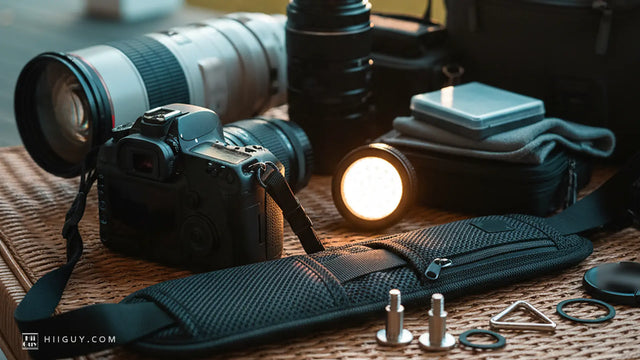
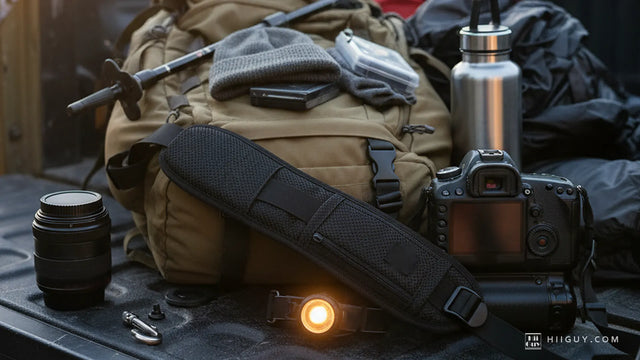
Look at the hardware in the photograph above, from one of our own shoots. The strap stays connected while he works, and the metal release sits right there under the body, which is what lets the camera come off for a tripod and go back on without hunting for anything. The HiiGuy strap is heavy-duty polyester webbing with a wide padded shoulder pad, a stainless steel quick release, and a safety tether sitting behind that release as a second connection for exactly the moment you are reaching over a railing.
It comes in two variations, identical apart from length. The Regular adjusts up to 32 inches on the body and the XXL adjusts up to 44 inches, which matters more than it sounds on a working day, because crossbody over a jacket needs noticeably more webbing than crossbody over a shirt. HiiGuy has made the strap since 2016 and backs it for three full years. You can see both variations on Amazon.
The unglamorous half, which is the half that saves jobs
- Gaffer tape, a short roll wound onto a pen. Tapes down a cable, blacks out a reflection, holds a backdrop. Never leaves residue.
- Two microfiber cloths. One stays clean for glass, one does everything else. They are not interchangeable after the first wipe.
- A rocket blower. Thirty seconds of air beats an hour of cloning out sensor dust later.
- A card reader and a cable. So a laptop that is not yours can still take your files.
- A small torch. For finding a dropped screw, and for throwing enough light to focus by.
- Water and something to eat. Six hours in, this is a gear item.
What is deliberately not in it
The third lens you packed last time and did not fit. Every filter you own, when you use one. A second charger for the same battery. The big flash, if you have been shooting available light all year and will again. Each of those fails the opening question: nothing breaks if you leave it at home.
If you are building towards this rather than working already, start from the photography essentials list, and pack this bag the night before. Lift it, walk a lap of the room with the camera on your shoulder, and take one thing out.