Two straps, roughly the same money. One is a leather camera strap, stitched and handsome, the kind that looks like it belongs on a film body. The other is flat black webbing with a pad on it. Nothing on either label tells you which one will still be comfortable at four in the afternoon, or which one will look like garbage in three years.
The labels are not much help because they mix two different things together. Here is what each material actually does on a shoulder, what it costs you, and the one piece of standard leather care advice that conservation science says to stop doing.
"Padded" is not a material, and that mix-up costs people money
There is a trap in the title of this piece, so let's open with it. Leather, nylon, polyester and cotton are materials. Padded is a construction.
Padding is whatever sits between the load-bearing part of the strap and your shoulder. Any of those materials can be padded or unpadded. A leather strap can have a thick shoulder section or be a plain flat band. Webbing can run bare across your neck or carry a wide pad.
You can see the confusion in what people actually type into Amazon: "padded camera strap", "camera strap leather", "camera strap nylon", "wide neoprene camera strap", "soft padded camera strap". Half of those name a fabric and half name a feeling.
So it is two questions, not one. What is the strap made of, and what is between it and you. Get those separated and the rest of this is straightforward.
Nylon and polyester look identical and do not behave the same
This is the comparison nobody can make by eye. Both are black woven webbing. On a product photo they are the same object.
The difference is written down in an industry that has to care about it. Lifting slings are made from the same two fibres and they are load rated, so the suppliers publish comparison tables. One such published fibre table gives these figures:
| Property | Nylon | Polyester |
|---|---|---|
| Moisture absorbed | 9% of its weight | 1% of its weight |
| Strength when wet | loses 15% of rating | no loss from moisture |
| Stretch at working load | 6 to 10% | 3 to 4% |
| Stretch at breaking point | 16 to 20% | 10 to 12% |
| Sunlight | considerable strength loss over time | better UV behaviour |
One honest caveat before you use that table. Those stretch percentages are measured at a sling's working load, which is hundreds of pounds. Your camera is three or four pounds. Nothing on your shoulder is anywhere near those numbers, and a nylon camera strap is not going to sag 8% while you walk. What transfers is the ranking and the reason for it, not the magnitude.
The ranking is what you want anyway. Nylon takes on water and polyester mostly does not, which is the difference between a strap that dries on the walk back and one that sits damp on your collarbone for the rest of the afternoon. Nylon gives more under load, so it is the softer, slightly springier feel. Polyester holds its length, which is why an adjustment you set in the morning is still the adjustment you have at dusk.
Sunlight is the one most people never think about. A camera strap lives outdoors, in direct sun, for its whole working life. Very little other webbing you own does.
The leather camera strap, and the care advice that turns out to be wrong
People buy a leather camera strap for how it looks and how it ages, and that is a completely legitimate reason to buy anything. Just buy it knowing what leather is.
Leather is a material with opinions about its environment. The Canadian Conservation Institute, which publishes the guidance museums use to keep leather objects alive for a century, recommends a stable relative humidity of 45% to 55%. Below 30% RH, its note says, leather loses moisture and becomes brittle. Above 65% you get mould growth and hydrolytic degradation of the leather fibres.
The word doing the work there is "stable". The same note says RH fluctuations may produce a progressive hardening of vegetable tanned leather. Not one bad day. The swings themselves do the damage, slowly.
Now think about where a camera strap actually lives. A hot car. A damp bag after a morning in drizzle. A closet with the heating on all winter. It is close to the least stable life any leather object you own will ever have.
The part that contradicts what you have been told
Here is the finding worth the price of admission. The conservation institute's position is that applying leather dressings and saddle soap is now not generally recommended as a treatment for leather. Its note says research has shown dressings are generally not effective in preserving leather, that applied oils can dehydrate the leather and increase stiffness unless the oil content is known to be too low, and that saddle soap is highly alkaline, which degrades leather.
So the twice-a-year ritual of rubbing conditioner into a leather strap, which every leather goods seller recommends, may be doing the opposite of what you think it is doing. The conservators' advice is to handle and store the thing well and leave the oils alone.
None of this means do not buy leather. It means a leather strap is a thing you look after, and looking after it is mostly about where it sleeps, not what you rub into it.
Cotton, canvas and the waxed version
Cotton canvas is the heritage option, and it is genuinely pleasant against skin in a way synthetic webbing is not. Soft from new, no break-in period, no plasticky edge.
Its problem is simple and you can guess it. Cotton holds water. A cotton strap caught in rain stays wet long after a synthetic one has dried, and it carries that wet against your neck and shirt for hours. It also picks up and keeps sweat, which over a few summers is how a pale canvas strap turns grey at the shoulder and stops going back.
Waxed cotton is the answer the outdoor trade arrived at a century ago. The wax fills the weave so water runs off instead of soaking in. The trade-offs are real: wax transfers onto a light shirt in hot weather, the finish wears at the fold points, and eventually you re-wax it or accept that it has stopped repelling anything.
Buy cotton because you like how it looks and how it ages. That is a good reason. Just do not buy it expecting it to be the one you grab on a wet day.
Neoprene, and why stretch cuts both ways
"Wide neoprene camera strap" is a phrase people type often enough that it is worth answering directly. Neoprene is foam rubber, and it is chosen for one property: it squashes.
Under load it compresses and spreads the weight over a wider contact patch, which is exactly what you want on a bare shoulder. It is the most immediately comfortable material in this list the moment you put it on.
The catch is that the same elasticity works in the other direction. An elastic strap under a hanging weight extends and recoils as you move, so the camera keeps bobbing slightly after you stop walking. With a light mirrorless body that reads as cushioning. With a heavy body and a long lens it reads as a camera that will not settle, and it is a reason some people find a stretchy strap unexpectedly annoying on a telephoto day.
Neoprene is also bulky. It does not fold flat, and it does not pack small.
What the padding is actually doing
Padding is not comfort magic. The mechanism is pressure, and pressure is load divided by area.
The same four pounds pressed through a half-inch band concentrates on a narrow strip of your trapezius. Spread across a two-inch pad, the same four pounds is the same four pounds, but the pressure at any one point drops a long way. That is the entire trick, and it is why width does more for comfort than softness does.
Two things follow. A pad only helps where it is sitting, so a pad that has slid round toward your back is decorative. And soft thin padding is worse than firm wide padding, because soft thin padding compresses to nothing and you are back to a band on bone.
If you want the rest of the buying checklist, we went through it in 4 things to check on any camera strap before you buy, and the metal parts get their own treatment in the hardware on a camera strap is what scratches your camera.
What we chose, and why

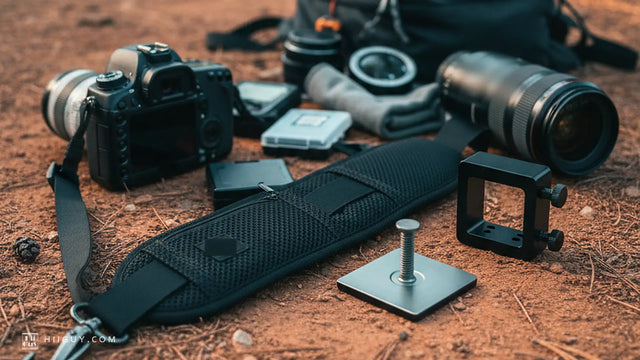
The HiiGuy strap is heavy-duty polyester webbing with a wide padded shoulder pad, a stainless steel quick release and a safety tether running alongside it. The fibre choice is the table above: we wanted the one that holds its length, shrugs off a wet morning and tolerates ten years of sun, because a strap is outdoor equipment whether anyone designs it that way or not.
It comes in two variations and length is the only difference between them. The Regular adjusts up to 32 inches on the body and the XXL adjusts up to 44 inches, which is the one to take if you are tall, broad, wearing a winter coat, or you want the body hanging low at your hip rather than up on your chest. Everything else in the package is identical. See it on Amazon.
Choosing in about a minute
Work out which of these you are first, then pick the fabric second.
You shoot outdoors in whatever the weather is doing. Synthetic webbing, and polyester over nylon for the water and the sun. Padded and wide, because the days are long.
You carry a light body around a city and you care how it looks. Leather or canvas are both reasonable. Store the leather somewhere with a stable temperature, and stop oiling it.
You carry heavy glass. Width and firmness beat softness. Be wary of anything very stretchy, for the bobbing rather than the strength.
You hated the strap that came with the camera. That strap is usually narrow unpadded webbing with the brand name printed down it, and narrow unpadded webbing is the single worst combination in this article. Almost anything is an upgrade.
The material matters less than those two questions from the start: what it is made of, and how wide the bit touching you is. Most people buy on the first and suffer on the second.