You come up out of a metro station in a city you have never been to, and for about four seconds you have no idea which way you are facing. Phone out. Map open. A camera and a lens worth more than your flight hanging off one shoulder, pointing at the pavement, while you stand still in the middle of a crowd.
That is the moment. Not the dark alley. The bright square at two in the afternoon, with you distracted and holding a map. Most people answer it by shopping for an anti-theft camera strap.
They find almost nothing, buy a sleeve or a wrap instead, and feel slightly better. The honest answer is duller and it works better: a handful of carrying habits you can start using today, with whatever strap you already own.
Who actually takes cameras, and where
Government travel advice is a better source on this than photography forums are, because it is written from reported crime rather than from anecdotes. Canada's official travel advice for Spain says petty crime such as pickpocketing and bag snatching is common, especially in larger cities like Madrid and Barcelona, and that thieves often target tourists, particularly during weekends, holidays and festivals. The same advice for Italy is blunter still: criminals on scooters or on foot often snatch bags and other valuables from pedestrians.
Read the list of where it happens and a pattern shows up fast. Both pages name the same places: public transport, train stations, airports, hotel lobbies, restaurants with outdoor seating, beaches, and the big tourist attractions. Not back streets. The places you were always going to stand still in with a camera around your neck.
So the threat is not a planned robbery of a photographer. It is an opportunist in a crowd, moving fast, taking whatever is loose on whoever is distracted. That changes what you should do about it, because almost nothing you can buy makes you less distracted.
Nobody is searching for an anti-theft camera strap
This is worth knowing before you spend money, because it tells you what the market actually makes. In the real search data behind this site, every variation of camera strap anti theft added together came to single-digit impressions in a month. Camera crossbody strap, crossbody camera strap and camera strap crossbody came to well over a hundred between them, and camera sling strap on its own ran into the hundreds.
People are not shopping for security. They are shopping for the thing that happens to deliver most of it, which is a strap worn across the body rather than hanging off one shoulder. The security is a side effect of the comfort, and nobody is marketing it that way because nobody is typing it into a search box.
The dedicated anti-theft strap category has mostly emptied out
There used to be a real answer here. Pacsafe's Carrysafe line built straps around a flexible stainless steel wire running through what they called a Slashguard strap, meant to stop a cut-and-run theft, on Dyneema webbing about half an inch wide. Their published specification for the neck strap adjusts from 39.5 to 46 inches and the release buckles at each end need two hands to open. Sensible engineering, honestly described.
Go looking for one now. The retailer listings I opened show the neck strap sold out on the main site, with the wrist strap marked unavailable and the earlier version listed as discontinued. Whatever is left is outlet stock. The category did not get better, it got smaller, and there is no obvious replacement line from anyone.
Which leaves the useful question: what was the wire actually buying you? It defends against one specific attack, somebody cutting the strap and running. It does nothing at all about the far more common one, which is the camera being lifted off a café chair, out of an open bag, or off a shoulder it was only resting on. A wire in the webbing cannot help with any of those. Your habits can.
Five habits that do more than any strap
1. Across the body, never on one shoulder
This is the whole game and it costs nothing. A strap over one shoulder is balanced there by friction and good intentions. Lift it an inch and it is off you. Run the same strap diagonally across your chest and it has to come over your head to leave, which no opportunist in a crowd is going to attempt. It is also simply more comfortable on a long day, which is why it is what people actually search for.
If you already carry a bag, the two straps have to be worked out together rather than fought over, and we went through that properly in wearing a camera strap with a backpack on.
2. Hand on the body in a crowd
Not gripping it, just resting on it. In a packed metro car, at a street market, pushing through a queue, put your hand on the camera and leave it there. It costs nothing, it stops the lens knocking into strangers, and it makes you a visibly worse target than the person next to you whose camera is swinging free. The whole technique is one movement you do without thinking after a week.
3. Shorten it in the crowd, lengthen it on the street
A camera at hip height is comfortable for walking and awkward in a crowd, because it sits behind you where you cannot see it and swings into things when you turn. Pull the adjuster up so the body sits high on your chest when you are in a crush, and let it back down when the pavement opens out. Two seconds each way. If your camera swings into doorframes and other people, the fixes in stopping your camera swinging into things when you walk all work in a city as well as on a trail.
4. Cover the branding, or stop worrying about it
There is a reason people tape over the white logo on a camera body and the red ring on a lens. A brand name on a strap across your chest is a price tag worn at eye level. Gaffer tape over a logo is free and reversible, and a plain black strap says less about what is hanging from it than a branded one does.
Be realistic about the limit, though. Anyone who steals cameras can recognise a camera. Covering branding lowers your profile to the general passer-by, not to somebody who does this for a living.
5. Decide in advance where the camera lives when you are not shooting
Most losses happen in the gaps. Sitting down to eat, buying a ticket, going to the counter for coffee. The rule that works is simple: the camera is either in your hands, on your body, or in a closed bag between your feet with a strap around an ankle. Never on the back of a chair. Never on the table. Never on the seat beside you. Canada's advice for both countries puts restaurants with outdoor seating on the list of places thieves are especially active, and that is exactly the moment it means.
What we carry, and how we wear it in a city

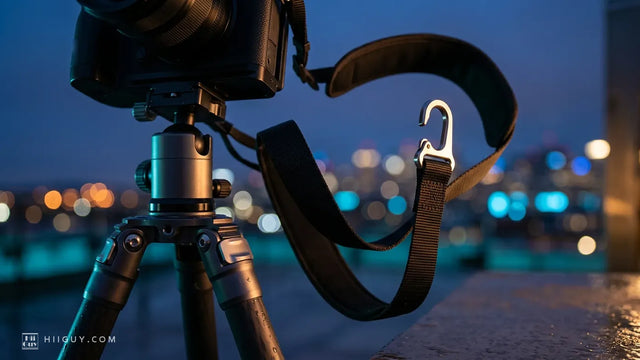
We have made straps out of Los Angeles since 2016, and the photographs on this site are our own gear on our own shoulders. The HiiGuy strap runs heavy-duty polyester webbing into a wide padded shoulder pad, finishing in a stainless steel quick release at the camera end with a safety tether sitting behind it as a second line of attachment. Two variations, and how far they adjust is the only thing separating them: the Regular goes up to 32 inches on the body, the XXL up to 44 inches. Three full years of warranty behind it.
The two parts that matter for the habits above are the adjuster and the quick release. The adjuster is what lets you move the camera from hip to chest as the street gets busier, which is habit three, and it only works if you can reach it with one hand while walking. The quick release is what gets the body off you and into a bag in one movement when you sit down to eat, which is habit five. Neither is a security feature. Both are what make a security habit something you will actually keep doing on day nine of a trip.
Length is the part people get wrong for city carry specifically. A strap that only just goes across your body will ride up into your neck all day and you will end up wearing it on one shoulder by lunchtime, which undoes the single most useful thing on this page. If you are not sure what you need, measure it first with the string method in measuring your own camera strap length with a piece of string.
What a strap will not do, said plainly
Our strap is not cut-resistant and we do not claim it is. There is no wire in the webbing. It is built to carry a camera comfortably and not drop it, and for the overwhelming majority of what actually goes wrong in a city, comfortable cross-body carry plus the habits above is the part that does the work.
Two more things worth saying out loud. No strap protects a camera you put down, and almost all of these stories are about a camera that was put down. And no strap is a substitute for insurance, which is the only thing on this list that gets you a camera back.
The two-minute version
Wear it across your body. Hand on it in a crowd. Short in the crush, long on the open street. Cover the branding if it makes you feel better, and do not believe it makes you invisible. Decide before you sit down where the camera is going to be, and never let the answer be the back of a chair.
None of that is a purchase. It is five decisions, and by the second day of a trip you are making them without noticing, which is the only form of security that survives being tired. Before any trip, it is also worth spending two minutes on the hardware itself, which is what the two-minute strap check before you walk out is for. A strap that fails on its own is the one risk on this page that nobody is stealing from you.