You have the money. That is the awkward part. If you were choosing between a beginner body and nothing, there would be no question. You are choosing between a beginner body and the better one two steps up the range, you can afford either, and every answer you find online either tells you to buy the cheap one because you are a beginner or tells you that full frame changes everything.
Neither of those is an answer to the question you are actually asking, which is whether a full frame camera is worth it for a beginner or whether the bigger body will sit in a cupboard. Here is the version I would give a friend, built on published specifications rather than on opinions, and it comes down to two things nobody puts on a spec sheet: what you will carry, and what you will learn on.
What the bigger sensor genuinely buys you
Start with the real difference, because there is one. A full frame sensor is roughly 36 by 24mm. Canon's published specification for the APS-C sensor in the EOS R50 is 22.3 by 14.9mm. That is well under half the area, and sensor area is what collects light.
You can see the consequence in the manufacturers' own ISO numbers. Canon rates the full frame EOS R8 to ISO 102,400, expandable to 204,800. The APS-C EOS R50, which has the same 24.2 megapixel count and the same DIGIC X processor, is rated to ISO 32,000, expandable to 51,200. Same company, same generation, same resolution, and roughly a two-stop difference in the stated ceiling. The sensor is what changed.
Two stops is not nothing. It is the difference between a usable frame and a mushy one in a dim restaurant, a church interior or a gig. If most of your photography is going to happen indoors or after dark, that is the single strongest argument for the bigger body, and it is a real one.
The second genuine difference is how a lens draws. At the same framing and the same aperture, the full frame body gives you shallower depth of field, which is most of what people mean when they say a photograph looks professional. You can get there on APS-C with a faster lens, but you have to buy the faster lens.
The weight is where the question is really decided
This is the part the comparison articles skip, and it is the part that decides whether a camera gets used.
Take Canon's own published figures, since they are the cleanest same-generation pair. The EOS R50 body is about 11.6 oz on its own and 13.2 oz with a card and battery under CIPA rules. The full frame EOS R8 is about 14.6 oz on its own and 16.3 oz loaded. Three ounces between them. If that were the whole story, nobody would think twice.
It is not the whole story, because the lens comes with the body. Canon's RF-S 18-45mm kit zoom for the APS-C body weighs about 4.6 oz. The RF 24-105mm f/4L that people actually put on an R8 weighs about 1.5 lb on its own.
Run the arithmetic on the thing you will be hanging off your shoulder:
- APS-C kit: body plus the 18-45mm zoom comes to roughly 1.1 lb.
- Full frame kit: body plus the 24-105mm comes to roughly 2.6 lb.
Not three ounces. Two and a half times the weight, and most of it hanging out front where the leverage is worst. That is the number to think about, because a camera is not heavy in a shop. It is heavy in hour six of a day out, and the camera you leave at home has an ISO ceiling of zero.
Nikon's figures tell the same story from the other side of the aisle. The Z50II is listed at about 17.5 oz for the body and 19.4 oz with a card and battery, which puts an APS-C mirrorless body in the same weight class as the full frame Canon before either has a lens on it. Body weight alone is a bad way to choose. System weight is the honest measure.
What you will actually learn on
Here is the uncomfortable truth about the first year: nothing a full frame sensor does will teach you anything. The things that make early photographs bad are not sensor-size problems.
Shutter speed too slow for the subject. Focus on the wrong eye. Nothing in the frame to be the subject. Flat light at midday. Every one of those is identical on both bodies, and you will spend the first year fixing them. We wrote up the most common version of the first one in why your indoor photos come out blurry, and the settings in it are the same settings on either camera.
There is one place the bigger body does help you learn, and it is worth naming because it cuts the other way. Shallower depth of field at the same aperture means a full frame camera is less forgiving about focus. Miss the eye at f/1.8 on full frame and it shows; miss it on APS-C and it half gets away with it. That is a reason to buy one if you want the feedback, and a reason not to if you want encouragement.
The lens money, which is the real budget
The body is a one-time decision. The lenses are the system you are joining, and full frame lenses are consistently bigger, heavier and dearer than their crop equivalents, for the straightforward reason that they have to project a larger image circle.
The weights above are the clearest illustration of that. Roughly three times the weight, for a zoom that covers a comparable range on its format.
There is also a crop-factor bonus on APS-C that nobody mentions until they want it. On a 1.5x or 1.6x body, a 300mm lens frames like a 450 or 480 would on full frame. If you expect to shoot wildlife, birds, motorsport or kids' sport, the crop body is reaching further for the same lens, the same money and considerably less weight.
So the question is not which body to buy. It is which system's lenses you are prepared to buy and carry for the next five years, and whether you want the second lens to live in a pouch on your belt or stay at home. We went through where it actually goes in where the second lens goes, and that choice gets a lot heavier on full frame.
So: is the bigger camera overkill?
Buy the full frame body if most of your shooting is indoors or at night, you want the shallow-depth look without buying fast primes to get it, you are happy carrying two and a half pounds all day, and you have budget left for one good lens after the body. The last clause is the one people break. A full frame body with nothing but a cheap zoom on it is the worst of both worlds.
Buy the crop body if you will be walking around with it, travelling with it, or shooting anything that needs reach. Also buy it if you genuinely do not know yet what you like photographing, which is most people in year one. Put the difference into a second lens, which will change your photographs more than the sensor will.
And buy used either way if the money is tight. A previous-generation full frame body plus a good lens beats a new crop body plus a kit zoom, in most of the situations where the sensor matters. If you go that way, run through the nine things to check before you buy a used DSLR first, because the shutter count is not the only thing that matters.
Whichever one you buy, the strap is not optional

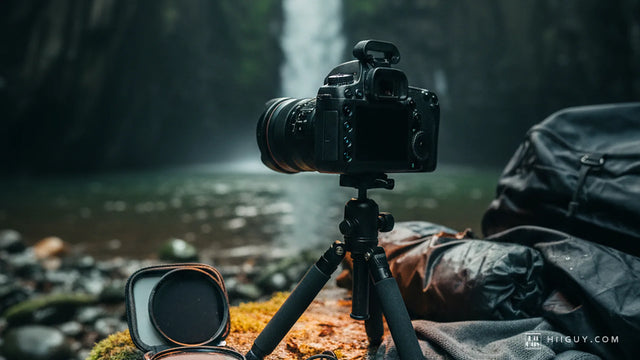
That photograph is the argument on this page in one frame. The body is not the problem. The lens hanging off the front of it is, and whatever you bought, it is going to spend most of its life suspended from a strip of webbing on one shoulder.
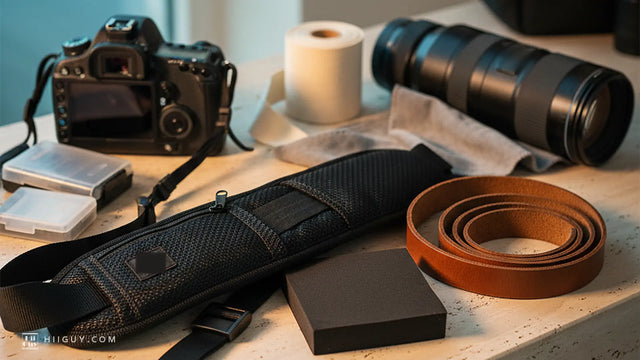
This is the problem HiiGuy has worked on out of Los Angeles since 2016. Our strap puts a wide padded shoulder pad on heavy-duty polyester webbing, with a stainless steel quick release where it meets the camera and a safety tether as a second line of attachment behind it. There are two variations, separated by nothing except how far they adjust: up to 32 inches on the body for the Regular, up to 44 inches for the XXL. We back it for three full years.
The reason it belongs in this conversation rather than in a footnote is the weight arithmetic above. The strap your camera came in the box with is a thin nylon band an inch or so wide. It is fine under about a pound. Put two and a half pounds on it for a day and you will feel exactly where it sits, and the width of the pad is what decides whether that is a dull ache or nothing at all.
So is a full frame camera worth it for a beginner?
The bigger camera is not overkill because you are a beginner. Nobody has ever been held back by too good a camera. It is overkill if the system it commits you to is heavier than the one you will actually carry, and that is a question about your shoulders and your weekends, not about your skill level.
If you are still genuinely split, there is a cheaper test than buying. Go to a shop and hang the full frame body with the lens you would really buy around your neck, and stand there with it for five minutes. Five minutes is not six hours, but it tells you more than any spec table on this page.