Two straps on the same shelf, both promising comfort. One tag says 32 mm, the other says 45 mm, and nothing printed on either box tells you what the difference buys. So most people shop on the photograph, pick whichever looks softer, and find out around hour six whether they chose correctly.
Width is the most useful number on a camera strap and the worst explained one. This is what it actually measures, what the real published figures are across the straps you are probably comparing, and why a padded camera strap feels almost identical to a cheap one for the first hour and nothing like it by the end of a long day.
There are two widths on the tag, and they are not the same number
Almost every argument about strap width is really two arguments stacked on top of each other, because a strap has a webbing width and a pad width and manufacturers quote whichever one flatters them.
Look at how the specifications are written. OP/TECH publishes its Pro Strap as a 2.5 inch pad, 15 inches long, connected to the camera by webbing tabs three eighths of an inch across. Two numbers, nearly seven times apart, on one strap. BlackRapid's own figures for the Sport Breathe give a shoulder pad that tapers from about 2.2 inches to 3.7 inches over a 16 inch length, running out to roughly one inch of webbing at the ends. Peak Design does something different again with the Slide: the published 45 mm is the webbing itself, padded internally, so a single figure covers the whole strap.
The number that decides whether your shoulder hurts is the one that touches you. A 3.7 inch pad on quarter inch webbing is a wide strap. A strap advertised as wide because the webbing is wide, with no pad on it anywhere, is a flat band.
The published widths, lined up
These are the manufacturers' own figures, converted to inches where a source gave millimetres. Nobody publishes them side by side, which is part of why the number means nothing to shoppers.
- Nikon AN-DC29, sold as the spare for the Z30 and Z50 strap: 29 mm, which is 1.1 inches, in woven fabric, flat, with no pad.
- Canon EW-400D, the band in the Rebel boxes: woven nylon about an inch and a quarter across, also flat.
- Peak Design Slide Lite: 32 mm of webbing, call it 1.3 inches, at 3.7 ounces, adjusting between 39 and 57 inches.
- Peak Design Slide: 45 mm, about 1.8 inches, the same idea with more of it.
- PGYTECH Camera Strap Pro: listed on a 60 mm shoulder pad, which is 2.4 inches.
- OP/TECH Pro Strap: a 2.5 inch neoprene pad over 15 inches, adjusting from 24 to 51 inches, at 3.2 ounces.
- BlackRapid Sport Breathe: 2.2 to 3.7 inches of pad, adjustable out to 66 inches.
From 1.1 inches to 3.7 inches is more than triple, across products all sold to the same photographer for the same camera. That spread is the whole reason the number on the tag is worth understanding.
Width is the only lever that lowers the pressure
The thing hurting your shoulder is not weight. It is pressure, meaning weight divided by the patch of you it lands on, and width is the only part of that you can buy.
The arithmetic is not complicated, and it is arithmetic rather than a study. Hold the length of contact steady and double the width of the band, and the pressure under it halves, because the same load is now spread over twice the area. Going from a 1.1 inch kit strap to a 2.5 inch pad is roughly 2.3 times the contact width, so a little under half the pressure per square inch, with the camera weighing exactly what it weighed before. No strap removes an ounce from your kit. A wide one just stops that weight arriving along one narrow line.
This is also why stiffness matters and nobody publishes it. A pad only spreads load across its full width if it stays flat. A soft band that curls into a rope under tension has quietly reverted to being narrow, which is the failure mode behind a lot of straps that measure well and feel bad.
What you are actually hanging on it
Published weights make the point faster than any opinion. A Canon Rebel T7 comes in at 16.8 ounces with a battery and card, so with a kit zoom on the front you are carrying a pound and a half. A Nikon D7500 is published at 25.4 ounces with battery and card, and a working lens puts that comfortably past two pounds. At the other end, Nikon lists the D850 body at 32.3 ounces and the 70-200mm f/2.8E at 50.5 ounces, and that pair is over five pounds before you add anything else.
That is a three to four times range of load, handed to straps whose widths also vary by three times, with no guidance anywhere about matching one to the other. OP/TECH is unusually honest here: it publishes a recommended comfort load of 15 pounds separately from how much the strap can physically hold, which are genuinely two different limits. Most brands publish only the second one, if that.
If your kit lives at the heavy end, width stops being a comfort feature and becomes the specification. We went into that properly in carrying a heavy telephoto without wrecking your shoulder.
Why a padded camera strap only proves itself at hour six
Here is the part that makes width hard to shop for. Your body tolerates a high pressure briefly and a low pressure for a long time, so for the first hour the narrow strap and the wide one feel much the same. Pick either one up in a shop and you will not be able to tell them apart. That is not you failing a test. It is the test being useless at that duration.
What changes is accumulated time under load, and it never announces itself. On day four of a trip, at hour six of walking, nobody decides to stop photographing. They just stop taking the camera out, because by then the strap has become the thing they are aware of and the photographs are the thing they are not. Ten years of selling straps has taught us that the complaint almost never arrives as pain. It arrives as a camera that stayed in the bag after lunch.
Which means the honest way to shop width is by how long you carry, not by how heavy the camera is. A body that comes out for twenty minutes at a wedding does not need three inches of pad. A body that is on you from breakfast to sunset does, and the two owners can have identical cameras.
Four ways padding goes wrong anyway
Width is necessary and not sufficient. Four failures we see repeatedly, none of which show up in a specification.
- The pad is too short for where it sits. A 15 inch pad centred on your shoulder works. The same pad pushed forward by a strap set too tight ends up with its edge on your collarbone, which is the one place you do not want an edge.
- The pad slides. Smooth padding on a smooth jacket migrates off the shoulder and down the arm, and once it is on the arm it is spreading nothing. Non-slip backing is doing real work here.
- Too thick, not wide enough. Thickness feels plush in the hand and changes nothing about the contact area. It is width that divides the load.
- The length is wrong, so the pad is in the wrong place. This is the most common one by far, and no amount of padding fixes it. Our camera strap length chart by height gets you the number before you order instead of after.
What our own strap does about it

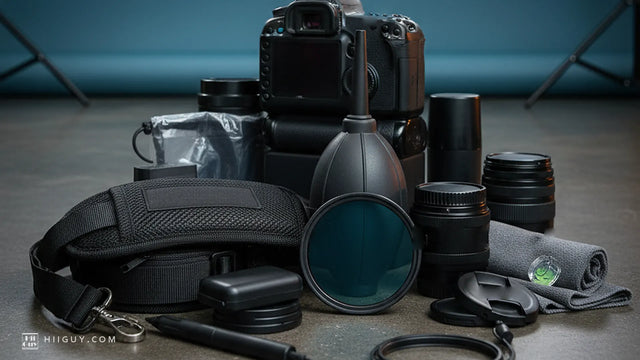
That photograph is our own kit, not a render, and it shows the two widths this article is about in one frame. The wide padded shoulder pad is the part doing the spreading. The heavy-duty polyester webbing running down her chest is noticeably narrower, because webbing only has to be strong and a pad has to be kind. The HiiGuy strap is built that way on purpose, with a stainless steel quick release threading into the tripod socket and a safety tether as a second load path up to a strap lug.
We do not publish a pad width in inches, and we are not going to invent one here. What we will say is where the weight lands: on the pad, across your shoulder, in a crossbody position rather than on the back of your neck. It comes in two variations and length is the only difference between them, the Regular adjusting up to 32 inches on the body and the XXL up to 44 inches, with the same webbing, pad, quick release and tether in both. HiiGuy has been making them in Los Angeles since 2016 and backs the HiiGuy strap for three full years. See it on Amazon.
So how wide should it be
Short version, by what you actually do rather than by what you own.
- Light body, short outings. An inch to an inch and a half is genuinely fine. The strap in the box is already that, and replacing it buys you adjustment and hardware, not comfort.
- Mid body with a zoom, a few hours at a time. Two inches of pad or thereabouts, and the pad matters more than the webbing.
- Heavy body, long lens, all day on foot. Two and a half inches and up, worn across the body, with a pad that does not slide.
- Anything on your neck rather than your shoulder. Go wider than you think, because the tissue either side of your spine is the least forgiving place on you to put a line of pressure. We pulled those two positions apart in shoulder or neck.
Then stop reading the tag and set the length, because a three inch pad sitting in the wrong spot is a worse strap than a two inch one sitting right. Width decides how much of you takes the load. Length decides where.