You have a nikon camera strap open in one tab and your camera on the desk beside you, and the only thing you actually want settled is whether the strap will go on. Not whether it is comfortable. Whether it physically attaches. It will, and the reason is worth two minutes of your time, because it changes what you should be shopping for.
Straps are not matched to camera models. They are matched to attachment points, and a D3500 and a D850 carry those in the same two places. The word "Nikon" in your search is doing almost no work. Here is what to put in its place.
The two things a strap on a Nikon actually touches
Nikon names them itself. The parts list in the D5600 manual calls them the eyelets for camera strap, two of them, one at each top corner of the body, and the first-steps page of the D3500 manual simply says to attach the strap to the two camera eyelets. No model numbers appear in that instruction because none are needed.
The second point is underneath. The tripod socket in the base plate is a quarter-inch thread, the same one a tripod plate uses, and sling and crossbody straps skip the eyelets entirely and screw a mount into it. That is why a sling hangs the camera lens-down from one point instead of swinging it from both top corners.
Those two holes are the whole compatibility question. If you know which of them your strap wants, you know whether it fits, and you can stop reading spec sheets. We pulled the two routes apart properly in tripod socket or strap lugs if you are still choosing between a neck strap and a sling.
Nikon itself does not use one strap across the range
This is the part nobody points at, and it is more honest than any compatibility chart.
A D3500 ships with the AN-DC3. A D850 ships with the AN-DC18, which Nikon's own accessory description calls a wide strap, black with yellow. Same company. Same eyelets at the same corners. Two different straps in the two boxes.
Nikon did not do that for decoration. It did it because the thing hanging off the strap is not the same weight in both cases, and the company knows a thin printed strap stops being pleasant somewhere between those two cameras. Which is exactly the decision you are making, except Nikon made it once at the factory and you get to make it properly.
The only number that changes across these four bodies
Nikon publishes weights with a battery and a memory card in the camera, which is the number that matters because that is how you will be carrying it.
- D3500. About 14.7 ounces loaded, 12.9 ounces for the bare body.
- D5600. About 16.4 ounces loaded. Within two ounces of the D3500, and it feels it.
- D7500. About 25.4 ounces loaded, which is most of a pound more than the D5600.
- D850. Around 2 pounds 3 ounces loaded, and 32.3 ounces body only.
Put it another way. A D850 with a battery and a card in it outweighs a D3500 and a D5600 put together. Every one of those four cameras takes the same strap by the same two routes, and the fourth one will wreck your afternoon on a strap the first one is perfectly happy with.
And none of that counts the lens. A kit zoom adds a few ounces. A 70-200mm roughly doubles the problem, and it is the combination you should be sizing for, not the body on its own.
Four things people check that have nothing to do with fit
These come up in every comparison between these bodies, including our own D3500 against D5600 piece, and not one of them changes where a strap attaches.
- Card slots. The D7500 has one SD slot. The D850 has two, one XQD and one SD. The strap does not know.
- The screen. The D3500's is a fixed 3-inch panel with about 921,000 dots. The D850's is larger, tilts and takes touch input. Both hang from the same corners.
- Megapixels. Obviously, but it still gets asked.
- Age. A strap built for a film body from the 1990s threads through a D850 eyelet, because the slot was never redesigned.
Where a nikon camera strap genuinely does not fit
There are three, and the model name is not one of them.
Something is already in the tripod socket. This is the common one. If an Arca plate or an L-bracket lives on the bottom of your camera, a screw mount wants the same hole, and you will be unscrewing one to use the other every time you go near a tripod. Decide now which of the two is going to live there. Some mounts thread through a plate that has a pass-through socket; plenty do not.
A battery grip is in the way. A grip bolts onto the base and takes over the whole underside of the camera, including that socket. The D850 is the one in this group that this applies to. Nikon's accessory range lists no battery grip for the D7500 at all, so the question never comes up on that body.
The eyelet is a slot, and some things are too thick for it. Thick cord anchors are the only things that ever fight a strap mount. They loop through the eyelet and stay there permanently, and on some cameras they have to pass through twice. If a strap you want uses them, that is the one measurement worth confirming before you order.
Once it is on, the real question is where the load goes

That is the quarter-inch route in use, photographed from behind so you can see what it does. The webbing crosses the back, the pad sits on one shoulder, the camera hangs at the opposite hip and turns freely because it is held at a single point. Nothing is loaded onto the back of the neck, which is where the strap in the box puts it.
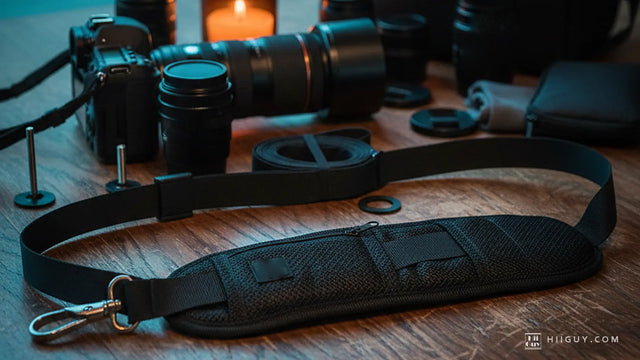
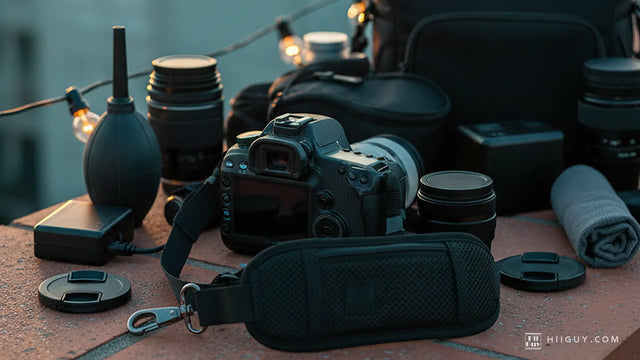
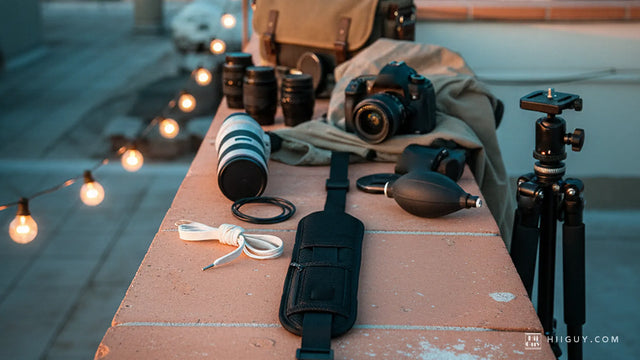
The HiiGuy strap is heavy-duty polyester webbing with a wide padded shoulder pad and a stainless steel quick release that threads into that same tripod socket. A safety tether runs up to an eyelet as a second path for the load, which is the detail worth knowing on a Nikon specifically: the tether uses the attachment point the screw mount leaves empty, so the two routes are not competing for one hole. The fittings are rustproof metal. HiiGuy has been making these in Los Angeles since 2016 and backs the HiiGuy strap for three full years.
There are two variations and the length is the only thing that separates them. The Regular adjusts up to 32 inches on the body and the XXL adjusts up to 44 inches, with the same webbing, the same pad, the same quick release and the same safety tether in both. So the choice is a measurement of you, not of your camera, and a D3500 owner and a D850 owner can easily need different ones. If you want to work out which before you spend anything, we built a length chart by height and carry style. See it on Amazon.
Two minutes with the camera in your hands
Do this before you order anything and you will not get it wrong.
- Look at both eyelets. Make sure they are empty. Used bodies often arrive with split rings or a previous owner's cord anchors still threaded in, and that quietly changes which straps clip straight on.
- Turn the camera over. If there is a plate, a bracket or a grip on the bottom, the socket is spoken for and a screw-mounted sling is the wrong purchase until you deal with that.
- Weigh the heavy day, not the light one. Hold the body with the biggest lens you own on it. That combination is what the strap has to carry, and on a D7500 or a D850 it is the number that decides how wide and how padded the strap needs to be.
The fit answer really is boring, and boring is the good outcome here. Nikon has left the eyelets and the socket alone for long enough that compatibility stopped being a question years ago. What is left to decide is how the weight sits on you and how far the strap adjusts, and that is worth thinking about properly. Canon owners asking the same thing can read the Canon version of this piece, which lands in the same place for the same reason.