Three hours into a shoot your neck is sore, the camera has been swinging into your hip all afternoon, and you go looking for something better. Within about four clicks you are reading about a camera hand strap, and it looks like the answer, because the photographs all show someone holding a camera with no effort at all.
Here is the thing nobody says on those listings. A hand strap, a wrist strap and a neck strap are not three grades of the same product. They are three different objects that solve three different problems, and two of them do not carry a camera at all.
What our own numbers say about this confusion
We can be unusually direct about it, because we have the data and we do not sell a hand strap.
In a single month of our own Amazon advertising, fifteen separate search phrases containing the word "hand" put the HiiGuy listing in front of shoppers 991 times. Twenty-nine of those people clicked. Not one of them bought anything. Seven phrases containing "wrist" did another 218 impressions and eight clicks, for a single order.
Read that honestly and it is not a story about a bad listing. Those shoppers wanted a different object than the one they found, and almost all of them worked that out within a second of arriving. The useful question is what each of the three actually does, and where each one quietly stops working.
A camera hand strap does not carry the camera
It removes the need to grip.
The strap runs across the back of your hand, anchored at one end to the camera and at the other to the base of the body, and when you pull it snug the camera is held against your palm. You can open your fingers completely and nothing moves. Your hand stops being a clamp and becomes a platform, which is the real benefit: your index finger sits on the shutter because it is not busy holding anything.
The padded hand strap we list works exactly that way. It mounts on the quarter-inch tripod screw underneath the body and adjusts to the size of your hand, so the camera is pressed to your palm rather than pinched between your fingers.
Where it stops working
Your arm is still carrying the weight. All of it, on one side, for as long as the camera is out.
Put real numbers on that. Canon's published specifications give the EOS 90D as 24.73 ounces with a battery and a card in it. Nikon's figures for the AF-S DX 18-140mm zoom are 17.3 ounces. Hang that lens off that body and you are holding roughly 2 pounds 10 ounces in one hand, and a hand strap does not reduce it by an ounce. It only guarantees that you will not drop it.
So a hand strap is a shooting aid, not a way to carry a camera. For an hour of concentrated work it is superb. For a day of walking between locations it is the wrong tool, and the ache in your forearm by mid-afternoon is the proof.
The tripod socket is the cost nobody mentions
Most hand straps anchor to the bottom of the camera, and that means the tripod socket.
Under the ISO 1222 standard, that socket on a consumer camera is a 1/4-20 UNC thread: a quarter of an inch across with twenty threads to the inch. It is the same thread your tripod's quick release plate screws into. One socket, two things that want it.
That is why better hand straps ship with a base plate that passes the thread through, and why cheaper ones leave you unscrewing the strap every time you want the tripod. If you use a tripod at all, work out how a given hand strap handles that before you buy it rather than in a field at dusk. We went through the two mounting points in detail in tripod socket or strap lugs, including which one takes the load better.
A wrist strap is a different object with a similar name
This is where most of the confusion lives, and the two words get used interchangeably even by sellers.
A wrist strap does not hold the camera against your hand. It is a loop that lives around your wrist, so that when you open your fingers the camera drops four inches and stops. You are still gripping the camera the entire time you are using it. The strap is a catch, not a grip.
The paracord wrist strap in our catalogue is a fair example of the type: 16 inches long, 1.6 ounces, hand-woven paracord, with a stainless steel quick-release ring that sets the tightness and holds it, and a round leather pad sitting between the hardware and the camera body so the metal never touches the finish. It mounts on a round lug, not on the base, which is the other practical difference. The tripod socket stays free.
A wrist strap suits a small body with one lens, shooting one-handed, in a crowd or on a boat where a long strap would swing into people. It is the wrong answer for anything heavy, because your fingers are doing the holding and nothing has changed about the weight.
Where the neck strap actually belongs
The neck strap gets dismissed too quickly, usually by people who have never moved it.
It is the only one of the three that takes the weight off your hands entirely, which is the whole reason it exists. The complaint it attracts is not really about the strap, it is about the position: hung around the neck, a camera loads the one part of your spine least suited to carrying anything, and it keeps your head tipped forward looking down at the screen. Move the same piece of webbing to one shoulder, or let it out and run it across your body to the opposite hip, and most of that complaint disappears without buying anything. We worked through all three positions in shoulder or neck.
What a neck or shoulder strap cannot do is steady the camera at your eye. That is the hand strap's job, and it is why these are not competitors.
Most working photographers use two of them

Look at what is happening in that photograph, from one of our own shoots. Both of his hands are on the camera doing the work of aiming it. The strap over his shoulder is slack and doing nothing at that moment. Two seconds later, when he drops his arms, it takes the entire weight and his hands are free.
That is the division of labour. Hands aim, strap carries, and they trade off hundreds of times a day. A hand strap and a shoulder strap are not alternatives, they are two halves of the same arrangement, and on most bodies you can run both at once because one uses a lug and the other uses the base.
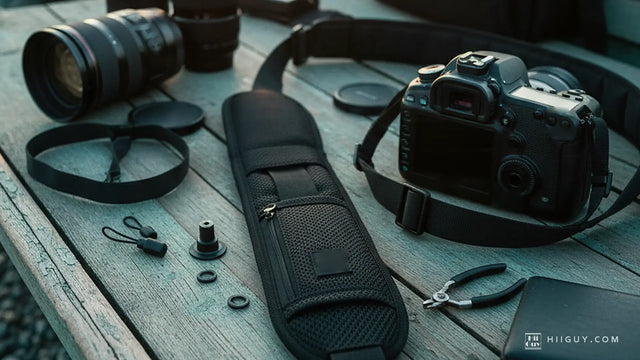
Our side of it is the carrying half. The HiiGuy strap is heavy-duty polyester webbing with a wide padded shoulder pad, a stainless steel quick release so the body comes off in one movement at a tripod, and a safety tether behind that release as a second connection. It comes in two variations, and length is the only difference between them: the Regular adjusts up to 32 inches on the body, the XXL adjusts up to 44 inches for taller and broader photographers. HiiGuy has made it since 2016 and backs it for three full years. You can see both variations on Amazon.
Pick one in thirty seconds
- Your hand cramps while shooting, but carrying is fine. Hand strap. Check the tripod socket question first.
- You shoot one-handed in crowds with a small body. Wrist strap. Lug mount, nothing on the base.
- Your neck aches after a few hours. Not a product problem yet. Move the strap you own to your shoulder, then across your body, before spending anything.
- The camera ends up in your armpit when you go crossbody. Now it is a product problem, and it is a length problem specifically.
- You are carrying heavy glass all day. Shoulder or crossbody, every time. No hand strap will fix a weight you are still holding.
The short version
A hand strap means you cannot drop the camera. A wrist strap means that if you do drop it, it stops at your wrist. Only a neck or shoulder strap means you are not holding it at all.
Most people searching for a camera hand strap after a long day actually want the third thing, and the ones who genuinely want the first thing usually want it as well as, not instead of. If the camera is tiring your hand, a hand strap. If it is tiring the rest of you, the hand strap is not going to help, and the fix may be free. If you want the full comparison of carrying methods, we laid out seven ways to carry a camera all day.