It is the end of a long summer and your strap smells. Not strongly, not in a way anyone else would notice, but you can tell when you pick the camera up. There is a pale crust along the edge of the shoulder pad where sweat dried, a faint orange tinge on the webbing that was not there in May, and the whole thing feels slightly tacky in the hand.
Most people deal with this by putting the strap in the washing machine. Sometimes that works. Sometimes it comes out looking older than it went in, and once in a while it comes out with a stain that will now never leave. A fabric camera strap is not a t-shirt, and the two things it has picked up over the summer, sweat and sunscreen, behave very differently in a wash. Here is what is actually on your strap, what gets it off, and the cases where the right answer is to leave it alone.
What is actually on there
Three different kinds of mess, and they do not respond to the same treatment.
Sweat is mostly water, and the water left ages ago. What stayed behind is salt and skin oil, which is why the pad feels stiff at the edges and why the smell comes back a few minutes after the strap warms up against you.
Sunscreen is the one that does real damage, and it is worth knowing why. Iowa State University Extension's AnswerLine has a post specifically on sunscreen stains, updated in March 2025, and it explains that the UV-blocking compounds in sunscreen oxidize and tend to produce a yellowish or rust-colored stain when they interact with minerals in water, particularly hard water. That orange tinge on your webbing is not dirt. It is a chemical reaction that happened in your last wash, which is why people so often report that the stain appeared after cleaning rather than before it. The same post notes that sweat makes it worse, which is exactly the combination a camera strap gets all summer.
The mineral sunscreens are a separate problem. Titanium dioxide and zinc oxide do not discolor fabric, but AnswerLine points out that their white particles cling to the fibers even after washing. That is the chalky grey look on black webbing that no amount of rewashing shifts.
Grit is the third one and the most boring. Dust and trail dirt work into the weave and into the moving metal. It does nothing to the fabric and a lot to the hardware.
The washing machine question
Start with the case for not doing it, because it is stronger than people expect.
A machine wash is three things at once: detergent, water and sustained mechanical agitation. The detergent is fine. The water is mostly fine. The agitation is what you are gambling with, because a strap is not a flat piece of cloth, it is webbing with metal on the end of it, and that metal spends forty minutes being slammed against a stainless drum and against whatever else is in the load. The clips come out scuffed. Sometimes the drum does too.
The bigger issue is chemical. AnswerLine is direct about it: avoid pretreating by soaking garments or using bleach or oxygen bleach products, because doing so will have little effect on the stain and may actually make it worse. If your strap has a sunscreen mark on it and you reach for a bleach-based stain remover, you are not cleaning it, you are setting it.
There is a second chemical warning worth borrowing from a sport that takes its webbing seriously. The UIAA, the international federation that writes climbing's safety standards, singles out nylon products, ropes, slings and cords, as the gear to keep sunscreen and insect repellent away from. Its safety commission says it has no confirmed chemistry for what in sunscreen attacks nylon, only the judgement that some brands may contain something that does, and the sensible recommendation that follows is to keep lotions and sprays off nylon gear in the first place. The same body sees no reason for small amounts of sunscreen to attack metal.
So: if your strap is plain synthetic webbing with no leather and no electronics, a cold hand wash is nearly always the better tool, and it takes less time than running a machine.
The method that works
Fill a sink with cool water and a small amount of ordinary liquid detergent. Not hot water, not bleach, not an oxygen booster.
Deal with the stains before the strap goes in, and blot rather than rub, because AnswerLine's first rule is that wiping a stain spreads it and makes a larger one. For the oily part of sunscreen, dish soap massaged gently into the mark. For a rust-colored avobenzone stain, the same post lists lemon juice and table salt, or a store-bought rust remover, as the things that are actually effective. For the chalky white mineral residue, rubbing alcohol.
Then put the webbing in and work it through your fingers rather than scrubbing it. Pay attention to the three inches either side of where it crosses your shoulder, which is where everything accumulates. Rinse until the water runs clear, because detergent left in webbing is itself slightly tacky and attracts dust.
Hang it to dry out of direct sun, and do not put it anywhere near a radiator or a tumble dryer. Synthetic webbing dries fast on its own. Heat is the one input in this whole process that has no upside at all.
When not to clean it: leather
If your strap is leather, or has leather ends, the advice above is wrong for it and most online cleaning advice is too.
The Canadian Conservation Institute's guidance on caring for leather, skin and fur states it plainly: most skins and leathers are damaged if in direct contact with water, and vegetable-tanned leather may shrink or stiffen if directly exposed to water. That is the opposite of how we treat fabric, where water is the solvent that does the work.
The CCI goes further than most people expect on conditioners. Asked whether a leather dressing should be applied to stiff vegetable-tanned leather, its answer is no. Its reasoning is that oils oxidize in time and may produce deteriorative effects, and that dressings can lead to sticky surfaces that attract dust and soiling. It says saddle soap should not be used.
Read that with some care, because the CCI is writing about objects in museum collections that are meant to survive centuries and are never worn. A leather strap you use every weekend is a different proposition, and a little conditioner on a dry strap is not vandalism. But it does reframe the question. Conditioning leather is not maintenance you owe the strap on a schedule. It is an intervention, it has costs, and the default for a leather strap that is not actually dry should be to wipe the surface and leave it.
If you are not sure what yours is made of, the differences are set out in what camera straps are made of.
The metal and the pad
Hardware wants a rinse and a dry, nothing else. Grit in a swivel or a snap hook is abrasive, and every time you turn a gritty swivel it machines itself a little. Clean water, work the moving part through its full range, dry it properly. No oil. Oil on a strap fitting is a dust magnet and it ends up on the camera body.
Padded shoulder pads hold water far longer than webbing does, so squeeze rather than wring, and give the pad a day rather than an afternoon before you call it dry. A pad that is still damp inside is the actual source of a smell that comes back a week after you washed it.
While it is in your hands and wet, you may as well look at it properly, since you will never have a better view of the stitching. What actually wears out on a camera strap covers what you are looking for, and the short version is that you are checking joints, not fabric.
Ours, and what it is made of

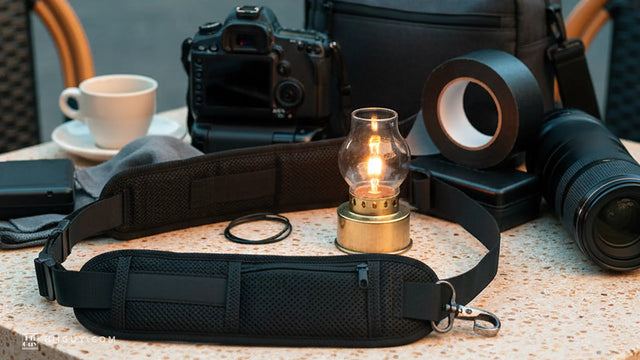
That photograph is ours, and it is here because it shows the exact problem this article is about. The padded pad is sitting on bare skin on a hot day. That contact patch is where the salt goes, where the sunscreen goes, and where a strap starts to smell first.
The HiiGuy strap is heavy-duty polyester webbing running into a wide padded shoulder pad, with a stainless steel quick release at the camera end and a safety tether on its own fixing. Polyester matters for cleaning specifically: it holds very little water, so a cool hand wash and a night on a hanger genuinely dries it, and stainless hardware does not care about a rinse the way a plated fitting would.
It comes as two variations and length is the only difference between them. The regular adjusts up to 32 in on the body and the XXL adjusts up to 44 in, and both are variations on the same Amazon listing.
The part nobody does, which is the part that works
Rinse the webbing in cool water at the end of a hot day and hang it up. Thirty seconds, no detergent, no stains to treat later, because you took the salt off before it dried into the weave.
Every deep clean in this article exists because that did not happen. Sunscreen that was rinsed off the same evening never oxidized into an orange mark. Salt that went down the sink in August never turned into a smell in September. The strap you have to rescue in October is the one you never rinsed in July.