The camera was the big present. Somebody spent real money, there was a moment when the box was opened, and now it is three weeks later and the thing is sitting on a shelf with the strap that came in the box still folded in its plastic bag.
Most gifts for new photographers fail in the same way: they assume the person needs more camera. They do not. What they need is the stuff a kit box leaves out, which is almost everything to do with carrying the camera, standing it up, and getting it out of the house. Fix those and the camera gets used. Buy them another lens and it joins the shelf.
Here is what to get, in the order it will actually get used.
Some links below go to Amazon, where HiiGuy earns a small commission as an Amazon Associate. It costs you nothing and it is not what decides this list.
1. A strap that fits the person, not the box

The strap in the box is a branded nylon band. It is thin, it is one size, and it hangs the camera at the height the manufacturer guessed, which for most people is somewhere unhelpful around the sternum. It is the first thing a photographer replaces and almost the last thing they think to ask for.
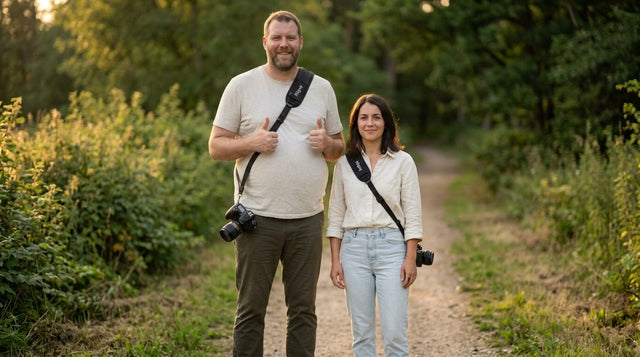
The HiiGuy strap is heavy-duty polyester webbing with a wide padded shoulder pad, worn across the body so the camera sits down at your hip. There is a stainless steel quick release at the camera end, so the body comes off in one movement when it goes on a tripod, and a safety tether in case the release is ever knocked open. It comes in two variations that differ in nothing but how far they adjust: the Regular adjusts up to 32 inches on the body and the XXL adjusts up to 44 inches for a taller or broader build. HiiGuy has been making these since 2016 and backs them for three full years.
If you are buying for someone tall, get the XXL and do not think about it further. That is the whole reason this version exists.
2. A bag small enough that they take it

New camera owners are usually given, or talked into, a big rectangular camera bag. It holds everything and it goes nowhere, because carrying it is a decision you have to make at the door. The bag that gets used is the one that is barely a bag.
This compact sling backpack is 9.5 by 6.3 by 14 inches and swallows a DSLR body with three lenses, or two lenses and a small tablet. One zip along the shoulder strap turns it from a sling into a proper two-strap backpack, which matters on a long day. The dividers are detachable so the inside can be rearranged as their kit changes, and there is a tripod holder underneath for the next item on this list.
3. A tripod tall enough to be worth setting up

There is an entire category of photograph a beginner cannot take handheld and usually does not realise is missing. Anything after sunset. Anything where water or traffic is deliberately blurred. Any group picture the photographer is also standing in. All of it needs the camera to hold still for longer than a person can.
This 74 inch aluminium tripod stands tall enough to shoot at adult eye level or over the heads of a crowd, and it is rated to hold 9.5 lb, which is far more than a beginner's body and kit lens will ever weigh. The leg locks set the height and hold it, and it folds into its own carry bag. A short tripod that makes them kneel in wet grass gets used twice.
4. A tripod small enough to be in the bag anyway

These two tripods do different jobs and it is worth understanding the difference before you decide you only need one. The tall one is for planned pictures. This 21.6 inch desk tripod is for the ones nobody planned, because it is already in the bag.
Metal legs, rubber feet and a metal ball head, and it folds down to something you can hold in one hand. It stands the camera on a table for a long exposure of a room, props it at ground level for a low angle, and works as a grip when they are filming and walking at the same time. It is the cheaper of the two and it very often gets used more.
5. A hand strap, for the days they want the camera in their fist

This is the small gift that gets the most surprised reaction. A padded hand strap pulls the camera back against the palm, so the fingers are steadying it rather than clamping onto it. Beginners grip too hard, and gripping too hard is one of the quiet reasons their pictures come out slightly soft.
It mounts on the quarter inch tripod screw on the base of the camera and adjusts to the size of the hand, and it fits most DSLR and mirrorless bodies. One thing to know before you buy: because it uses that socket, it and a tripod plate want the same piece of real estate. That is a trade-off rather than a fault, and it is the same one we go through in the four things to check on any camera strap.
The things to buy that we do not sell
Three more items belong in this list and none of them are ours, so take this as advice rather than a pitch.
A memory card, and the numbers on it
Card labelling is deliberately confusing and most people buy on capacity alone. The SD Association, which sets the standard, publishes what each symbol guarantees: a U1 card promises a minimum sustained write of 10 MB/s and U3 promises 30 MB/s, while the V numbers say the same thing more plainly, with V30 meaning 30 MB/s and V60 meaning 60 MB/s. Those are minimums held under sustained writing, which is precisely what video needs and what a burst of stills needs.
For a beginner shooting stills and occasional video, a V30 card is the sensible floor. The faster V60 and V90 cards only reach their rated speed on the UHS-II bus, per the same specification, so paying for one is wasted unless the camera supports it. Buy two mid-sized cards rather than one enormous one, because a card that fails takes everything on it.
A spare battery, but less urgently than you think
Everyone buys a spare battery first. It is usually not the shortage it feels like. Nikon rates the D3500 at 1,550 shots per charge to the CIPA standard, and an entry-level DSLR with an optical viewfinder genuinely will go a weekend. Mirrorless bodies and anyone shooting video are the real exceptions, and there a second battery is worth having. Check which they own before you spend.
A blower and a microfibre cloth
Unglamorous and constantly needed. A rubber air blower shifts dust off the front of a lens without touching it, which is what you want, because wiping grit across glass is how lenses get scratched. Keep the cloth for fingerprints, after the blower has done its job.
What not to buy someone with a new camera
Anything that has to match their exact model, unless you have the model number in front of you. That rules out batteries, lens caps, screen protectors and most filters, all of which look like safe small gifts and are not.
Skip a second camera bag if you have not seen the first one. Skip filter sets sold as bundles, which are mostly effects nobody uses twice. And skip anything described as a lens kit for phones, which is a different hobby wearing a similar costume.
If you are only buying one
Buy the strap. It is the only thing on this list they touch during every single minute of every single shoot, it is the item almost nobody upgrades for themselves, and the free one in the box is genuinely the weakest part of the whole kit.
If the strap is already sorted, buy the small tripod. It is cheap enough to feel like a stocking present and it goes out of the house more than anything else here.
And if the person is still at the stage of wondering what to photograph at all, the gear is not the gap. Send them the four things you need to get started in photography and let the camera earn its place on the shelf.