You are eight people back from the barrier, the stage has gone purple, and somebody behind you has decided this is the moment to move forward. Your camera is down around your hip. In two seconds you need it at your eye. For the ninety seconds after that you need it back against your ribs, where nobody's elbow can find it.
That is the real problem with shooting in a crowd, and it is a carrying problem long before it is a camera problem. Exposure, autofocus, which lens you brought, all of that can be settled at home on the kitchen table. How the camera travels from your hip to your eye and back again gets settled in the dark, one-handed, with a stranger's shoulder in your back. A camera shoulder strap that is fine on a hiking trail can be genuinely bad here, and the reasons are specific.
What a crowd does to a camera that a hillside does not
On a trail the load is vertical. The camera hangs, you walk, gravity does the same thing all day and the only question is how much of it ends up on one shoulder. In a crowd almost nothing is vertical. You get shoved sideways. You turn to let someone past and the camera keeps turning after you stop. You step up onto a curb and the body swings forward into the back of the person in front.
Three things go wrong, and they are worth naming separately because they want different fixes.
The swing
A body on a long strap is a pendulum with a lens for a weight. Every time you pivot, the camera carries on and then comes back. In open space that is annoying. In a packed room it is how a lens hood ends up in somebody's drink and how a front element ends up against a metal barrier.
The snag
Long webbing has to go somewhere. If there is slack in it, the slack finds arms, bag handles, railings and other people's lanyards. Being tethered to a stranger at the exact second the headliner walks on is the kind of thing you only have to experience once.
The blind fix
Everything that goes wrong has to be corrected without looking down, because looking down in a crowd means losing your spot and your frame at the same time. If a strap needs two hands and a glance to sort out, it is already failing.
Tight between shots, free in one movement
The carry that works in a crowd has two positions and almost no travel between them. Position one is tight. The body sits high on the chest or snug against the hip with the webbing short, nothing hanging loose, your forearm able to rest over the top of it. Position two is your eye. You want one movement to get there, started with one hand, finished without untangling anything.
Most people buy this backwards. They set the strap long at home because a long strap feels comfortable when you are standing still in a living room, and then they spend the night fighting a camera that is three inches lower than it should be. Shorten it. In a crowd you want the body higher and tighter than feels natural, and you want to make that adjustment before you walk in rather than at the barrier.
This is also where a sling and a two-point strap genuinely part company, and not in a way either marketing page will tell you. A sling hangs the camera from one fixing, so the body pivots up to your face and the webbing stays flat across your back while it happens. A two-point strap holds the body square and lifts it like a tray. We went through the trade in detail in one point or two point, and for a pit, a sideline or a parade the pivot usually wins, because it is the one you can start with the hand that is already on the camera.
The thing holding the camera, and the thing holding it if that fails
Being knocked about changes which failure you should be worrying about. On a quiet walk the honest answer is that almost nothing fails. In a crowd there is constant small movement at every fixing, in every direction, for hours, and the screw or clip that has been fine for two years is now being worked on by somebody else's shoulder.
That is the argument for a safety tether, and it is a boring argument right up until the evening it is not. A tether is a second path for the weight, clipped to a different point on the camera than the main fixing. It does nothing at all for as long as the main fixing holds. If the main fixing lets go, the camera drops a few inches instead of the whole way to a concrete floor.
Plenty of people search for a camera strap quick release and never think about the second half of the same question, which is what happens after the release lets go when you did not ask it to. In a crowd, where you cannot see your own feet and the floor is somebody's boots, it is the half that matters.
What a sports photography camera strap has to do that a walking strap does not
The same demands show up on a sideline, which is why a sports photography camera strap and a concert strap are more or less the same brief written by two different people. You are kneeling, standing, turning and running in short bursts. You are often carrying more than one lens. You need the body out of the way of your own arms while play is at the far end, and in your hands in the time it takes for play to come back.
Three requirements fall out of that, and none of them are about comfort while standing still.
The webbing has to be adjustable in one pull, because the right length kneeling is not the right length upright. The shoulder end has to spread the load across the top of the shoulder rather than biting into one line of it, which is a padding and width question we have pulled apart in strap width and padding. And the camera end has to be something you can operate with cold hands, in gloves, without looking, which in practice means metal hardware you can feel rather than a plastic catch you have to find.
Set the camera before you walk in
Everything above is about the strap, but a crowd punishes unprepared settings just as hard, and the people who shoot these rooms for a living have published how they work.
Nikon's own concert-shooting guide, written by Mike Corrado of its professional services team, starts not with exposure but with access. Know the rules before you go. Find out whether you are in the pit, whether you are limited to the first three songs, or whether you are in the fifth row with the other parents, because that decides everything else. His blunt advice on lighting is to forget flash for the most part, since few clubs, bands or performers will permit it, and to accept that rock photographs are only as good as the band's light show. His rule of thumb on lenses is worth writing on your hand: the worse the access, the longer the lens. He keeps a 70-200mm handy even when he has been promised a close spot, because people change their minds.
For the camera itself, Corrado sets aperture priority and pushes the ISO rather than trusting program mode, uses spot metering on a flesh tone or a highlight, keeps autofocus continuous so it tracks the performer, and leaves the drive on continuous for rock and on single frame for something slower like a school recital.
Todd Owyoung, writing in Nikon's own piece on event photography with the D500, puts actual numbers on it. He rarely shoots below ISO 3200, and says a typical concert might need ISO 6400 at f/2.8 and 1/500. He also worked that night front of stage, in with the crowd, with two bodies slung on him and a different lens on each. If you have ever wondered whether carrying two cameras in a crush is a professional habit or a bad idea, that is your answer, and the strap is the part of it that makes it survivable.
Where the strap mounts, and the one measurement worth checking
There are only two places a strap can attach to a camera, and the makers document both.
Sony's help guide for the a6700 labels the two fittings on the sides of the body as hooks for a shoulder strap, with a one-line instruction next to them: attach both ends of the strap onto the camera. That is the two-point route, and it is what the strap in the box is designed for.
The other route is the threaded hole underneath. The same Sony guide lists that socket as supporting 1/4-20 UNC screws, and adds a warning that is easy to skip and expensive to learn: use a screw shorter than 7/32 of an inch, in Sony's own conversion, because a longer one cannot be secured firmly and may damage the camera. If you are buying any sling plate or screw mount for an event, that is the measurement to check, and it applies to a tripod plate on the same hole as well.
Where our strap fits into a night like that

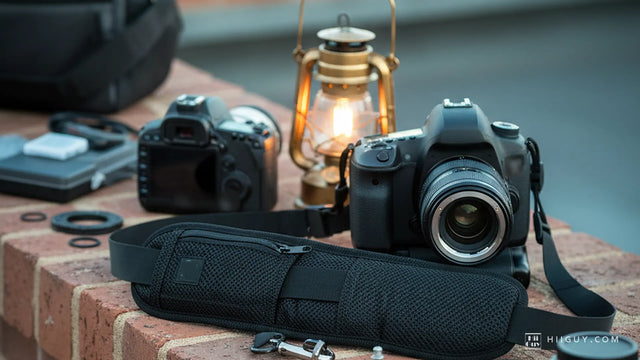
That is one of our own photographs, taken on an ordinary afternoon rather than in a studio, and the hand on the camera body is the point of it. Whatever strap you own, that grip is what stops the swing in a crowd, and a strap is good or bad mostly according to how little it fights you when you reach for it.
The HiiGuy strap is a one-point sling. The camera end is a stainless steel quick release on a screw mount that goes into the tripod socket, so the body hangs lens-down at your side and pivots up to your eye instead of being lifted. The safety tether clips to a strap eyelet, which is a different fitting from the one carrying the weight, and that is deliberate: a backup that shares a fixing with the thing it is backing up is not a backup. Above that there is heavy-duty polyester webbing running into a wide padded shoulder pad, and it carries a 3 year warranty from HiiGuy.
It comes as two variations, and length is the only difference between them. The regular adjusts up to 32 in on the body and the XXL adjusts up to 44 in, which is the one to take if you are tall, broad, wearing a winter coat over the top, or you simply want the camera riding lower across the body than most straps will let it. Both sit on the same Amazon listing, as two options on one page.
A two-minute check before you walk in
Do this in the queue, not at the barrier.
Shorten the webbing until the camera sits where your forearm naturally rests, then take one step and a half turn and see whether the body swings into anything. Put a finger on the main fixing and try to turn it; a screw mount that has worked loose in a bag will tell you now rather than later. Check that the tether is actually clipped to something, which is the single most commonly skipped step on any strap that has one. Get the lens cap off and into a pocket, because you will not find it in the dark. And make a decision about the second body before you go in, since a crowd is the worst possible place to change your mind about what you are carrying.
Then stop thinking about the strap. That is the whole point of getting it right beforehand. If you are still aware of it an hour in, something about it is wrong, and it is usually the length.