The D3500 is a camera with a very clear edge to it. Nikon's published specifications put the body at 12.9 ounces, or about 14.7 ounces once a battery and a card are in it, with a single SD slot, a fixed 3-inch screen of roughly 921,000 dots, a shutter that runs from 1/4000 of a second to 30 seconds plus Bulb and Time, and a battery rated at around 1,550 shots per charge. That last number is remarkable for a camera this size.
Read that list as a map rather than a scorecard and choosing Nikon D3500 accessories gets easy. Every pick below exists because of a specific line in it, and the three at the bottom are the ones to walk past, including one that physically cannot work on this body.
Some of the links below are affiliate links, which means we earn a small commission if you buy through them. It costs you nothing and does not change what gets recommended here. The HiiGuy strap is our own product and is not an affiliate link.
1. A lens that will actually autofocus on it
Start here, because this is the one place a D3500 will genuinely refuse something you have bought.
The body has no focus motor in it. Nikon's compatibility notes for this camera are blunt about what follows: it supports autofocus with AF-P and type E and G AF-S lenses only, and autofocus is not supported with other AF lenses. So the bargain second-hand Nikon lens with a screw-drive autofocus coupling, the sort that has been floating around since the 1990s and costs almost nothing, will mount and meter and then sit there while you turn the ring by hand.
The kit lens Nikon sells with this body is the AF-P DX 18-55mm f/3.5-5.6G VR, and it is fine. What it cannot do is let in much light, which is what puts you at the top of the ISO range indoors. The AF-S DX 35mm f/1.8G is the usual next lens for a reason: it is a type G AF-S design, so it autofocuses on this camera, and on the DX sensor the 35mm focal length behaves like a standard lens rather than a portrait one. That makes it a genuine walk-around rather than something you put on for one kind of shot.
See the Nikon AF-S DX 35mm f/1.8G on Amazon
2. One SD card you trust, not four you do not
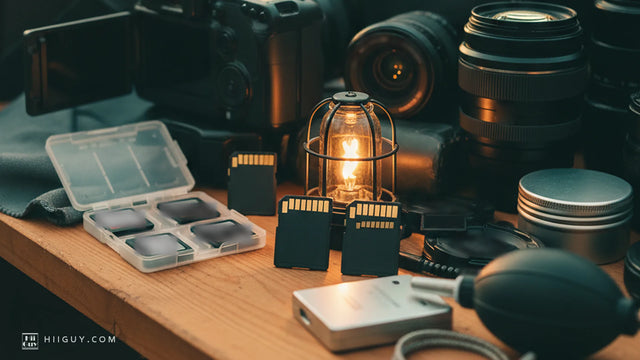
There is one card slot. Not one card slot and a backup, one slot, which means that for the length of a trip the card in the camera is the only copy of everything on it. Nikon's specification lists SD, and UHS-I compliant SDHC and SDXC cards, so UHS-I is the standard to buy into.
Resist buying speed. The camera tops out at about 5 frames a second, and Nikon's own footnote on that figure assumes manual focus, manual or shutter-priority exposure and a shutter of 1/250 or faster, which is to say it is a best case rather than a normal afternoon. A SanDisk Extreme 128GB SDXC card is far quicker than this body will ever ask for. What you are paying for is the part that matters on a single-slot camera, which is a card that comes home from a holiday with every frame still readable.
If the markings on the front of a card are a mystery, we decoded them in what the numbers on memory cards mean.
See the SanDisk Extreme SDXC on Amazon
3. A strap that puts the weight somewhere better

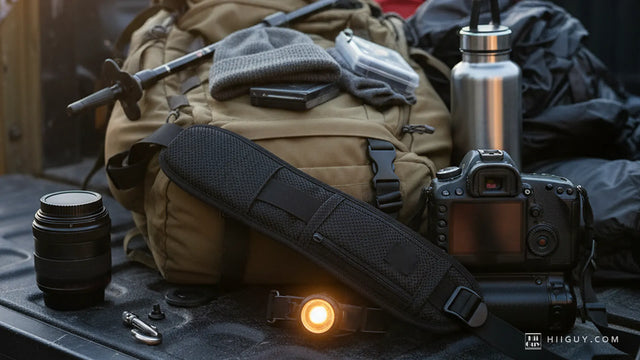
At 14.7 ounces loaded, a D3500 is light enough that the thin strap in the box is not painful. That is exactly why this gets skipped, and why it is worth saying what actually goes wrong. A narrow neck strap at that weight is tolerable rather than comfortable, so the camera comes off at lunch and spends the afternoon in a bag, and a camera in a bag takes no pictures. Then you add a longer lens and the tolerable part stops being true.
The HiiGuy strap is long enough to wear across the body, which moves the load off the back of your neck and onto a shoulder. It is heavy-duty polyester webbing with a wide padded shoulder pad, a stainless steel quick release that threads into the tripod socket, rustproof metal fittings and a safety tether that gives the load a second path up to a strap eyelet. HiiGuy has been making these in Los Angeles since 2016 and backs the HiiGuy strap for three full years.
Two variations, and length is the only difference between them: the Regular adjusts up to 32 inches on the body and the XXL adjusts up to 44 inches. Everything else in the two is identical. If you want the full attachment picture for a Nikon first, we wrote where a strap attaches on a D3500, D5600, D7500 or D850.
4. A tripod, because this camera has no other way to stay still
The shutter goes to 30 seconds, and then there is Bulb and Time on top of that. Nikon built a camera that can shoot a long exposure and then, as the accessory list makes clear below, gave it nothing to trigger the shutter with except your finger or a phone.
So the tripod is doing double duty here. It holds the camera still for the exposure, and it means the shake from your hand on the shutter button is the only variable left to deal with. Buy one tall enough that you are not stooping, because a tripod you have to crouch over is a tripod that stays at home. The VICTIV aluminum model extends to 74 inches and comes with a carry bag. Aluminum rather than carbon fibre at this end means heavier to carry and cheaper to replace, which is the right trade for a first tripod.
See the VICTIV 74-inch tripod on Amazon
5. A blower, and nothing else that touches the sensor
This one is less about buying a thing and more about not wrecking a camera, and Nikon's care instructions for the D3500 are unusually direct about it.
The manual says to remove dust and lint from the sensor with a blower. It says not to use a blower-brush, because the bristles can damage the sensor. It says that under no circumstances should you touch or wipe the sensor, and that Nikon recommends the sensor be cleaned only by Nikon-authorized service personnel. For the lens, mirror and viewfinder it calls the glass easily damaged and points at a blower again, with the note that an aerosol can should be kept vertical so it does not spit liquid onto the glass.
A plain rubber blower is therefore the entire sanctioned toolkit, and the Giottos Rocket Air Blaster is the one most people end up with. Every swab kit and sensor pen that gets recommended alongside it is doing something Nikon explicitly tells you not to do on this body.
See the Giottos Rocket Air Blaster on Amazon
6. A rain cover, because of where Nikon draws the line
Nikon's stated operating environment for the D3500 is 32 to 104 degrees Fahrenheit at 85 percent humidity or less, with no condensation, and its storage advice is to avoid anywhere above 60 percent humidity for the long term. That is a camera designed for ordinary conditions and honest about it.
A packable rain cover costs almost nothing, weighs almost nothing and is the difference between carrying on in a shower and putting the camera away. Altura sells them in a two-pack, which is sensible, because the first one always ends up left in another bag. Keep one permanently in whatever you carry.
See the Altura rain cover two-pack on Amazon
Three things not to buy for a D3500
All three get recommended in accessory lists for this camera. None of them works.
The ML-L3 infrared remote. This is the big one, because it is sold constantly as a Nikon remote and the D3500 has no infrared receiver for it to talk to. Nikon's own support answer is that the ML-L3 is not compatible with the D3500 and points owners at the SnapBridge app for remote release instead. Nikon's accessories list for this body names batteries, a charger, a power connector, filters, eyepiece attachments, body caps, a shoe cover and cables, and no remote control of any kind, wired or wireless.
A linear polarizing filter. Nikon's accessory notes for this camera recommend circular polarizers, the C-PL and C-PL II types, and state that linear polarizers are not compatible. Cheap polarizers in unbranded kits are frequently linear. Read the box, buy circular, and buy it in the thread size printed on the front of your lens rather than the size on someone else's.
An external microphone. Nikon lists a built-in monaural microphone with adjustable sensitivity on this body and no external microphone input. A shotgun mic in a video bundle has nowhere to plug in. If you want better audio out of a D3500, record it separately on a phone and line it up afterwards.
The order to buy them in
The lens first, and it is not close. Nothing else on this list changes what the photographs look like, and going from the kit zoom at f/5.6 to a prime at f/1.8 is the difference between a camera that struggles indoors and one that does not.
The strap second, because it decides whether the camera is on you or in a bag, and the rest of this list is irrelevant to a camera in a bag. Then the card, which you should own before a trip rather than during one.
The blower, the rain cover and the tripod are the slow, unglamorous three. Buy them when you notice you need them, which for most people is after the first dusty lens change, the first shower and the first evening you try to photograph something after sunset.
One thing we have deliberately left off: a spare battery. At roughly 1,550 shots per charge this camera is an outlier, and unless you are shooting a lot of video or living in live view, you will not finish a battery in a day. Buy it when it runs out on you, not before. If you are still assembling the whole kit from nothing, the complete DSLR starter kit lays out the full picture.