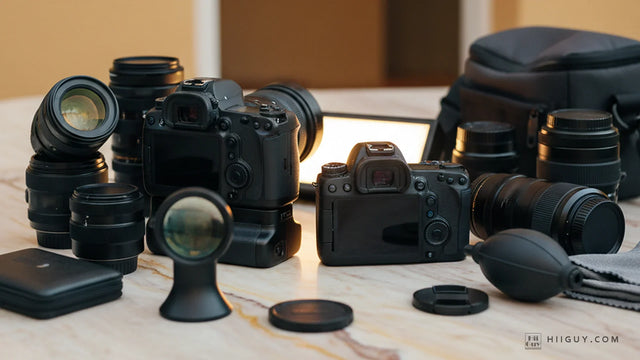
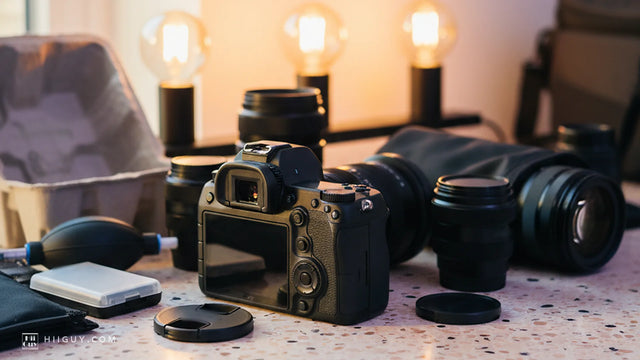
Somebody typed "r10 vs r7 autofocus" into a search box this morning, and they will have typed it because that is where every argument about these two bodies ends up. Canon R10 vs R7 gets discussed as if the bigger camera must focus better, because it costs more and it is heavier and it sits above the other one in the range.
Read Canon's own specification pages for the two bodies side by side and the autofocus lines are the same. Not similar. The same.
Which is annoying if you wanted the question settled for you, and useful if you would rather spend the difference well. Everything that actually separates these cameras is the body built around the sensor, and most of it you feel with your hands rather than see in a file.
Canon lists the same autofocus system on both bodies
Both spec sheets name Dual Pixel CMOS AF II. Both give the same figure for coverage: up to 651 AF frame zones. Both list eye detection for people and animals, and both name the same subject priorities, people, animals including dogs, cats and birds, and vehicles.
Neither of the pages I read publishes a low-light autofocus limit in EV, so I am not going to quote one. If you see a number for that in a comparison table, ask where it came from.
There are things a spec sheet cannot tell you about autofocus, and the honest position is that the processing, the buffer and the firmware behind those 651 zones are not fully described by any published line. What I can say is that the single number everyone compares is identical, so if autofocus is the whole of your question, the question is already answered and you should be deciding on something else. We went through which numbers on a spec sheet are worth believing in how to read a camera spec sheet.
What the extra money does buy, line by line
These are the lines where Canon's two pages genuinely disagree.
In-body stabilization. This is the big one. The R10 page states it plainly: in-body image stabilizer, sensor shift IS, "No". The R7 has it, five axis, and Canon's page claims up to 8 stops through coordinated control with a compatible lens. Treat that as the best case rather than the number you will live with, because it depends on the lens cooperating. The effect is real though. It is the difference between handholding at a shutter speed you would otherwise refuse, in a church, at dusk, on a lens with no stabilization of its own.
A second card slot. The R7 takes two SD cards and supports UHS-II. The R10 takes one. For a hobbyist this is a line in a table. For anybody shooting an event that cannot be reshot, it is the only insurance that exists against a card failing, and it is the reason a lot of people buy up a tier.
Shutter and flash. The R7's mechanical shutter runs 30 seconds to 1/8000 with flash sync at 1/250. The R10 runs 30 seconds to 1/4000, sync at 1/200. That matters in exactly two situations: wide open in bright sun, and anything with a flash in daylight.
Burst. Both do 15 fps with the mechanical shutter. On the electronic shutter the R7 does 30 fps and the R10 does 23.
Resolution. 32.5 effective megapixels on the R7 against 24.2 on the R10, both APS-C CMOS. For most people this changes nothing. For somebody photographing birds who crops hard into every frame, it is extra room to crop and it is worth paying for.
Screen, and not the viewfinder. The R7's rear screen is 3.0 in at 1.62 million dots, the R10's is 3.0 in at 1.04 million. The viewfinders are the same on paper: 0.39 in OLED, approximately 2.36 million dots, 100% coverage, and the same 59.94 and 119.88 fps refresh options. If you expected the more expensive body to have a better finder, it does not, at least not as published.
Weather. Canon's R7 page says the camera is designed to be dust and drip resistant. The R10 body page I read makes no sealing claim at all. That is not the same as saying the R10 is unsealed, and I am not going to say it. It means Canon declines to promise anything, and an unmade promise is the one you plan around when it starts raining.
The part that follows you around all day
Here is the spec that decides more purchases than anything above, and it is the one people skim.
The R7 weighs 21.6 oz with its battery and a card in it. The R10 weighs 15.1 oz the same way. That is a difference of about 6.5 oz, which sounds like nothing while you are holding both in a shop for ninety seconds and is a completely different conversation six hours into a day with one of them on your shoulder.
The bodies are 5.2 by 3.6 by 3.6 in for the R7 and 4.8 by 3.5 by 3.3 in for the R10. Width and height barely differ. The depth does, by about a third of an inch, and depth is grip. If you have big hands, the R7 is the one that fills them, and a camera you can hold properly is a camera you hold more steadily. If your hands are small, that same third of an inch is a stretch you make a few thousand times a day.
Then the multiplier nobody puts in the comparison: the lens. Neither of these numbers includes glass, and the telephoto you buy for the crop sensor will outweigh the difference between the bodies several times over. That is also the argument for not spending every last dollar on the body, which we worked through in is a bigger camera overkill for beginners.
So which one, honestly
Buy the R7 if any of these is actually true of you, not aspirationally true.
- You shoot handheld at slow shutter speeds, indoors or at dusk, with lenses that are not stabilized. The in-body stabilization is the one thing here that money cannot buy back later.
- Somebody is paying you, and a corrupt card would be a disaster rather than a bad evening. Buy the second slot.
- You photograph wildlife and you crop into most frames. Take the extra pixels.
- You work outdoors in weather and you want the maker to have said something about it.
Buy the R10 if autofocus was the question, because you are getting the same system Canon puts in the other one. Buy it if you walk all day, if you travel light, or if the gap between the two is the difference between a kit zoom and a lens you actually want. A lighter body you carry everywhere beats a better one you leave at home, and that is not a consolation prize.
The honest one-liner: the R7 buys stabilization, redundancy, a faster shutter and crop room, and it charges you 6.5 oz and a deeper grip for them. Nothing in it buys you better focus.
Whichever one you carry, fix the strap before the first trip

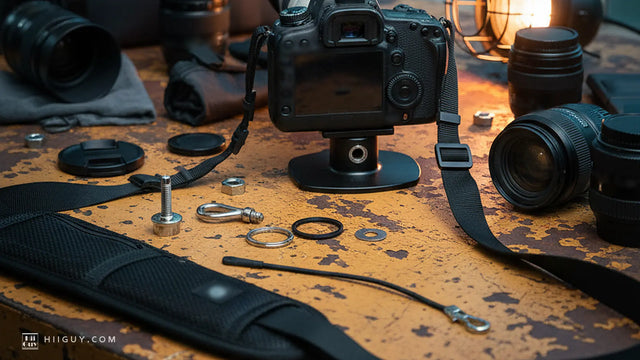
That is one of our own photographs, and it is the situation both of these cameras put you in: body plus a long lens, hanging off one shoulder, for hours. 21.6 oz is the R7 before a single piece of glass is attached, and the thing between all of that and your collarbone is a strap you did not choose.
Our own Amazon advertising data says something about where buyers get to on this. Of 620 phrases real customers typed in the period to August 2026, 65 of them name Canon, for 327 impressions, and almost all of them are people looking for a strap for a body they already own rather than a body to buy. Neither the R7 nor the R10 appears once. People stop thinking about the camera and start thinking about carrying it, usually a week or two late.
The HiiGuy strap is built for that second week. Heavy-duty polyester webbing into a wide padded shoulder pad, a stainless steel quick release so the body comes off in one motion, rustproof metal fittings and a safety tether behind the release. It comes in two variations and length is the only difference between them: the Regular adjusts up to 32 in on the body and the XXL adjusts up to 44 in, with the same contents in both boxes. HiiGuy has made it in Los Angeles since 2016 and the warranty from HiiGuy runs three full years. If you are shooting Canon, the fit and the mounting points are covered in our guide to a camera strap for Canon bodies, and if the one in the box is still on your camera, read why the kit strap goes first.
The short version
Canon R10 vs R7 is not an autofocus question. Canon publishes the same system, the same 651 zones and the same subject detection on both, and the pages do not separate them there at all.
The R7 is the heavier, deeper, higher-resolution body with in-body stabilization, two card slots, a 1/8000 shutter and a dust and drip resistant design. The R10 is 6.5 oz lighter with one slot, no sensor-shift stabilization and a 1/4000 shutter, and it focuses on the same system.
Decide on stabilization and the second card slot. Those are the two things you cannot add afterwards. Everything else on that list you can either live without or buy later, and the 6.5 oz you are saving gets spent on the lens.