Your camera weighs less than a can of soup and every strap listing you open shows a DSLR the size of a brick. That is the awkward bit. The reviews all talk about weight relief and shoulder load, and you are holding an a6400 that disappears in one hand, wondering whether any of this applies to you or whether you are about to bolt a harness onto a sparrow.
Two separate questions are hiding in there. Will a Sony camera strap physically attach to an Alpha body, and does a small, light body want the same carry setup as a heavy one. The first has a short answer. The second is the one worth your time, and almost nobody writes it down.
What Sony actually calls the attachment points
Start with Sony's own words, because they settle the compatibility question in one line.
Open the help guide for the a7 III, the a7C II or the a6400 and look at the parts diagram. Sony labels the two slots on the sides of the body Hooks for shoulder strap, and the instruction under them is identical on all three: attach both ends of the strap onto the camera. Not one end. Both. That is Sony describing a two point strap, which is also the strap it puts in the box, because every one of those three bodies ships with a Shoulder Strap listed in its supplied items.
Turn the camera over and there is a second route. Sony's a7C II guide prints it plainly: the tripod socket hole supports 1/4-20 UNC screws. That is the same quarter inch thread a tripod plate uses, and it is what a sling or crossbody strap screws into so the camera can hang lens down at your hip.
So: two hooks up top, one threaded socket underneath, on every body in this article. Nothing about an Alpha is unusual. If a strap works on a DSLR, the attachment works here.
The one measurement to check, and it is on the screw
There is a limit Sony prints that most people never read. In both the a6400 and the a7C II guides, the note under the tripod socket says to use a screw less than 7/32 in long, because a longer one cannot secure the camera properly and may damage it.
That matters for strap mounts, not just tripods. A screw mount is a short bolt with a strap loop on it, and the ones sold for heavier bodies are not all cut to the same length. Before you tighten anything into the base of an a6100, look at how far the thread protrudes. If it bottoms out before the mount sits flush against the body, stop. A quarter inch socket in a magnesium and plastic chassis is not a place to apply force and hope.
Why the Sony camera strap question is really four different cameras
Here is where the model name finally earns its place, and it has nothing to do with whether the strap fits.
Sony publishes the weight of each body including the battery pack and card, which is the honest number because that is how you carry it. The a6100 is 14.0 oz. The a6400 is 14.3 oz. The a7C II is 1 lb 2.2 oz. The a7 III is 1 lb 7.0 oz. Put the two ends of that range side by side and the full frame body is more than two and a half times the little one, before a lens goes on the front.
Size splits the same way. Sony lists the a6400 at roughly 4 3/4 by 2 3/4 by 2 3/8 in, the a7C II at 5 by 2 7/8 by 2 1/2 in, and the a7 III at about 5 by 3 7/8 by 3 in. The a6000 series bodies are genuinely small objects. The a7 III is a normal sized camera that happens to have no mirror in it.
What follows from that is not a strength problem. Fifteen ounces of camera will not test any strap made. It is a position problem, and it goes in the opposite direction to what people expect.
- a6100 and a6400. Light enough to forget, small enough to swing. A short strap parks a 14 oz body right at your sternum where it knocks into everything you lean over, and because it weighs nothing you never notice it happening until you hear it.
- a7C II. The compact full frame case. Barely heavier than the crop bodies, but it attracts full size glass, and the lens is what decides the carry, not the body.
- a7 III. Heavy enough that a thin strap on the back of your neck is noticeable in an afternoon, and the only one of the four where padding is doing real work.
Sony owners search by model, and the data is blunt about it
We run Amazon ads on our own strap, and the search term report for the period ending August 2026 holds 620 distinct phrases that real people typed before clicking one. We went through it looking for how Sony shooters describe themselves.
Thirty eight of those 620 phrases contain the word Sony. Exactly two contain the word mirrorless, and between them they drew eight impressions. People typed "sony a7iii camera strap", "sony a6100 strap", "sony a6400 camera strap", "sony a7cii accessories". Almost nobody searched for a mirrorless camera strap, because almost nobody thinks of their camera that way. They think of it as an a6400.
That is useful to you as a buyer, not just to us. It means most strap listings are written for whoever searches loudest, and the loudest searches in that report are generic ones. A listing that never mentions your body is not a listing that excludes it. It is a listing written for the search traffic.
Where a light camera should sit, and the length that decides it
This is the part that is different on a small body, and it is the thing to get right.
With a heavy rig you set the length so the weight lands on the muscle at the top of your shoulder. With a 14 oz body you are not managing weight, you are managing a small hard object on the end of a pendulum. Let it ride high and it bangs the table when you sit down and clips the door frame when you turn. Let it hang long, around the hip, and it stops being in the way, because your arm naturally rests over it.
Crossbody is the setup that does this best on an Alpha, and it is almost entirely a question of how long the strap runs. We worked that out properly in how a crossbody strap should fit, and the numbers by height are in the camera strap length chart. If you are still deciding between hanging from the hooks or hanging from the base, tripod socket or strap lugs is the piece that compares the two load paths.

That frame is from our own 2018 shoot, so the camera in it is a DSLR with heavy glass on the front rather than an Alpha. Look past the body and at the geometry, because the geometry is the whole point: the webbing crosses the chest, the camera parks at the opposite hip, and the whole rig hangs from one connector so the lens points straight down instead of lying flat against the body. Hang an a6400 there and the swing problem disappears, which is the one thing a small body genuinely needs from a strap.
Which HiiGuy strap suits an Alpha
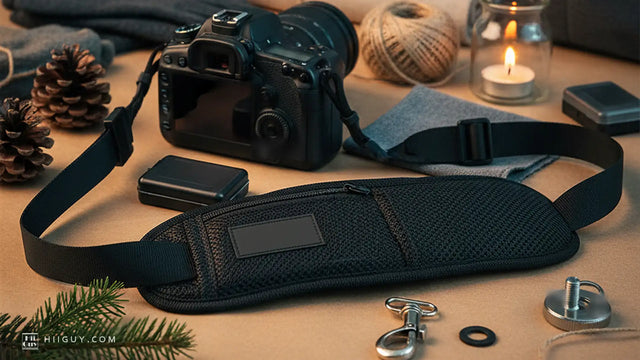
We have been making this strap in Los Angeles since 2016, so the straight version. The HiiGuy strap is heavy-duty polyester webbing with a wide padded shoulder pad, a stainless steel quick release that threads into the 1/4-20 socket, and a safety tether that runs up to a strap hook so the load has a second path if the first one is ever disturbed. On a Sony that tether detail is worth a second of thought, because the hooks sit empty once the mount is in the base, and using one of them costs you nothing.
There are two variations and length is the only difference between them. The Regular adjusts up to 32 in on the body and the XXL up to 44 in, with the same webbing, the same pad, the same quick release and the same safety tether in both. For a light Alpha the longer run is usually the more comfortable answer rather than the tall person answer, because the camera wants to be down at the hip and out of the way. HiiGuy backs the HiiGuy strap for three full years. See it on Amazon.
Three things to check with the camera in your hand
A minute settles all of it.
- Look at both hooks. Sony's instruction is to attach both ends, so if a previous owner left a cord loop or a split ring in one of them, decide now whether it stays.
- Look in the socket. One quarter inch hole, and a tripod plate, an L bracket and a strap mount all want it. If a plate already lives down there, you are choosing between them unless the plate has a pass through thread.
- Put the lens you actually use on the front. An a7C II with a small prime and an a7C II with a 70-200mm are two different carrying problems, and the strap has to suit the heavier day.
The fit answer is dull: it goes on, on all four bodies, by either route. The interesting answer is that a light camera does not need a stronger strap than a heavy one. It needs a longer one, so the thing stops swinging into the world every time you turn around.