You have already made the hard decision. You want a Nikon DSLR, you want the one with the mirror and the optical finder, and you have narrowed it to the two everybody narrows it to. Then you opened the spec sheets and got less certain instead of more, because the Nikon D5600 vs D7500 comparison does the one thing a comparison is not supposed to do: the cheaper body wins the number you have been taught to care about.
Nikon's own published specifications give the D5600 24.2 million effective pixels and the D7500 20.9 million. That is not a typo, it is not a trick, and it is not Nikon being careless. It is the clearest example in the current lineup of the gap between the numbers beginners check and the numbers that decide what a camera is like to use.
Here is the whole thing, laid out honestly, with every figure taken from Nikon's own product pages for the two bodies.

The four numbers you are checking, and the D5600 wins all four
Watch anybody compare two cameras for the first time. They check the same four things in the same order, every time. On all four, the cheaper camera is ahead.
Resolution. 24.2 million effective pixels on the D5600 against 20.9 million on the D7500. Both on a DX-format sensor of essentially the same physical size.
The screen. Both are 3.2 inches. The D5600's is a 1,037,000-dot vari-angle touchscreen that swings out and rotates. The D7500's is a 922,000-dot touchscreen that tilts up and down only. More dots and more movement, both to the cheaper camera.
Battery life. Nikon rates the D5600 at 970 shots to CIPA and the D7500 at 950. The D5600 does that on the smaller EN-EL14a while the D7500 uses the bigger EN-EL15a, which makes it a wider gap than the twenty shots suggest.
Weight. Nikon lists the D5600 at 14.7 oz and the D7500 at 22.6 oz for the body alone. Put a battery and a card in each and the D5600 comes to 16.4 oz while the D7500 reaches 1 lb 9.4 oz. The D5600 is also smaller in all three dimensions, at 4.9 by 3.8 by 2.8 inches against 5.3 by 4.1 by 2.9.
Four for four. If those were the only figures that existed, the comparison would be over and nobody would buy the other one.
The four numbers you are not checking, and the D7500 wins all four
Now the other column. These are not obscure specifications. They are just the ones that mean nothing to you until you have missed a shot because of them.
The metering sensor, which is the one nobody ever mentions
The D5600 meters the scene with a 2,016-pixel RGB sensor. The D7500 uses one with approximately 180,000 pixels. That is not a refinement, it is roughly ninety times the information, and it is the single largest proportional gap between these two bodies.
That sensor is what the camera uses to decide exposure, to recognise what it is looking at, and to feed subject tracking. A metering sensor that sees the scene in detail is why one camera holds exposure when a bird crosses a bright sky and the other blinks. You will never see this figure on a shop shelf tag, and it changes more day-to-day pictures than the megapixel difference does.
Autofocus
39 points on the D5600, from Nikon's Multi-CAM 4800 module. 51 points on the D7500, from the Advanced Multi-CAM 3500 II, and Nikon states that 15 of those are cross-type. Cross-type points read detail in both directions rather than one, which is why they hold onto a subject that a single-axis point lets go of.
Nikon does not publish a cross-type count for the D5600, so I am not going to claim one. The honest comparison is 51 points of which 15 are confirmed cross-type, against 39 points with the cross-type count unstated.
Frame rate, and the buffer behind it
The D5600 shoots up to 5 frames per second in JPEG and 12-bit raw, dropping to 4 fps at 14-bit. The D7500 does 8 fps, and Nikon's published buffer capacity is around 50 raw frames.
The frame rate is the headline, but the buffer behind it is what decides whether you can use it. Fifty frames at eight a second is a little over six seconds of holding the button down, which is long enough to settle on a moment and wait for it rather than stabbing at the shutter and hoping. A camera that runs out of buffer mid-burst stops just as the thing you were waiting for happens.
ISO ceiling
The D5600 runs ISO 100 to 25,600. The D7500 runs 100 to 51,200 natively, and Nikon publishes an expansion down to an ISO 50 equivalent and up to a Hi 5 setting equivalent to ISO 1,640,000.
Treat that top figure as the marketing number it is. Nobody shoots at 1,640,000. The useful part is the native ceiling being one full stop higher, which is one more stop of shutter speed in a dark church or a school hall. If the numbers on the ISO dial still feel arbitrary, we went through what each range actually buys you in what ISO your camera can actually use.
So why does the cheaper camera have more pixels?
Because pixel count and image quality stopped being the same thing a long time ago, and because the two sensors are almost exactly the same physical size.
Run the arithmetic on Nikon's published dimensions. The D5600 puts 24.2 million pixels on a sensor Nikon lists at 23.5 by 15.6 mm. The D7500 puts 20.9 million on one listed at 23.5 by 15.7 mm. Divide it out and each D7500 photosite occupies about 17 per cent more area than each D5600 photosite. Bigger buckets, fewer of them.
That is the trade, and it is a deliberate one. The D7500 gave up resolution to collect more light per pixel, which is the same decision sitting underneath its higher ISO ceiling. The D5600 kept the resolution, which is genuinely useful if you crop hard or print large.
And the resolution gap is smaller than it sounds. 24.2 against 20.9 million is about 16 per cent more pixels, but pixels are counted in two dimensions, so along each edge of the frame it works out at roughly 8 per cent more. On a print that is the difference between 20 inches wide and 21.6. It is not nothing. It is also not the thing the comparison turns on.
The viewfinder difference nobody puts in the table
You will look through this thing hundreds of thousands of times, and it is the one spec that almost no comparison bothers with.
Nikon rates the D5600's optical viewfinder at approximately 95 per cent coverage and 0.82x magnification. The D7500's is approximately 100 per cent coverage at 0.94x.
Two separate things there. 95 per cent coverage means roughly five per cent of what the sensor records is not visible to you when you compose, so things creep into the edges of frames you thought were clean. 100 per cent means what you saw is what you got. And 0.94x against 0.82x is a visibly bigger, brighter view, which matters most when you are manually focusing or shooting in poor light.
Spend five minutes with both bodies in your hands and this is the difference people actually notice first, long before they notice anything about pixels.
What Nikon does not say about either one
Worth saying plainly, because the internet says otherwise. Nikon's own specification pages for these two cameras state no dust or drip resistance rating and no weather sealing claim for either body. The D7500's page uses general language about rugged design, which is marketing copy rather than a sealing specification, and the only environmental figure Nikon publishes is an operating range of 32 to 104°F.
You will read in a hundred places that the D7500 is weather sealed and the D5600 is not. That may well be true in practice, and the D7500 is clearly the more solidly built of the two. But it is not something Nikon's published specifications settle, so we are not going to present it as a fact we checked.
Neither does Nikon publish a shutter durability rating for either camera. If you are buying used, that absence matters more than anything in the spec table, and it is the first thing on our 9 things to check before you buy a used DSLR.
The other published differences worth knowing: the D7500 shoots 4K UHD at 30, 25 and 24p while the D5600 tops out at Full HD 60p with no 4K at all, and the D7500's shutter runs to 1/8000 against the D5600's 1/4000. Both take a single SD card.
Which one you should actually buy
Not a crowning. Two different right answers.
Buy the D5600 if the camera has to be light enough that you take it, if you shoot stills of things that hold reasonably still, if you want the screen that flips all the way out because you film yourself or shoot at odd angles, and if the extra resolution earns its keep because you crop. It is also the easier first DSLR, and if you are still weighing the step below it, we put that one side by side in Nikon D3500 vs D5600.
Buy the D7500 if anything you photograph moves unpredictably, if you shoot indoors or after dark often, if you want 4K, or if you simply want the better viewfinder and the deeper grip. You pay for it in nearly 8 oz of extra body weight and in resolution you will mostly not miss.
The one thing that should not decide it is the megapixel count. That is the figure the two cameras are least separated by, and the only one most people look at.
Whichever body you end up with, deal with the strap
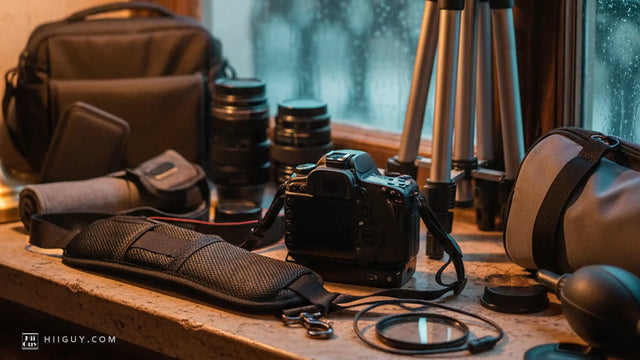
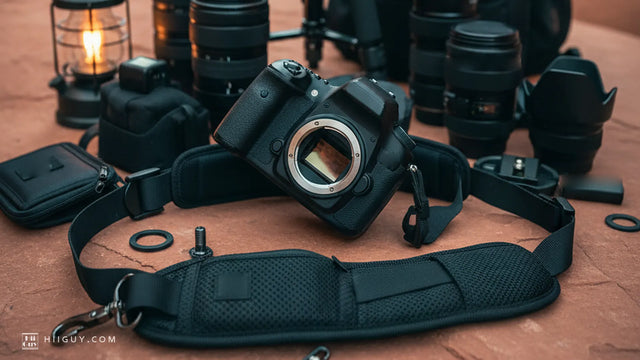
Here is the part the spec sheets never cover. The strap in that box was designed to be cheap to include, and on the D7500 in particular it is doing a real job badly, because 1 lb 9.4 oz of camera plus a lens on a thin nylon band around your neck becomes uncomfortable faster than you expect.
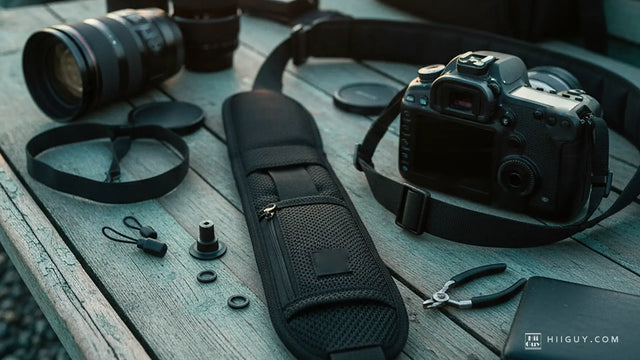
The HiiGuy strap exists for that, and we have been making it in Los Angeles since 2016. It comes in two variations and length is the only difference between them: the Regular adjusts up to 32 in on the body, the XXL up to 44 in. Everything else in the box is identical. Heavy-duty polyester webbing into a wide padded shoulder pad that spreads the load across a shoulder instead of hanging it off your neck, a stainless steel quick release at the camera end, a safety tether behind it as a second path for the weight, and rustproof metal fittings. HiiGuy backs the HiiGuy strap for three full years.
It mounts by a 1/4-20 screw into the tripod socket, so it fits both of these bodies and anything else you move on to. If you want the specifics for Nikon DSLRs in particular, including where the eyelets sit on each body, we covered the D3500, D5600, D7500 and D850 in will this strap fit my Nikon. Otherwise, the full specification is on the product page and you can see both variations on Amazon.
The short version
The D5600 wins resolution, screen, battery and weight. The D7500 wins metering, autofocus, frame rate and ISO, plus the viewfinder and the shutter. Those are the two halves of the Nikon D5600 vs D7500 question and they do not overlap.
If your subjects move or the light is bad, take the D7500 and accept the weight. If portability and resolution matter more and your subjects stay put, take the D5600 and spend the difference on glass. The megapixel count is the one figure that should not be casting a vote.