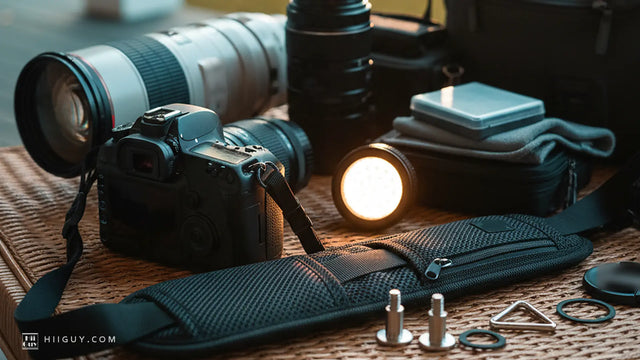
You have decided to buy a photographer a camera strap, and it is a better instinct than you know. It is the one thing they touch every single time they pick the camera up, and it is almost always the thing they never get round to replacing for themselves. Then you hit the wall. You do not know what camera they own. You cannot just ask, because asking is the end of the surprise. And every product page is written as though you already knew.
Camera accessories are an unusually good gift and an unusually frightening one for the same reason: they look specific. A strap feels like it needs a part number. It does not. Of the four things that could go wrong here, two are settled by an international standard and are genuinely not your problem, and the other two are about the person rather than the camera. You can work out both of those without saying a word to them.

The make and model are the two things you can stop worrying about
Underneath almost every camera there is one threaded hole. It is not a Canon hole or a Nikon hole. ISO 1222 governs tripod connections and specifies a 1/4-20 thread for consumer cameras, which is why a tripod bought in 1998 still screws onto a body bought last week. Any strap that mounts by screwing into that socket is, for practical purposes, model-blind. You are not matching a part to a camera. You are using the one fitting the whole industry agreed on decades ago.
The other attachment point, the two small metal eyelets on the top corners of the body, is a different story and it is worth being straight about it. There is no published standard for those. Manufacturers put them where they like and make the slots the size they like, which is why thin cord and split rings exist as a product category at all. In practice nearly every interchangeable-lens camera has a pair, and nearly every strap fitting goes through them, but "nearly" is doing real work in that sentence.
So if you want the decision to be airtight, buy the strap that screws into the socket. That is the part of this that is actually standardised, and it takes the camera out of the equation entirely. If you want to go further into why the two attachment points behave differently once the camera is hanging, we pulled that apart in tripod socket or strap lugs.
The two things you do need to know are about them, not the camera
1. Where they let the camera hang
This is the one that decides whether the strap gets used or goes in a drawer, and it has nothing to do with the body. People are oddly fixed about where they want the weight, and a strap built for the wrong answer does not get a second chance.
There are really only four answers. Around the neck, with the camera on the chest. Over one shoulder and across the body, with the camera parked at the opposite hip. Around the wrist. Or gripped, with a hand strap holding the camera into the palm.
Our own Amazon advertising report for the period ending August 2026 shows how lopsided that is in practice. Across 620 phrases people typed, the shoulder family runs to 54 separate terms and 2,693 impressions, and the sling family to 78 terms and 1,415. Neck comes in at 39 terms and 331 impressions, harness at 34 and 302, wrist at seven terms and 218, hand strap at eight and 129. Carrying off the shoulder, at the hip, is not a niche preference. It is what most people are shopping for and have been for years.
You do not have to guess which camp yours is in. Find any photograph of them holding the camera, which on most people is not hard. Look at where the camera actually is. On the chest means they are a neck-strap person and may well be ready to stop being one. At the hip, with the strap running diagonally across them, means a sling. In the fist with nothing around them means a hand strap, and a long strap will annoy them. We went through all seven arrangements and who each suits in 7 ways to carry a camera all day.
2. Roughly how tall and how broad they are
Not exactly. Roughly. You already know this about them, you have just never been asked to put a number on it.
Length matters because a strap worn across the body has to travel over a shoulder, down a back and round to the far hip, and a bigger person needs more webbing to cover the same geometry. This is the single thing people get wrong when they buy a strap for themselves, so it is not a shameful thing to get wrong as a gift. The consequence of guessing short is a camera that sits up under the ribs and digs in. The consequence of guessing long is a camera slightly lower than ideal, which is a setting you can change. Those two mistakes are not equally bad, and that asymmetry is your friend here.
If you want to be more precise than a guess, we worked the drop out by height and by carry position in our camera strap length chart. For a gift you do not need the chart. You need to know whether they are closer to average or closer to tall and broad, and whether they spend half the year in a coat.
Finding out without ruining it
Three things work, and one does not.
Their own photographs work. Anyone who shoots has been photographed holding the camera by somebody else, and that frame answers the carry question in a second.
The drawer works, if you live with them. Whatever is currently on the camera tells you what they have tolerated and roughly how long it is.
A mutual friend who also shoots works, and is the best of the three, because they will know the make and model as well and can tell you whether the person has already solved this.
Asking them directly does not work, and not only because of the surprise. Ask a photographer what strap they want and you will get a brand name they read about, which may be built for a carry style they do not use. The question you would need to ask is "where do you like the camera to hang", and nobody asks that out of nowhere without giving the game away.
Why shopping for camera accessories as a gift feels so hard
There is a reason the whole category reads as though it was written for somebody else. It was.
In that same report of 620 real search phrases, not one of them contains the word "gift". Not one. Meanwhile 65 of those phrases are people searching for accessories, and 47 of the 65 name a specific camera body: "nikon d5300 accessories", "canon eos rebel t7 accessories", "fujifilm x-s20 accessories". Across the whole report, 164 phrases name a camera brand.
That is the shape of the problem in one line. Accessory shopping is overwhelmingly done by the person who owns the camera, starting from the model name. Every guide, every comparison and every product page is built for that entrance. You are coming in by a different door, without the one piece of information the entire category is organised around, and the result is a lot of pages that feel like they are ignoring you. They are not. You are simply not who they were written for.
The useful reframe is that the model name was never the deciding factor anyway. It is a filing system, not a fit requirement.
Which HiiGuy strap goes in the box
We have been making this strap in Los Angeles since 2016, and the gift question lands in our inbox every November, so here is the straight answer.
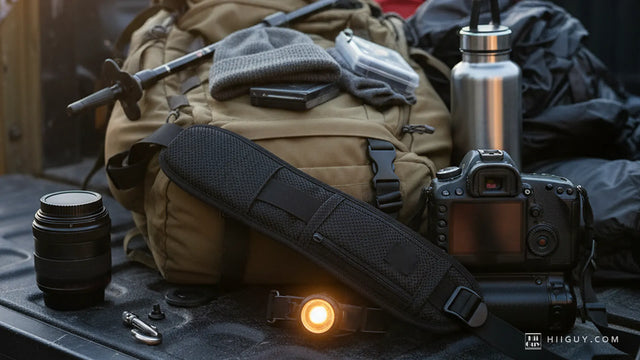
The HiiGuy strap comes in two variations. The Regular adjusts up to 32 in on the body and the XXL adjusts up to 44 in. Length is the only difference between them. The webbing, the wide padded shoulder pad, the stainless steel quick release, the safety tether and the rustproof metal fittings are identical in both boxes, and HiiGuy backs the HiiGuy strap for three full years.
Pick the XXL if they are tall, if they are broad through the chest, if the photograph you found shows the camera at their hip rather than their chest, or if they shoot in a jacket for a good part of the year. Pick the Regular otherwise. And if you genuinely cannot tell, take the XXL. It is the one that reaches the long end of the range, and the long end is the end people run out of.
On compatibility, it is a 1/4-20 screw mount into the tripod socket, which is the standardised fitting from the first section, with a safety tether that clips to a camera eyelet as a second path for the load. That combination is why we can say with a straight face that you do not need to know their camera. You can read the full specification on the product page, or see both variations on Amazon. If you would rather put more than one thing under the tree, we itemised a wider list in 8 gifts every photography lover will actually use.
The short version
You do not need the make. You do not need the model. The tripod socket is an international standard and a strap that screws into it fits what they own.
You do need two things, and both are about the person. Find one photograph of them with the camera to see where they let it hang, and know roughly how tall and how broad they are. Shoulder or hip carry plus a tall or broad build means the XXL. Chest carry on an average build means the Regular.
That is the whole decision. The part that frightened you was never the part that mattered.