Somebody searched "rapid camera neck strap shoulder belt sling" before they landed on our Amazon listing. That is four carry positions stacked into one query, and it is not the phrasing of a confused person. It is the phrasing of somebody who wants one piece of webbing to do more than one job and has no single word for that.
Which leaves a real question that almost nobody answers. Can the strap you already own hang round your neck on the walk out and sit across your body for the rest of the day, and if so, what do you actually change to move it between the two?
Mostly yes. And there is one thing on the strap that decides it, which is not the thing people reach for first.
A camera neck strap, a shoulder sling and a crossbody strap are usually one object
Our own Amazon advertising report for the period ending August 2026 covers 620 search phrases and 34,542 impressions, and the carry words are scattered right through it. Sixty-two of those phrases contain "shoulder" and together they drew 2,693 impressions. Eighty-eight contain "sling", for 1,415. Fifty-one contain some spelling of crossbody, for 267. Forty-four contain "neck", for 331.
Four vocabularies, one shelf. And our own listing is no better: it describes the same product as a camera neck strap in one line and a travel camera sling three lines later, because those are the words people type.
Here is the useful part of that mess. With one genuine exception, those words name where you put it, not how it is built. The exception is a true sling with a glider, where the camera rides on a runner and slides up the webbing to your eye. That is a different mechanism and it behaves differently enough that we gave it its own article. Everything else sold under those four headings is webbing, a pad and an adjuster, and you decide which kind of strap it is by how you wear it.
The only thing that really changes is the size of the loop
A strap is a closed circle. It leaves the camera at one attachment point, goes up over you, round, and comes back down to the other one. The camera closes the circle rather than dangling off the end of a line.
So moving from a neck carry to a crossbody carry is not a change of object or even really a change of technique. It is a change in the circumference of that circle, and the two carries want very different numbers.
Think about the paths. A neck carry runs round the back of your neck and down the front of your chest. The circle has to clear your head on the way on, and after that it is a neck-and-chest sized thing. A crossbody carry goes over one shoulder, down across your back, under the opposite arm and up your front. That circle has to clear a shoulder, a chest and an armpit. It is a torso sized thing.
Those two are not close together, and that is why "just let it out a bit" so often fails. If you want the real number rather than the feel of it, there is a string-and-tape method in how to measure your own camera strap length, and the thing to measure is the whole loop, camera back to camera.
One adjuster, and why the pad ends up in the wrong place
This is the part that gets left out, and it explains the specific annoyance of converting a strap: you set the length correctly and the pad is now somewhere stupid.
Count the sliders on your strap. If there is one, every inch of webbing you release comes out of one side of the loop. Let out 8 inches and the circle gets 8 inches bigger, but the run from the pad down to one attachment point grew by all 8 while the run to the other one did not move at all. The pad has shifted 8 inches around the circle. On your body that means it has slid off the top of your shoulder and down toward your chest or your shoulder blade, which is exactly where a pad is no use.
If there are two sliders, you let out 4 inches on each side and the pad stays put. That is the whole advantage of a second adjuster and nobody ever advertises it.
Then the question that actually decides whether your strap converts: is the padded section free to slide along the webbing, or is it sewn in place? A free pad means the one-slider problem is a two-second fix, because you push the pad back up to your shoulder after you change the length. A pad stitched to the webbing cannot move, so the strap has one length at which the pad is in the right place and it does that carry and only that carry properly. Check yours before you plan your day around it.
Set it for the crossbody carry, not for your neck
If you are only going to set the length once, set it long. The two failures are not symmetrical and that asymmetry should decide it for you.
A strap set for crossbody, dropped over your head instead, hangs the camera low, somewhere around your belt. That is not where you want it and it swings more than it should, but you can shoot like that, and you can take up the slack for a few minutes by hooking a thumb through the webbing or by putting one arm through as well, which is crossbody again.
A strap set for the neck, forced into a crossbody carry, does not work at all. Either it will not go over the shoulder and under the far arm, or it goes on and parks the camera in your armpit with the webbing cutting across your throat. There is no technique that rescues it. You have run out of strap.
So one of those two settings degrades and the other one fails. Set the long one, live with a slightly low neck carry on the days you want it, and spend the adjustment only when you are doing a whole day on one carry. Set it in the jacket and with the bag you will actually be carrying, too, which is the mistake we see most often and which we went through properly in getting a crossbody camera strap to sit right.
Four things that hang off you differently in each position
Length is the setting. These are the consequences, and they are what make the second carry feel unfamiliar for the first hour.
- The tail. Letting a strap out leaves loose webbing past the adjuster. Eight inches of it will slap your arm every stride. Tuck it back through the keeper, or fold it and put a small elastic band round it, before you decide you dislike the carry.
- The angle of the camera. On your neck the body sits flat against your chest with the lens pointing out at the room. Across your body it tends to roll nose down at your hip, so the barrel lies along your thigh instead of leading the way into doorways and the backs of chairs. Which way it ends up depends on whether the strap is on the top lugs or the tripod socket.
- Where the hardware sits. A quick release that lived at chest height on the neck carry drops to your hip on the crossbody one, right where your hanging hand already is. That is a better place for it, and it is worth knowing it has moved before you grope for it in a hurry. We covered what that fitting is for in what a quick release actually does on a camera strap.
- Handedness. A neck strap has none. A crossbody carry does: the pad belongs on the shoulder opposite your shooting hand, so the camera lands on the same side as the hand that is going to pick it up. Get it backwards and your arm crosses your own body every time.
A 30 second test on the strap you already own
Before you buy anything, four checks, in this order:
- Push the pad. Slide it hard along the webbing. If it moves, your strap can do both carries. If it is sewn down, it can do one.
- Count the adjusters. One means you will be resetting the pad every time you change length. Two means you will not.
- Let it all the way out and look at the tail. No spare webbing past the slider means no range left, whatever the listing said.
- Put it on crossbody and drop your arm. Relax the hand on that side and close it. Your fingers should land on the camera. If they close on air, or your forearm is lying on top of the body, the length is wrong, and if the slider has nothing left to give then the strap is.
How ours handles both carries

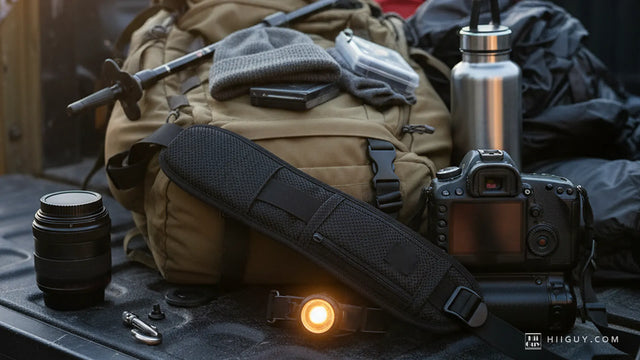
That photograph is one of ours, and it is the long setting: pad on the shoulder, webbing straight down the back, camera parked past the opposite hip with the lens pointing at the ground. The same strap, pulled in, is a neck strap.
HiiGuy has been making this one in Los Angeles since 2016, and length is the reason it exists. It comes in two variations and that is the only difference between them: the Regular adjusts up to 32 in on the body and the XXL adjusts up to 44 in. Both give you the same box. Heavy-duty polyester webbing, a wide padded shoulder pad, a stainless steel quick release so the body comes off in one motion, rustproof metal fittings and a safety tether sitting behind the release. The warranty on it runs three full years from HiiGuy.
The reason the XXL variation matters to this particular question is the asymmetry above. If you want one setting that covers both carries, the setting you keep is the crossbody one, and that is the end of the range where ordinary straps run out. Both variations sit on the same Amazon listing, and if you want the numbers before the pictures, the specification is on the product page.
The short version
Neck, shoulder, sling and crossbody are four words for four positions, and one strap can usually reach at least two of them. What you change is the circumference of the loop, not the strap. What goes wrong is the pad, because on a single-adjuster strap it travels the full distance you let out and it needs pushing back.
Check whether your pad slides. If it does, set the length for the crossbody carry, tuck the tail, and take the slightly low neck carry on the days you want your hands free in a crowd. If the pad is sewn down, or the adjuster runs out before the camera reaches your hip, you have found the one case where the strap genuinely is the problem.